Quick overview
This is some text inside of a div block.
.png)
When OFAC sanctioned Tornado Cash in August 2022, it did something that had never been done before in financial regulation: it sanctioned a smart contract. Not a person, not a company, but a piece of code running autonomously on a public blockchain. Every wallet that had ever interacted with it became a point of potential exposure for any business holding or transferring those funds.
That moment changed how the compliance industry thinks about crypto sanctions screening. A binary check against a names list was never going to be enough. The question was no longer just "is this address sanctioned?" It became "where has this address been, what has it touched, and how far back does my liability extend?"
This guide answers those questions. It covers how crypto sanctions screening works at a technical level, what direct and indirect exposure actually mean in practice, what regulators across the US, EU, and UK expect from the businesses they supervise, and where free cryptocurrency sanctions screening tools fit into a complete compliance programme.
Crypto sanctions screening is the systematic process of checking blockchain wallet addresses, transaction counterparties, and associated entities against official government and international sanctions lists before processing a transfer, onboarding a customer, or executing a trade.
The objective is to ensure that a business does not send, receive, process, or otherwise facilitate funds that touch sanctioned individuals, entities, or jurisdictions. In the context of blockchain, this means checking specific on-chain addresses as well as the entities behind them, because many sanctions authorities now publish wallet addresses directly alongside traditional name and entity designations.
Not all sanctions lists are equal, and not all of them include on-chain addresses. The lists with the most direct relevance to crypto businesses are:
Screening against a single list is not a defensible compliance posture. A wallet address that clears the OFAC SDN check may still appear on the EU consolidated list, the UN list, or a relevant national list. Multi-list coverage is the baseline expectation, not an advanced feature.
This is the most important concept for any compliance team building a crypto screening programme, and the one most frequently misunderstood.
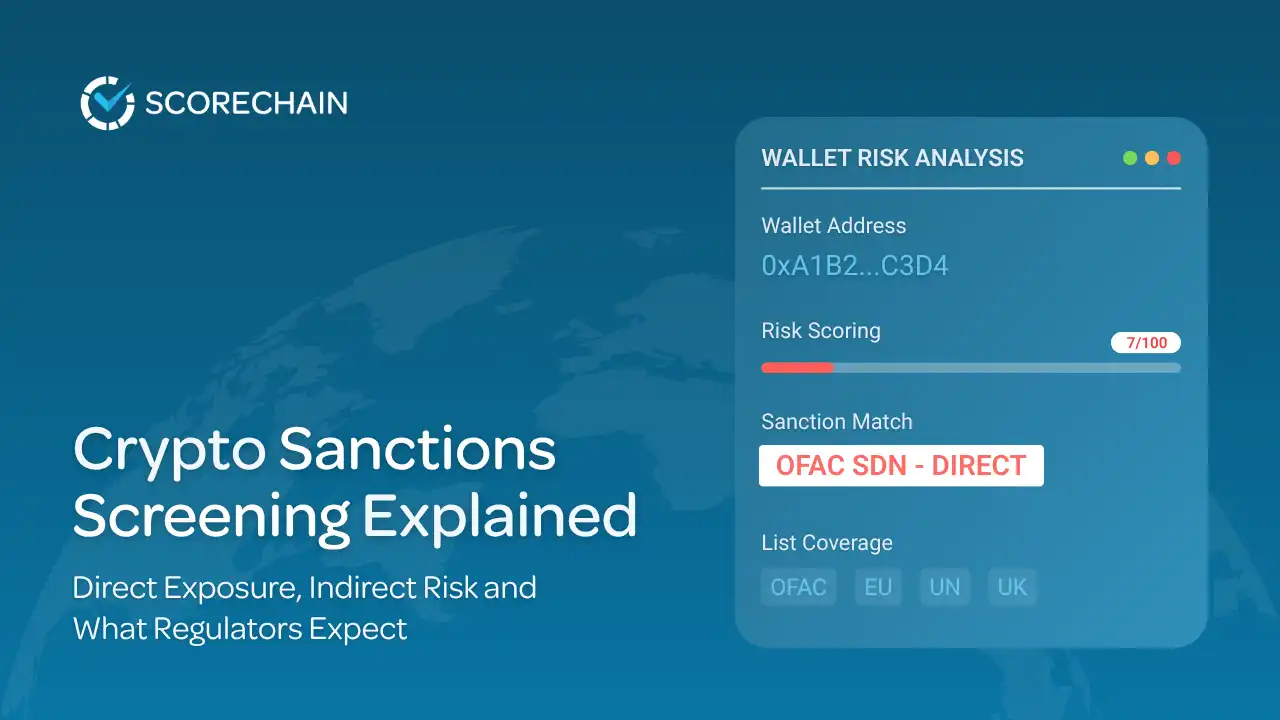
Direct exposure is the straightforward case. A wallet address appears on a sanctions list. When your screening tool checks that address, it returns a match. You have a direct sanctions hit, and the action is clear: block the transaction, freeze the funds if required, file the necessary reports, and document the decision.
Most free cryptocurrency sanctions screening tools handle direct exposure adequately. They maintain a regularly updated copy of one or more sanctions lists and check submitted addresses against them. For many low-volume use cases, this is sufficient.
Indirect exposure is where crypto sanctions screening fundamentally differs from traditional financial sanctions screening, and where the compliance risk is most frequently underestimated.
In a blockchain context, every transaction leaves a permanent, publicly auditable trail. If a wallet received funds from a sanctioned address two, three, or five transactions ago, that transaction history is on-chain and visible. The wallet you are about to transact with may not be sanctioned itself, but it has received funds that originated from, or passed through, a sanctioned entity.
This is what compliance professionals call multi-hop exposure, or contaminated funds risk. The degree of concern generally scales with proximity: direct receipt from a sanctioned address in the most recent transaction is a near-certain compliance event; exposure three hops back through a mixing service is a risk signal that requires investigation rather than automatic blocking. The risk scoring methodology that governs these decisions is a core function of a KYT platform, not a feature available in free screening tools.
OFAC's guidance on virtual currency, most recently updated in its Framework for OFAC Compliance Commitments, makes clear that US persons can have liability for transactions involving blocked property even without actual knowledge, if they had reason to know. That standard has direct implications for how far back a compliance team's transaction graph analysis needs to go.
A compliance programme that only checks for direct exposure will miss a category of risk that regulators increasingly expect to be managed. The practical implication is that a crypto screening workflow needs two distinct capabilities: a sanctions list match for direct exposure, and a transaction graph analysis capability for indirect exposure. These are architecturally different functions and are rarely available together in a free tool.
A robust crypto wallet screening workflow is not a single check. It is a sequence of interconnected steps, each of which generates data that feeds the next. The five components of a complete workflow are:
1. Pre-transaction wallet screening Before any transaction is approved, the counterparty wallet address is checked against all relevant sanctions lists. This is the foundational step and the one free tools cover. The check should return the list version used, the result, and a timestamp, all of which become part of the audit record.
2. Risk scoring with indirect exposure analysis Beyond the direct sanctions check, the wallet's full transaction history is analysed to identify exposure to sanctioned addresses, darknet markets, mixing services, high-risk exchanges, and other flagged counterparties across multiple transaction hops. The output is a risk score that informs whether to approve, flag for review, or block the transaction.
3. Ongoing monitoring and re-screening Sanctions lists are updated continuously. OFAC alone makes multiple additions and removals per week. A wallet that was clean when a customer was onboarded may have been added to a list in the interim. A complete compliance programme includes automated re-screening of existing customer wallets and counterparty addresses on a regular cadence, not just at the point of onboarding.
4. Audit trail and record keeping Every screening decision generates a record: the address checked, the lists queried, the version of each list at the time of the check, the result, the risk score, and the action taken. This record is the evidence that regulators and examiners review. Free tools almost never generate compliance-grade audit trails.
5. Case management and SAR filing When a screening check returns a hit or an elevated risk score, there needs to be a structured workflow for the human review that follows. This includes escalation paths, a freeze or block function, documentation of the investigation, and integration with Suspicious Activity Report (SAR) filing processes where required.
Free cryptocurrency sanctions screening tools cover step one. In some cases they partially cover step two with basic risk labels. Steps three through five are the domain of purpose-built compliance infrastructure.
Free cryptocurrency sanctions screening tools are a legitimate and useful entry point. They lower the barrier for smaller teams, allow developers to test integrations before committing to a paid platform, and give early-stage businesses a functional starting point before their transaction volumes justify a full enterprise deployment.
The typical feature set of a free crypto sanctions screening tool includes:
Scorechain's free sanctions API and free crypto wallet screening tool are built on this model. They provide a clean, documented starting point for teams building their first screening integration, with straightforward API responses and no subscription required.
The limitations of free tools are structural rather than a product quality issue. They reflect what is technically and economically possible without a full compliance infrastructure behind them:
Regulatory expectations for crypto sanctions screening have moved significantly in the past three years. What was considered advanced practice in 2021 is now the baseline expectation in most major jurisdictions.
FATF Recommendation 15, updated in 2019, brought virtual asset service providers formally within the scope of FATF's AML and CFT standards. VASPs are now expected to apply the same risk-based approach as traditional financial institutions, including customer due diligence, transaction monitoring, and sanctions screening. The 2021 update to the FATF guidance on virtual assets reinforced that Travel Rule obligations under Recommendation 16 apply to crypto transfers and that sanctions screening of originator and beneficiary information is part of that obligation.
In the European Union, the Markets in Crypto-Assets Regulation (MiCA) brings crypto-asset service providers under formal regulatory supervision for the first time across all EU member states. AML obligations for CASPs flow through the existing Anti-Money Laundering Directives, with the Sixth AMLD (AMLD6) and its successor framework setting the standard for sanctions screening, transaction monitoring, and reporting. National competent authorities are increasingly conducting examinations of CASP AML programmes as MiCA authorisations are processed.
In the US, crypto businesses with US nexus face obligations under two distinct frameworks. The Bank Secrecy Act, administered by FinCEN, requires registered money services businesses to maintain AML programmes that include sanctions screening. Separately, OFAC's sanctions programme applies to all US persons and US-nexus transactions regardless of whether the business is formally registered as an MSB. OFAC enforcement actions against crypto businesses have consistently cited failures in screening and transaction monitoring as the basis for civil liability.
The FCA's cryptoasset registration regime under the Money Laundering Regulations requires businesses to demonstrate adequate AML controls as a condition of operating in the UK. The FCA has been explicit in supervisory communications that transaction monitoring and sanctions screening are expected components of a registered firm's AML programme. The Office of Financial Sanctions Implementation (OFSI) administers UK sanctions compliance separately and has published specific guidance for the financial sector that applies to cryptoasset businesses.
When a regulator examines a crypto business's sanctions screening programme, the questions are practical and specific. Can you demonstrate which lists were checked for a given transaction? What version of each list was current at the time? What was the risk score assigned to the counterparty wallet? What did your team do when a flag was raised, and is there a documented record of that decision?
A programme built on a free tool with single-list coverage, no re-screening capability, and no audit trail will produce unsatisfying answers to those questions. The compliance standard a defensible programme must meet includes multi-list coverage, pre-transaction screening with a documented record for every check, periodic re-screening of existing counterparty wallets, risk-based escalation with documented investigation, and integration with transaction monitoring.
Free and paid crypto sanctions screening tools serve different points in a business's compliance journey. Understanding which is appropriate for your current situation is a practical decision, not a value judgement about product quality.
For a developer building and testing an integration, a startup at pre-licensing stage, or a compliance team running ad hoc due diligence on a small number of addresses, a free tool is appropriate and sufficient. For any regulated VASP, licensed exchange, or crypto business with live AML obligations and meaningful transaction volumes, a free tool is one component of a broader workflow, not a standalone compliance solution.
The practical threshold is not a volume number. It is the moment your business becomes subject to regulatory examination. At that point, the questions an examiner asks cannot be answered with a free tool's output alone.
Scorechain provides both a free sanctions screening API for teams at the starting point of their compliance build, and a full wallet screening and KYT platform for compliance teams that need to operate at a regulatory standard.
The free sanctions API allows developers and compliance teams to screen crypto wallet addresses against major sanctions lists with no subscription or commitment required. It is documented, straightforward to integrate, and returns structured responses suitable for automated decision-making in existing workflows. It is the right tool for testing, early-stage programmes, and low-volume due diligence.
The full Scorechain compliance platform builds on that foundation with multi-list sanctions screening across OFAC, EU, UN, UK FCDO, and relevant national lists; risk scoring with indirect exposure analysis across multiple transaction hops; Know Your Transaction (KYT) monitoring; Travel Rule compliance; automated re-screening; and a complete audit trail designed for regulatory review. Network coverage spans Bitcoin, Ethereum, Tron, and over 50 additional blockchain protocols.
For teams building their compliance stack from the ground up, the path from free API to full enterprise deployment is designed to be incremental and without architectural rework.
Access the free sanctions API
Explore the full wallet screening platform
Book a demo
Sanctions screening is the process of checking customers, counterparties, and transactions against government and international sanctions lists to ensure a business does not facilitate funds or services involving sanctioned individuals, entities, or jurisdictions. In an AML context, sanctions screening sits alongside customer due diligence and transaction monitoring as one of the three core pillars of a compliant financial crime programme. The purpose is both legal, avoiding regulatory liability, and operational, preventing blocked or frozen funds after the fact.
Crypto wallet screening is the application of sanctions screening and risk analysis to blockchain wallet addresses. Rather than checking a name or account number against a list, a wallet screening tool checks an on-chain address against sanctions lists and assesses the transaction history of that address for exposure to high-risk counterparties. It is the blockchain equivalent of correspondent banking due diligence, applied at the address level before a transaction is approved.
Direct exposure means a wallet address appears on a sanctions list. Indirect exposure means a wallet has transacted with a sanctioned address at some point in its history, even if it is not itself listed. In a blockchain context, every transaction is permanently recorded on-chain, so a wallet that received funds from a sanctioned entity two or three hops back carries measurable indirect exposure. Regulators increasingly expect VASPs to assess both, which is why transaction graph analysis is a core component of a complete crypto compliance workflow.
The purpose of sanctions screening is to ensure that a business does not send, receive, process, or facilitate funds involving parties that governments have designated as posing national security, foreign policy, or economic risks. For crypto businesses, sanctions screening protects against OFAC civil liability, EU and UK sanctions violations, and reputational damage from processing funds linked to sanctioned entities, terrorist financing, or state-sponsored cybercrime.
Sanctions screening should be performed at a minimum at three points: before onboarding a new customer or counterparty, before processing any individual transaction, and on an ongoing basis as sanctions lists update. OFAC and other sanctions authorities update their lists multiple times per week. A wallet that was clean at onboarding may be designated by the time the next transaction is processed, which is why automated re-screening rather than one-time checks is the regulatory expectation for active businesses.
For regulated virtual asset service providers in most major jurisdictions, yes. FATF Recommendation 15 extended AML and CFT obligations to VASPs globally. In the EU, MiCA and the Anti-Money Laundering Directives require crypto-asset service providers to maintain sanctions screening programmes. In the United States, OFAC's sanctions programme applies to all US persons and US-nexus transactions, and FinCEN's Bank Secrecy Act rules apply to registered money services businesses including many crypto firms. The UK, Singapore, UAE, and other jurisdictions have equivalent requirements under their national frameworks.
Crypto businesses automate sanctions screening by integrating an AML screening API into their transaction processing workflow. The API accepts a wallet address as input, checks it against one or more sanctions lists in real time, and returns a structured response indicating whether the address is sanctioned and, in more capable tools, a risk score based on transaction graph analysis. Automation ensures every transaction is screened consistently, generates a timestamped audit record, and removes the manual bottleneck that makes high-volume screening impractical without purpose-built infrastructure.
False positives occur when a screening check flags an address that is not actually sanctioned, typically due to name similarity or shared address characteristics. In crypto, false positive rates are lower than in traditional finance because wallet addresses are unique and deterministic rather than name-based. When a flag is raised, the standard process is to escalate to a compliance officer for manual review, document the investigation and conclusion, and maintain the record as part of the audit trail. A risk-scored output rather than a binary flag helps triage which alerts require immediate human review and which can be resolved through automated rules.
KYC, or Know Your Customer, is the identity verification process conducted at customer onboarding to establish who a customer is and assess their risk profile. Crypto sanctions screening is the ongoing operational process of checking wallet addresses and transaction counterparties against sanctions lists throughout the customer relationship. KYC is a one-time or periodic process; sanctions screening is continuous. Both are required under most AML frameworks, but they address different risk questions: KYC asks who is this person, while sanctions screening asks whether it is legal to transact with them right now.
No. Free cryptocurrency sanctions screening tools check whether a wallet address appears directly on a sanctions list. They do not perform transaction graph analysis to identify indirect exposure across multiple hops in a blockchain's transaction history. Indirect exposure analysis requires a KYT platform with graph traversal capabilities, which is architecturally distinct from a list-matching tool and is not available in free screening products.
Crypto sanctions screening is one of the most technically distinctive compliance challenges in financial services. The pseudonymous, permanent, and graph-structured nature of blockchain transactions means that a simple address-against-list check catches only the most obvious risk. Understanding direct exposure, managing indirect exposure through transaction graph analysis, maintaining automated re-screening as lists update, and generating audit-grade records for every decision are the components of a programme that regulators will find defensible.
Free cryptocurrency sanctions screening tools have a genuine and valuable role. They are the right starting point for developers, early-stage teams, and low-volume operations. The step up to a purpose-built compliance platform is not about scale alone. It is about what a regulatory examination requires, and ensuring the infrastructure exists to answer those questions before they are asked.
Scorechain is a blockchain analytics and crypto AML compliance platform headquartered in Luxembourg. The Scorechain platform covers wallet screening, KYT, Travel Rule compliance, and source of funds analysis across 50+ blockchain networks. The free sanctions API is available with no subscription required. For enterprise-grade compliance, book a demo.