.png)
Quick overview
This is some text inside of a div block.
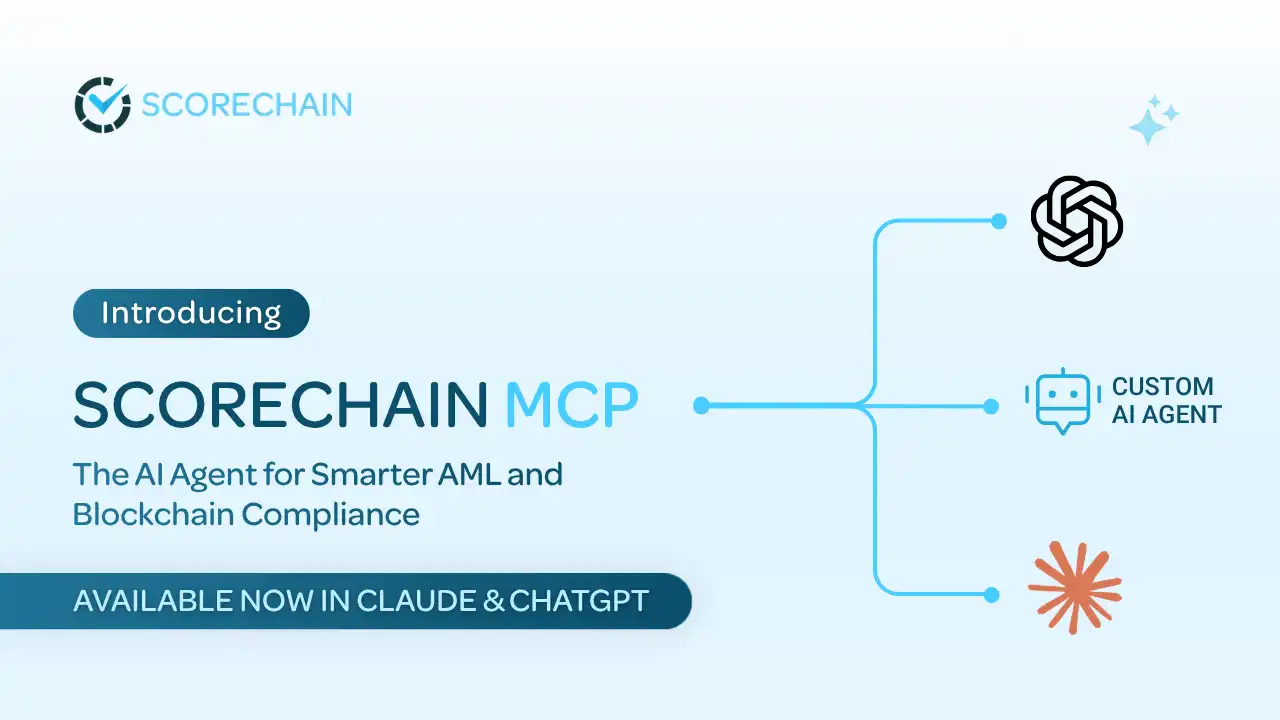
Scorechain MCP is an AI agent that connects Claude, ChatGPT, and custom-built tools directly to Scorechain's blockchain risk intelligence. It runs on the Model Context Protocol, an open standard for connecting AI models to external data. Scorechain MCP drafts, investigates, and explains. It does not close a compliance case; the analyst still makes that call.
Every compliance team is now facing the same question: what happens when you connect an AI assistant to real blockchain risk data, and what should that assistant actually be allowed to do with it? Some tools in this category are being built to let an agent carry an alert all the way to disposition on its own. Scorechain MCP takes a different position, and this page explains both what it does and why it's built that way.
Scorechain MCP is an AI agent integration that gives Claude, ChatGPT, and custom-built AI agents direct, live access to Scorechain's blockchain risk intelligence: address and entity risk scoring, fund flow analysis, transaction history, and alert data. It runs on the Model Context Protocol (MCP), the open standard Anthropic introduced in November 2024 for connecting AI models to external tools and data. Any Scorechain customer with an active license can connect it.
Scorechain MCP is available two ways today. It's listed as an app in the ChatGPT app directory, and it's available as a connector for licensed customers in Claude, set up through Scorechain's documentation. Both routes use the same underlying data and scoring methodology as the core Scorechain platform, not a delayed or simplified version of it.
MCP separates three roles: a host application (Claude, ChatGPT, or a custom agent), a client that manages the connection, and a server that exposes tools and data. Scorechain's MCP server exposes a defined set of tools, address and entity lookups, transaction and activity history, fund flow and exposure visualization, and alert data, along with reference resources such as Scorechain's risk scoring guide and entity type taxonomy.
Authentication runs through your existing Scorechain license. There is no separate MCP-specific account to set up. When a licensed user connects, the host model calls these tools directly and reasons over live results in the conversation, rather than a person manually pulling a report and pasting numbers into a chat window.
A chat interface is only as useful as the intelligence behind it. Scorechain MCP exposes hop-depth fund flow analysis and indirect exposure detection, coverage across more than 50 blockchains and asset types including stablecoins and tokenized real-world assets, and a European regulatory frame built around the Markets in Crypto-Assets Regulation (MiCA), the Sixth Anti-Money Laundering Directive (AMLD6), and the Financial Conduct Authority (FCA), with Office of Foreign Assets Control (OFAC) and Financial Crimes Enforcement Network (FinCEN) context available where relevant.
In each of the four situations below, the model reasons over real, current Scorechain data rather than general knowledge, and the analyst remains the one who verifies and acts on the output.
Drafting the first pass of a suspicious activity report. A suspicious activity or transaction report needs a chronological, evidence-backed account of what happened and why it's suspicious, typically the most time-consuming part of a filing to write. With Scorechain's entity attribution, fund flow, and risk data in context, a model can produce a first draft of that narrative directly from the evidence. This isn't a completed filing. Subject identification, jurisdiction-specific formatting, and every other required field still depend on the analyst's own work, and a human officer of record reviews, verifies, and certifies any filing before submission.
Unblocking a stalled investigation. When a trail runs into a bridge, a no-KYC exchange, or a fresh unlabeled wallet, a static dashboard has nothing further to show. A model holding the same case context can suggest a next step, the way a more experienced colleague would, giving the analyst something concrete to validate rather than a dead end.
Supporting classification. The Financial Action Task Force's Virtual Assets Red Flag Indicators of Money Laundering and Terrorist Financing describe patterns such as reliance on mixing or anonymity-enhancing services, exposure to exchanges operating in weakly regulated jurisdictions, or transaction patterns with no clear business rationale. A model working from Scorechain's transaction data can point out which published characteristics a given case exhibits and why, giving the analyst a documented starting point rather than a final classification they'd still need to verify independently.
Explaining the unfamiliar. A flagged interaction with a bridge, a mixer, or an unfamiliar protocol means little to a team member without deep on-chain experience. A model with the case in context can explain what that interaction actually involves in plain language, alongside the risk data itself.
No. Scorechain MCP is scoped to read-only intelligence and drafting support. It can tell you what it found, explain why it matters, and write a first draft of your reasoning. Closing an alert, recording a disposition, and standing behind that decision stays a human action, inside your own case management system.
This was a deliberate choice, not a limitation we haven't gotten to yet. Under MiCA and AMLD6, the record needs to show that a qualified person made the compliance decision and can account for it under supervisory review. An AI-drafted justification is useful evidence in that record. It isn't a substitute for the sign-off itself.
"We didn't want this to be just another button inside Claude or ChatGPT," says Pierre Gérard, CEO and co-founder of Scorechain. "The more interesting part is that any of our customers can now build their own agent on top of the same data, one that fits how their team actually works, not how we imagined they would. We built Scorechain MCP. What compliance teams build with it is where this gets interesting."
Yes. Because Scorechain MCP runs on an open standard rather than a proprietary integration, any licensed customer can connect the same MCP server to a custom agent, whether that means routing alerts into an internal case management tool, running scheduled screening jobs, or building an assistant for a specific desk. A custom agent built this way can flag high-risk transactions, trace illicit funds, and draft investigation reports in the background, without a team member manually looking up data or copying wallet addresses between tools. The data and scoring stay identical across every route in; only the interface changes.
The timing reflects a broader operational pressure rather than a single regulatory trigger. Reporting obligations under MiCA and the ongoing FATF Travel Rule implementation continue to require faster, better documented decisions from virtual asset service providers (VASPs), at a moment when transaction volume and the number of active blockchains and bridges keep expanding.
Scorechain has added AI-assisted functionality across the platform over the past two years, including natural language configuration for transaction monitoring scenarios. Scorechain also operates a separate, publicly available tool, Scorechain AI, which lets individuals run a pay-per-report wallet check without a platform subscription. This release extends that broader AI direction to Scorechain's licensed enterprise customer base specifically.
Do I need a new license to use Scorechain MCP?
No. Access runs through your existing Scorechain license, the same one used for the core platform.
What data leaves Scorechain's systems when I use Scorechain MCP?
Queries run live against Scorechain's data at the time you ask. The connection itself doesn't create a separate copy of your data outside Scorechain's systems.
Which Scorechain MCP endpoints are available in this release?
Address and entity lookups, transaction and activity history, fund flow and exposure visualization, risk scoring, and alert data. Write actions, such as closing or reassigning an alert, aren't exposed through MCP in this release.
Can Scorechain MCP file a suspicious activity report on my behalf?
No. It can draft a first-pass narrative from the evidence in context. A human officer of record still reviews, verifies, and certifies any filing before submission.
Is Scorechain MCP only available in Claude and ChatGPT?
No. Any licensed customer can connect the same MCP server to a custom agent of their own design.
Do I need to already be a Scorechain customer to try Scorechain MCP?
Querying live data requires an active license. If you're not yet a customer, you can book a demo to see it in action.
If you are already a Scorechain customer, connect Scorechain MCP in Claude in a few minutes through Scorechain's documentation, or find Scorechain in the ChatGPT app directory. If you're not yet a customer and want to see it in action, book a demo.