Spain’s MiCA transition period ended on 30 June 2026. Crypto firms now need CNMV authorisation or an EU passport to serve Spanish clients. Scorechain supports CASP AML compliance.
CASP License in Spain: Everything You Need to Know
MiCA Requirements and Compliance Support for Crypto Businesses in Spain
Spain has a clear regulatory framework for crypto-asset services. The National Securities Market Commission (CNMV) authorises and supervises crypto-asset service providers, the Bank of Spain (Banco de España) supervises stablecoin issuers, and SEPBLAC oversees anti-money laundering. Now that the Markets in Crypto-Assets (MiCA) regulation applies in full, a business that offers crypto services in Spain needs a CASP (Crypto-Asset Service Provider) authorisation. That authorisation also lets it operate across the EU.
The transition period has closed, so applicants must show strong AML and risk management controls from the start. Scorechain provides blockchain analytics, transaction monitoring and AML tools that help CASPs meet these expectations.
CASP License Timeline in Spain
To operate under MiCA, a business must hold a CASP authorisation, or qualify under one of the exemptions below. The transition period is now over:
30 December 2024: MiCA’s CASP rules start to apply across the EU. The Transfer of Funds Regulation (Travel Rule) applies to CASPs from the same day.
30 June 2026: last day of Spain’s 18-month transition period.
1 July 2026: MiCA applies in full. Providers without CNMV authorisation, a bank or investment firm notification, or a valid EU passport must stop serving clients in Spain.
30 June 2027: the European Commission’s report on the application of MiCA is due.
31 December 2027: trading platforms must have published white papers for crypto-assets admitted before 30 December 2024.
2026 Update: Spain’s MiCA Transition Period Has Ended
Spain chose the full 18-month transition that MiCA allows. Since 1 July 2026, only the following can serve clients in Spain: providers authorised by the CNMV, banks and investment firms that have notified the CNMV, and CASPs with a valid EU passport.
A pending application does not change this. Filing an application does not allow a provider to keep operating after the transition period, and only a granted authorisation does.
Providers that were not authorised by the deadline needed a client migration plan, so customers could withdraw their assets or move them to an authorised provider. During wind-down, these providers must stop taking on new clients, return client assets in full and keep meeting their AML/CFT obligations.
Spain market snapshot (CNMV register, 2 October 2026):
9 authorised Spanish CASPs, including Bit2Me, Due Network, Crossmint Europe, Criptan, Minos Global, Prosegur Crypto, Iqana Technologies, Fazil Crypto and CryptoPocket.
160+ CASPs from other EU and EEA countries operate in Spain under a passport.
These counts change as the register is updated, so check the live CNMV register before relying on them.
What is a CASP License in Spain?
A CASP license is required for companies that provide crypto-asset services in Spain and across the EU under MiCA.
It replaces the previous Bank of Spain VASP registration, which was an anti-money laundering registration only. The Bank of Spain no longer accepts new entries, and its register is kept for historical reference. The new regime covers MiCA conduct and prudential rules as well as AML and counter-terrorism financing (CFT) obligations. A VASP registration alone no longer allows a company to operate in Spain.
Who Supervises Crypto-Asset Service Providers in Spain?
CNMV: authorises and supervises CASPs, including conduct rules and crypto advertising.
Banco de España: supervises issuers of asset-referenced tokens and e-money tokens.
SEPBLAC: Spain’s financial intelligence unit and AML/CFT supervisor. CASPs report suspicious transactions to SEPBLAC, which can also carry out its own inspections, separate from the CNMV’s supervision.
MiCA and CASP License Requirements in Spain
To obtain a CASP license in Spain, a business must meet the following requirements:
Authorisation from the CNMV: the Bank of Spain supervises stablecoin issuers only.
EU presence with real substance: a registered office in an EU member state, effective management in the EU, and at least one EU-resident director. The CNMV can verify that management and resources are real, so a purely formal structure will not pass.
Minimum capital: the amount depends on the services offered. The classes section below sets it out.
AML and KYC controls:customer due diligence, ongoing monitoring and suspicious transaction reporting.
Travel Rule compliance: in the EU this is set by the Transfer of Funds Regulation (EU 2023/1113), which has applied to CASPs since 30 December 2024, whether or not the CASP is authorised yet. The Travel Rule requires CASPs to send and receive originator and beneficiary data with crypto transfers.
Additional Requirements for CASP Applicants in Spain
Fit and proper management: directors and shareholders with qualifying holdings must show good repute, knowledge and enough time to commit to the role.
AML/CFT framework: Spain’s AML law (Law 10/2010) requires customer due diligence, ongoing transaction monitoring, suspicious transaction reporting to SEPBLAC, and a named compliance officer from day one.
ICT and operational resilience: DORA-aligned security, incident handling and business continuity arrangements.
Client asset protection: segregation of client assets, plus complaints handling and conflicts of interest policies.
Marketing rules: crypto advertising must be identifiable as such, fair, clear and not misleading. The CNMV can require corrections or withdrawal, and it has required risk warnings and prior notification of large campaigns since 2022.
CASP License Classes in Spain
Spain does not issue different license names. MiCA groups crypto-asset services into three capital classes, and your class depends on the services you want to provide. The capital figure is the higher of the minimum below and 25% of the previous year’s fixed overheads.
Class 1 (minimum capital €50,000): execution of orders, placing, reception and transmission of orders, advice, portfolio management and transfer services for crypto-assets.
Class 2 (minimum capital €125,000): everything in Class 1, plus custody and administration of crypto-assets and exchange of crypto-assets for funds or for other crypto-assets.
Class 3 (minimum capital €150,000): everything in Class 2, plus operating a trading platform for crypto-assets.
Other routes exist. Banks and investment firms do not apply for a full CASP license. They notify the CNMV at least 40 working days before starting crypto-asset services. A CASP authorised in another EU member state does not need a second Spanish license and can use an EU passport to serve Spanish clients. Planning other EU markets? The CASP license rules also differ in Germany, France, Malta and the Netherlands.
Procedure for Obtaining a CASP License in Spain
Scope your business model: map your services to the MiCA service list and capital class. Classify first, because capital, custody and governance all follow from it.
Set up the entity and team: incorporate in the EU, appoint directors and a compliance function, and prepare your governance structure.
Build policies and systems: prepare AML/CFT, Travel Rule, ICT, custody and complaints procedures, and choose your transaction monitoring tools.
Check the CNMV’s guidance: the CNMV has published an authorisation manual, a notification template and a MiCA Q&A. Read them before you file.
File the application with the CNMV: submit the full authorisation file with all required documents.
CNMV review: the CNMV has 25 working days to check that the file is complete and 40 working days to decide. Requests for more information can suspend the clock for up to 20 working days.
Authorisation and registration: approved CASPs are added to the CNMV and ESMA registers.
Passporting and ongoing supervision: notify other member states to passport your services, and keep up with reporting, audits, SEPBLAC obligations and conduct rules.
A well-prepared file is the best way to avoid delays, because the review time limits run from the date the application is complete. The legal clock adds up to about 70 working days, but preparing and processing a solid file typically takes three to five months. Capital, custody and the AML framework are the parts that most often slow applications down.
Required Documents for a CASP License in Spain
The CNMV application covers ten document groups, following Article 62 of MiCA and the CNMV application form:
Corporate documents: incorporation, articles, registered office and group structure.
Programme of operations: services, business model, target markets and financial projections.
Governance: management body details, CVs, good repute and criminal record evidence, and shareholder information.
Capital and prudential: evidence of own funds, insurance or equivalent safeguards, and a recovery and wind-down plan.
AML/CFT: business-wide risk assessment, customer due diligence, monitoring and reporting procedures, and Travel Rule process.
ICT and security: ICT risk framework, incident reporting, business continuity and DORA alignment.
Custody and client assets: custody policy, segregation of client assets and wallet security, where relevant.
Client protection: complaints handling, conflicts of interest and order execution policies.
Outsourcing: contracts and oversight for third-party providers, including compliance tooling.
Trading platform rules: Class 3 applicants only.
Evidence matters as much as policy text. What you market, what you do and what you document should match, and each control should point to records that show it working.
How Scorechain Supports CASP Compliance in Spain
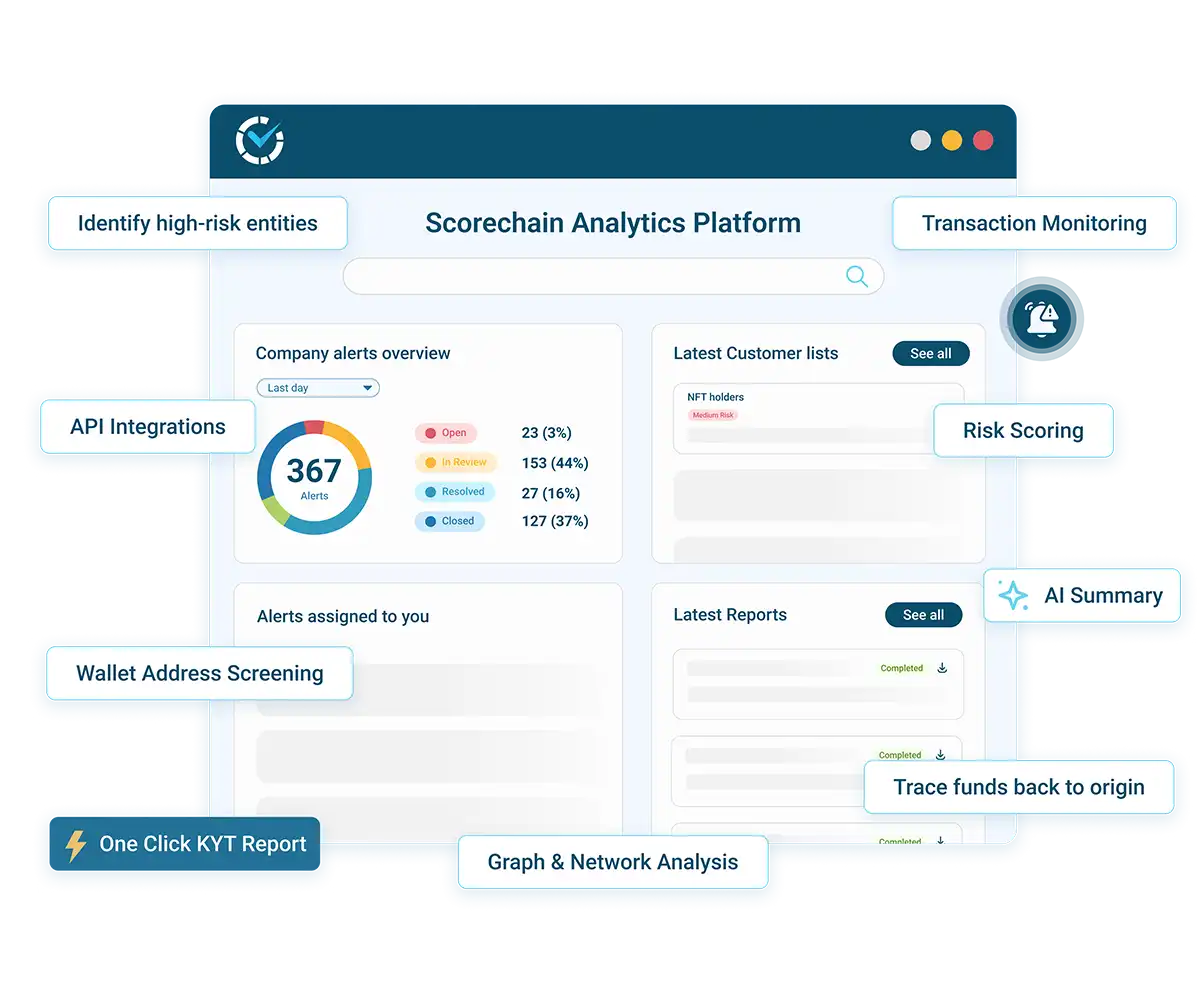
Scorechain’s blockchain analytics and monitoring tools support the AML, KYT and counterparty risk controls that a CASP needs to show in its application and in day-to-day operations. They support your compliance program. They do not replace your own policies, your compliance officer or the CNMV’s assessment.
1. Transaction Monitoring
Real-time risk scoring of crypto transactions
Alerts on suspicious wallet activity, based on your own risk rules
Records that support your suspicious transaction reporting to SEPBLAC
2. Travel Rule Data Exchange
One API to send and receive originator and beneficiary data, routed through established partner infrastructure
Counterparty VASP due diligence and risk screening
Works alongside your wider EU Transfer of Funds Regulation process
3. Blockchain Risk Analytics
Wallet risk screening for onboarding and ongoing monitoring
Exposure to darknet markets, fraud, scams and sanctioned entities flagged on every address
Fund flow tracing for investigations and regulatory reporting
4. Sanctions Exposure Monitoring
Screen wallets and counterparties for sanctions exposure
Alerts when a transaction involves a high-risk or sanctioned address, so your team can review and act
Documented checks that show your controls in an audit
Training and Education: blockchain compliance training for your team.
Why Get Your CASP License in Spain?
A defined licensing process: the CNMV publishes a MiCA Q&A, an authorisation manual and an application form, so applicants know what to prepare.
EU and EEA passporting: one authorisation lets you serve clients in every EU member state, plus the EEA countries, without a separate license in each.
A regulated market with room to grow: nine Spanish CASPs and six notified banks are already authorised, and 160+ foreign CASPs passport into the market, so there is demand for compliant providers.
Prepare Your CASP License Application with Scorechain
More than 200 organisations use Scorechain for transaction monitoring, wallet screening and counterparty due diligence. To see how Scorechain fits the AML and monitoring side of your Spanish CASP application, book a demo with the Scorechain team and we will walk through it on your own use case.
Frequently Asked Questions
Who issues a CASP license in Spain?
The CNMV is the competent authority for CASP authorisation under MiCA. The Banco de España supervises stablecoin issuers, and SEPBLAC supervises AML/CFT obligations.
When did the MiCA transition period end in Spain?
Spain applied the maximum 18-month transition. It ended on 30 June 2026, and MiCA has applied in full since 1 July 2026.
Can I keep operating in Spain while my CASP application is pending?
No. A pending application does not allow you to keep operating after the transition period. Only CNMV authorisation, a bank or investment firm notification, or a valid EU passport does. Providers without one must stop onboarding new clients, return client assets and keep meeting their AML obligations while they wind down.
Is the Banco de España VASP registration enough to operate in Spain?
No. That register was for AML purposes only, and the Bank of Spain no longer accepts new entries. Providers now need CNMV authorisation, a bank or investment firm notification, or a valid EU passport.
How much capital do I need for a CASP license in Spain?
MiCA sets €50,000, €125,000 or €150,000 depending on the services, or 25% of previous-year fixed overheads if that is higher. The classes section above shows which services fall into each.
How long does the CNMV take to decide on an application?
The CNMV has 25 working days to check completeness and then 40 working days to decide. Requests for information can pause the clock for up to 20 working days. Preparing and processing a solid file typically takes three to five months overall.
Can I use a CASP license from another EU country in Spain?
Yes. A CASP authorised in another member state can serve Spanish clients with an EU passport and does not need a separate Spanish license.
Do banks need a CASP license in Spain?
No. Credit institutions and investment firms notify the CNMV at least 40 working days before offering crypto-asset services.
Does the Travel Rule apply to CASPs in Spain?
Yes. The EU Transfer of Funds Regulation (2023/1113) has applied to CASPs since 30 December 2024, whether or not they are authorised yet. It requires CASPs to collect, verify and send originator and beneficiary information with crypto transfers.
Does a CASP need AML and transaction monitoring tools?
Yes. CASPs must run customer due diligence, monitor transactions, comply with the Travel Rule and report suspicious activity to SEPBLAC. Blockchain analytics and monitoring tools are the practical way to meet these obligations.
Ready to Get Clarity on Your Risks?
From wallet screening and KYT monitoring to deep-dive investigations, Scorechain gives you everything you need to stay compliant, secure, and audit-ready.