How to Get a CASP License for Poland?
The Markets in Crypto-Assets (MiCA) regulation has applied across the EU since 30 December 2024, and the transitional period for firms that operated under national rules ended on 1 July 2026. Any firm serving EU customers must now hold a CASP (Crypto-Asset Service Provider) authorisation. In Poland, nobody can currently apply for one, because the national law that would designate the Polish Financial Supervision Authority (KNF) as competent authority is not in force. Firms serving Polish customers therefore need a CASP license from another EU member state, which they can passport into Poland.
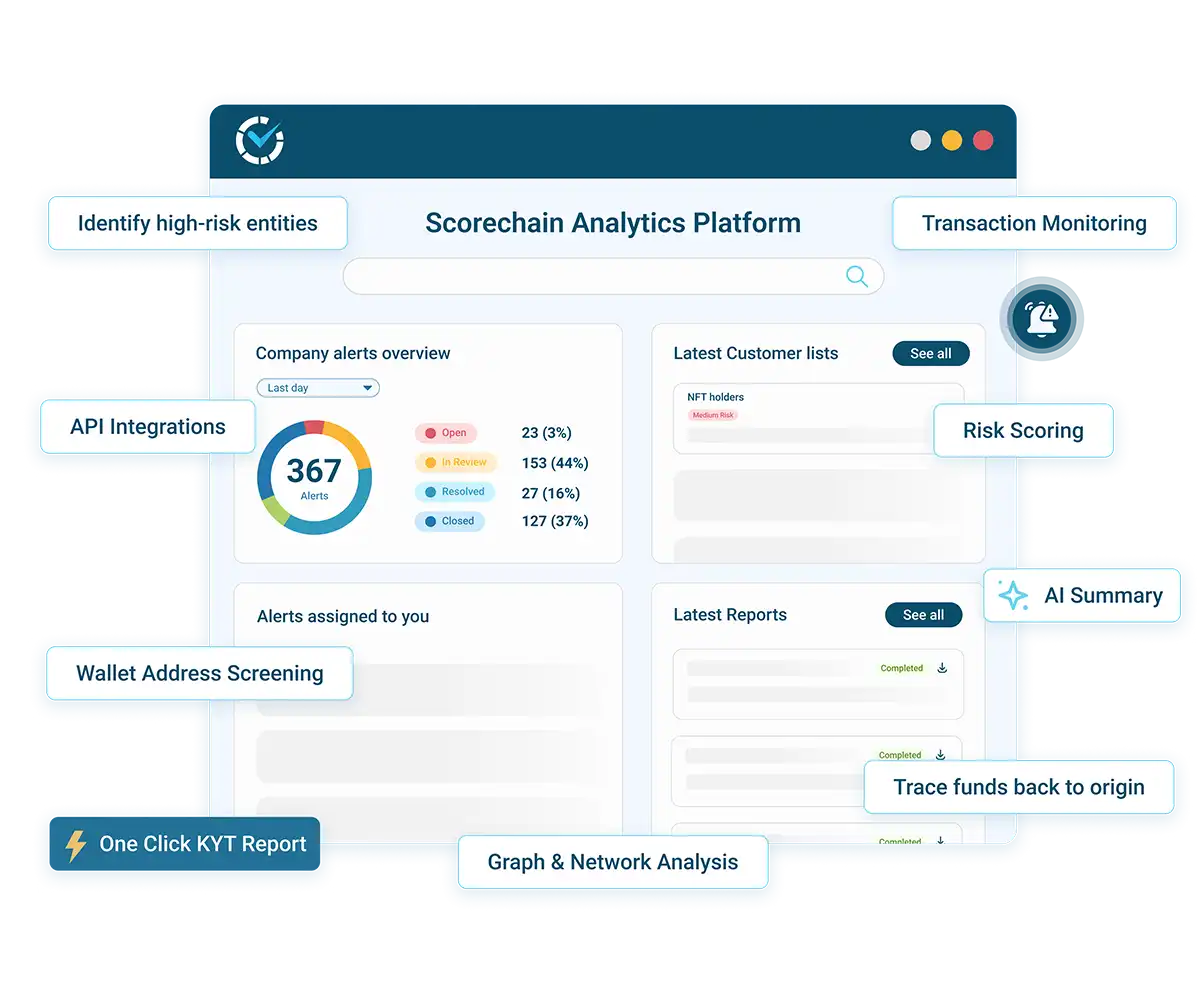
Whichever route you take, strong AML and transaction monitoring controls are a core licensing requirement. Scorechain’s blockchain analytics and transaction monitoring platform makes that part straightforward.
Current Status of CASP Licensing in Poland
- CASP authorisation in Poland: KNF cannot accept or process CASP applications, because Poland has not passed the Crypto-Asset Market Act designating a competent authority.
- Presidential vetoes: the president vetoed the act on 1 December 2025, 12 February 2026 and 11 June 2026.
- Parliamentary vote: on 4 September 2026 the Sejm voted 241 to 198 (three abstentions) to override the third veto, short of the 266 votes (three-fifths) required.
- MiCA transitional deadline: the EU-wide transitional period ended on 1 July 2026. KNF has said neither a law nor a KNF decision can extend it. Providing crypto-asset services without CASP authorisation may breach MiCA, even where national implementation is incomplete.
- Legacy VASP registrations: entities on the register of virtual currency activities kept by the Tax Administration Chamber in Katowice could operate under national rules during the transition. That registration is not a MiCA authorisation.
- Cross-border CASP services: KNF has confirmed that firms authorised in another EU member state can serve Polish clients under MiCA, without a Polish authority or contact point.
- Further legislative developments: the president’s second draft act was reported on 8 September 2026. On 29 September 2026 the government spokesman said a fourth government draft could go to cabinet in October. No adoption had been reported at the time of writing. The position can change quickly, so check the latest Sejm and KNF announcements.
CASP License Timeline in Poland
- 30 December 2024: MiCA applies across the EU.
- 1 December 2025: first presidential veto of the Crypto-Asset Market Act.
- 12 February 2026: second veto.
- 8 May 2026: the government adopts its third draft and sends it to the Sejm.
- 15 May 2026: the Sejm passes a revised version (241 to 200).
- 11 June 2026: third veto.
- 1 July 2026: MiCA transitional period ends across the EU.
- 4 September 2026: the Sejm fails to override the third veto (241 to 198; 266 needed).
- 8 September 2026: the president’s new draft act is reported as submitted to the Sejm.
What is a CASP License in Poland?
A CASP license authorises a business to provide crypto-asset services under the EU MiCA framework. Any crypto exchange, trading platform or wallet provider operating in the EU needs one. Stablecoin issuers are authorised under separate MiCA rules for e-money tokens and asset-referenced tokens. The authorisation is granted to a specific legal entity, so a group license or brand reputation does not cover other entities.
Crypto-Asset Services a CASP License Can Cover
A CASP license can cover one, several or all ten MiCA services:
- Custody and administration of crypto-assets on behalf of clients
- Operation of a trading platform for crypto-assets
- Exchange of crypto-assets for funds
- Exchange of crypto-assets for other crypto-assets
- Execution of orders for crypto-assets on behalf of clients
- Placing of crypto-assets
- Reception and transmission of orders for crypto-assets on behalf of clients
- Advice on crypto-assets
- Portfolio management of crypto-assets
- Transfer services for crypto-assets on behalf of clients
The services you choose depend on your business model and set your minimum capital requirement.
Who Can Provide Crypto-Asset Services
- Legal entities authorised as a CASP under Article 63 of MiCA.
- Credit institutions, central securities depositories, investment firms, market operators, electronic money institutions, UCITS management companies and alternative investment fund managers that notify their home regulator under Article 60 of MiCA.
CASP License Requirements in Poland
To obtain authorisation, applicants must:
- Apply to the home state authority: in Poland that will be the KNF once the national act is in force. Until then, applicants authorise in another EU member state.
- Show real EU presence: a registered office in the member state where part of the services is carried out, effective management in the EU, and at least one director resident in the EU.
- Meet minimum capital: EUR 50,000, 125,000 or 150,000 depending on service class (see below).
- Run AML/KYC and risk-management controls: including business continuity planning.
- Comply with the Travel Rule: the EU Transfer of Funds Regulation applies the Travel Rule to CASPs, alongside ongoing transaction-monitoring obligations.
- Meet fit and proper standards: management board members and shareholders with qualifying holdings must be of good repute, with the knowledge, skills and experience for their roles.
Minimum Capital Requirements
| Class |
Services |
Minimum capital |
| Class 1 |
Execution of orders, placing, transfer services, reception and
transmission of orders, advice and/or portfolio management
|
EUR 50,000 |
| Class 2 |
Class 1 services plus custody and administration, and/or exchange
of crypto-assets for funds or for other crypto-assets
|
EUR 125,000 |
| Class 3 |
Class 2 services plus operation of a trading platform
|
EUR 150,000 |
If a quarter of the previous year’s fixed overheads is higher than the minimum, that higher amount applies.
How the CASP Application Process Works
The MiCA procedure below applies in any member state with an operational authority. Poland’s own procedure will follow it once the national act is in force.
- The company submits its application to the competent authority of its home member state.
- The authority acknowledges receipt within 5 working days.
- Within 25 working days it checks whether the application is complete and may request missing documents by a set deadline.
- Once the file is complete, the authority has 40 working days to assess it.
- During the assessment it may ask for additional information, which pauses the clock for up to 20 working days.
- The authority grants or refuses authorisation.
The statutory steps alone add up to roughly three months, and correspondence time can extend them.
What the Application File Includes
- Programme of operations and proof of prudential safeguards
- Governance arrangements and internal control mechanisms, including AML/CFT policies and a business continuity plan
- Proof of good repute and competence for board members, and the identity and repute of shareholders with qualifying holdings
- Technical documentation of ICT systems and security arrangements
- Procedures for segregating client assets and funds, and for complaints handling
- Service-specific policies, such as custody policy, trading platform operating rules and market abuse detection, execution policy, and commercial policy and pricing methodology for exchange services
Management Board, Shareholders and Staff
- Board: members must be of good repute, with the knowledge, skills and experience for their roles. ESMA’s supervisory briefing expects the CEO to devote full time to the role as a rule, other executive members to commit at least half their working time, and at least one executive member to be located in the country of authorisation.
- Russia and Belarus ties: KNF’s resolution of 14 April 2022 treats links to Russia or Belarus as a substantial doubt about whether a licensed entity, its major shareholders and its managers meet the proper-conduct requirement. Applicants should expect the same scrutiny, although KNF has not yet applied it to a CASP file.
- Shareholders: applicants must provide an ownership structure chart, clean criminal records and statements on any penalties.
- Key functions: ESMA expects risk management, compliance (including AML) and internal audit to be distinct functions, with at least one dedicated compliance person.
How to Serve Polish Customers Today
- Passporting: obtain a CASP authorisation in another EU member state and notify your home authority of your intention to provide services in Poland under Article 65 of MiCA. You may start when your home authority confirms it has passed on the notification, or at the latest on the 15th calendar day after you submit it. A single authorisation covers all EU member states.
- Reverse solicitation: a non-EU firm does not need a license when a client in the EU approaches it entirely on the client’s own initiative. Regulators interpret this exemption narrowly, so it should not be the basis of a business model.
- Counterparty checks: if a platform claims to be registered in Poland, verify its status on the ESMA CASP register. The VASP Directory and the Know Your VASP Report help you assess the VASPs you transact with.
How Scorechain Supports CASP Compliance in Poland
Supervisors look for AML controls that run, not only policies. This table links each expectation to the proof you can show and the Scorechain tool that produces it.
Scorechain’s tools support your compliance program and do not replace your own policies or compliance officer.
Why Get a CASP License to Serve Poland
- EU access: one authorisation lets you serve clients across the EU through passporting, including Poland.
- A route that works today: KNF cannot authorise anyone yet, but an authorisation from another member state is accepted in Poland.
- Choice of home state: with no Polish procedure available, you can pick an EU jurisdiction with an operational authority and a timeline that suits your business. Spain is one example, where the CNMV authorises CASPs.
Compliance Evidence for Your CASP License Application
Reviewers want to see AML controls working before they authorise. Scorechain gives you the tooling to show them:
- Preparing an application: evidence your risk framework with transaction monitoring and wallet screening that run in real time.
- Already authorised elsewhere and serving Poland: keep passported services covered with Customisable Alerts and the Travel Rule API.
- Reviewing a risky counterparty: trace funds and wallet relationships in the Exploration Tool before you onboard or transact.
To see how this fits an application or a passported service into Poland, book a demo with the Scorechain team.
Frequently Asked Questions
Can I still operate in Poland with my old VASP registration?
No. The MiCA transitional period ended on 1 July 2026, and a national VASP registration is not a MiCA authorisation.
Does a CASP license cover only one country?
No. Once authorised in one EU member state, a CASP can provide the same services across the EU through passporting, without additional national licenses.
How long does it take to get a CASP license?
The statutory steps add up to roughly three months. Preparing the application file often takes longer.
Are there limits on transaction volume for a CASP?
No. MiCA sets no cap on the volume or number of transactions a CASP can handle. Trading platforms must have systems that reject orders above pre-set volume thresholds, but that is a risk control and not a limit on the CASP.
Do I need another license for e-money token transfers?
Possibly. Following a European Banking Authority non-action letter, transfers of e-money tokens on behalf of clients should from March 2026 be handled by licensed payment service providers. This depends on your business model and the legal nature of the token.