.png)
Quick overview
This is some text inside of a div block.

Address screening tells you who you are dealing with. It does not tell you what you are holding, or, if you are the issuer, what you have put into the market.
For most of the last decade, on-chain risk assessment stopped at the wallet and the transaction. You screened a counterparty, checked indirect exposure a few hops out, and made a call. That is still necessary work, and it is now a commodity. Every serious compliance team already does it.
Tokenization changes the question. If your institution issues a tokenized money market fund, a gold-backed token, or a regulated stablecoin, the wallet is no longer the only unit of risk that matters. The asset is. Who holds your token? How concentrated is that ownership? How much of the circulating supply sits with high-risk actors, and is that share growing or shrinking, on each chain you have deployed to? A supervisor, a listing venue, or a banking partner can reasonably ask any of those questions, and "we monitor transactions" is not a complete answer to them.
Scorechain's Asset Directory is built to answer them quickly, whether you are assessing your own asset or one you are about to support. This walkthrough shows how to go from a token's name to a documented, defensible view of its risk in about a minute.

The market has moved. There are now tens of thousands of distinct assets on-chain, including thousands of tokenized real-world assets and hundreds of stablecoins, many of them deployed across several blockchains at once. A single stablecoin can exist as a dozen different contracts on a dozen different networks, each with its own holder base and its own risk profile.
Regulation has moved with it, everywhere, not in one jurisdiction alone. In the European Union, the Markets in Crypto-Assets Regulation (MiCA) gives issuers direct obligations on the issuers of regulated tokens, including stablecoins around the integrity and oversight of what they put into circulation. The same expectation runs through the Financial Action Task Force (FATF) standards that most countries now implement, through United Kingdom supervision under the Financial Conduct Authority (FCA), through the sanctions regimes enforced by the Office of Foreign Assets Control (OFAC) and the Financial Crimes Enforcement Network (FinCEN) in the United States, and through the frameworks maturing across Singapore, Hong Kong, and the wider Asia-Pacific region. Wherever you issue, and wherever your holders sit, the direction is identical: you are expected to understand the instrument you have put into the market, not only the transactions that move it. And the crypto asset service providers (CASPs) that list or support your token carry their own due diligence duties, which means your token will be screened by the venues you want to list on whether or not you screen it first. Knowing what they will see, before they see it, is now part of running a credible issuance in any market.
Asset-level intelligence closes that gap. It treats the token as the unit of analysis, aggregates every holder and deployment behind it, and gives you a structural read on integrity. This is the difference between transaction monitoring, which watches individual transfers, and assessing the overall risk of the asset as a whole. For an issuer, it is the difference between hoping your supply is clean and being able to show that it is.
Here is the full path from search to decision.
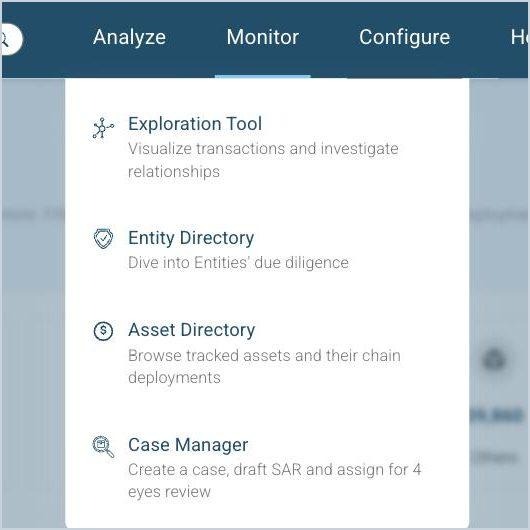
From the platform, go to Monitor, then Asset Directory. You land on a searchable catalogue of every asset Scorechain tracks, with category counters at the top: total assets, tokenized real-world assets, and stablecoins. At the time of writing (July 31, 2026) that catalogue holds more than 40,000 assets, including over 2,000 tokenized real-world assets and around 350 stablecoins. These counters update as coverage grows, so treat them as a live figure rather than a fixed one.
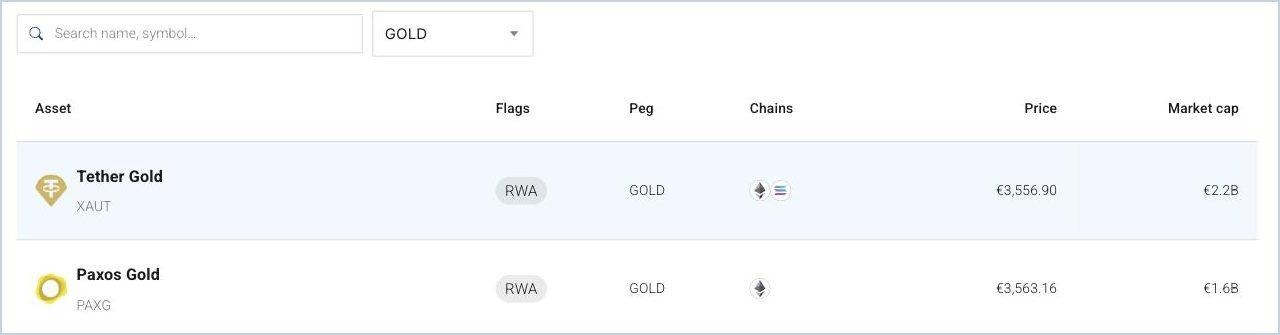
You can search any asset directly by name or symbol, which is the fastest route to your own token. You can also filter. Filter by category to separate stablecoins, real-world assets, and other tokens. Or filter by peg to isolate assets backed by a specific reference: US dollar, euro, gold, or treasuries. Setting the peg filter to gold, for example, surfaces tokenized commodity assets such as Tether Gold and Paxos Gold side by side, which is exactly the shortlist you want if you are benchmarking a commodity-backed token against its peers.
For an issuer, this is also a competitive-intelligence step. In a few seconds you can move from the entire market to your own instrument, and then to the handful of tokens you consider comparable.
Search narrowed by the stablecoins category filter.
Open any asset and you get a per-asset snapshot. On one screen it shows:
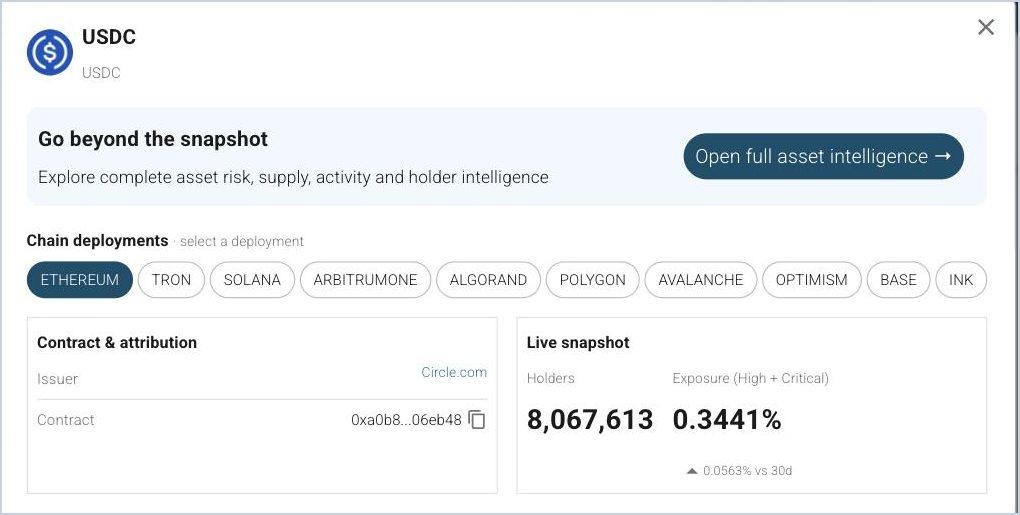
For an issuer, that snapshot answers the two questions you will be asked most often. First, how concentrated is my token? A holder ranking that shows a large share of supply sitting in a few addresses is a governance and liquidity signal worth knowing before someone else raises it. Second, how much of my circulating supply is exposed to high-risk or designated entities? That is a number you want to watch continuously, not discover during due diligence run by a counterparty.
This is the step that matters most for multi-chain assets, and it is where a single-chain view quietly misleads people. A widely used stablecoin like USDC is tracked across 11 separate chain deployments. A tokenized fund such as BlackRock's BUIDL is tracked across seven. Each deployment has its own contract, its own holder base, and its own exposure figure. The token is the same; the risk is not.

Switching the selected chain on the snapshot updates the contract, the holders, and the exposure accordingly. Your token can look clean on the network where most of your supply lives and carry meaningfully higher exposure on a secondary deployment you pay less attention to. If you have issued across multiple chains, reviewing each one individually, across the networks Scorechain covers, is the only way to see your true position. Coverage spans major EVM and non-EVM networks, though not every chain in existence, so scope your conclusions to the deployments shown.
One click from the snapshot opens the full asset intelligence page. This is where a quick read becomes a full assessment: total supply, transfer activity, ownership distribution, the complete holder ranking, and the underlying transactions.
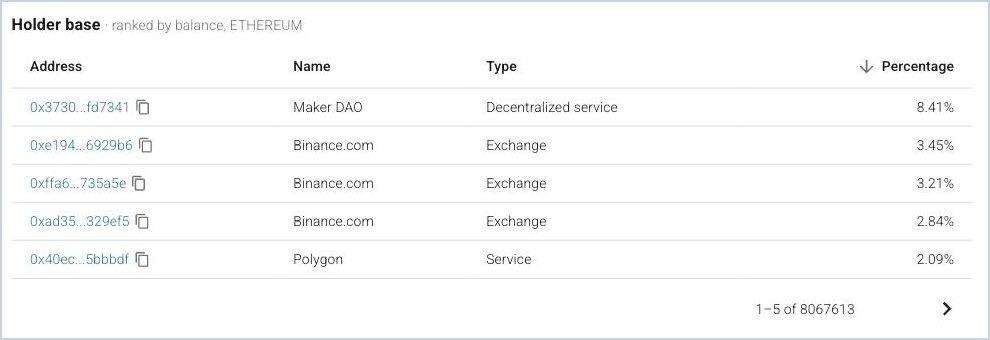
On a large asset that holder base can run to millions of addresses, so the ranking and the entity labels are what make it navigable. You move from the headline exposure figure to the specific holders and flows behind it, which is what you need when you have to explain a number to a board, a partner bank, or a regulator.
Precision matters here, so read the exposure figure for what it is. Exposure is a snapshot measure of how much of an asset is held by high-risk entities at a point in time. It is a structural risk indicator, not a rating, and not an endorsement or condemnation of the asset. It informs a decision; it does not make one. The analyst still makes that call.
A few other honest limits are worth stating. The risky flow trend reflects recent activity, so it moves. Prices and market capitalisation depend on external market data and are not available for every instrument, particularly some bonds and funds. And coverage, while broad, is not universal across networks. None of this undermines the value of the view. It is simply the difference between a tool that reports what it computes and one that overstates itself. For an issuer building a case for regulators or counterparties, that restraint is a feature, not a caveat: the figures you present are the figures the platform can stand behind.
The directory earns its place at four moments in an issuance lifecycle.
Before launch, it gives you a baseline. You can see how comparable assets are distributed and exposed, and set expectations for what a healthy holder profile for your token should look like.
After launch, it becomes an ongoing supply-monitoring tool. Exposure of your circulating supply to high-risk actors is not a fixed property; it drifts as your token changes hands. Watching it on each chain, on a regular cadence, is how you catch a concentration or exposure problem while it is still small.
At the point of a listing or a partnership, it prepares you for someone else's due diligence. The venue or bank assessing your token will form a view of it. Seeing what they will see, and being ready to explain it, turns a defensive conversation into a confident one.
And for reporting, it gives you evidence. Whether the audience is your board, an auditor, or a supervisor, a documented, dated read on holders, concentration, and exposure is far stronger than an assurance that everything is fine.
Transaction monitoring answers who moved value. Asset-level intelligence answers what the value is and who stands behind it. As tokenized assets and stablecoins move from the edge of the market to the centre of regulated finance, issuers are increasingly expected to know both, and to be able to prove it.
The Asset Directory makes the second question fast enough to ask on every asset you issue or support, not just the ones that raise a flag. Search it, read it, and decide, with the evidence on one screen.
To see it against your own asset universe, book a demo with the Scorechain team.



















.webp)