.png)
Quick overview
This is some text inside of a div block.
.webp)
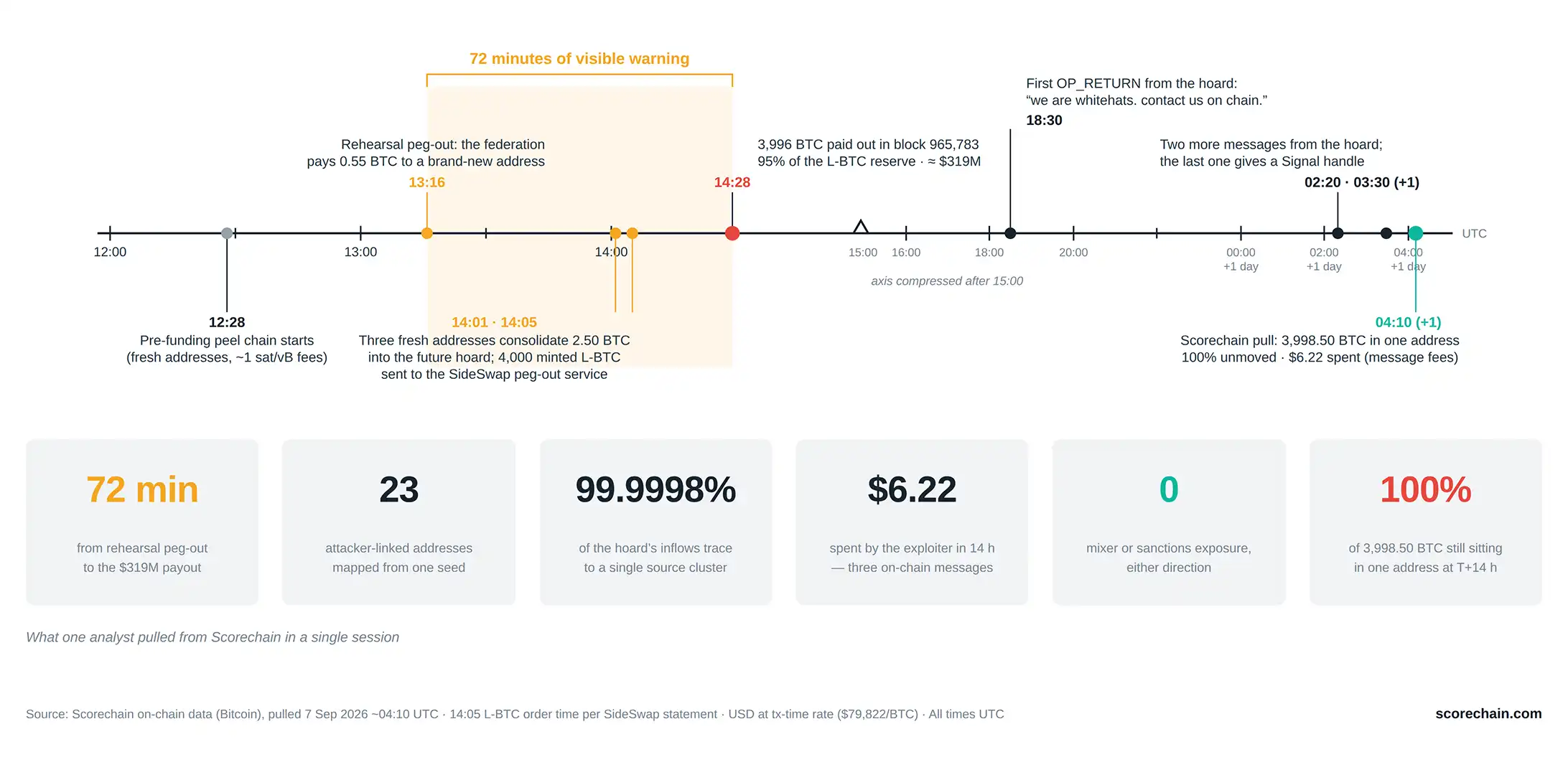
The largest Bitcoin-related drain of the year did not begin at 14:28 UTC on September 6, when a single wallet received 3,996 BTC from the Liquid Network federation. It began 72 minutes earlier, at 13:16:32 UTC, when a brand-new address quietly received a fraction of a coin. No label existed for that address. No sanctions list flagged it. But its behaviour was already legible on-chain, and that is the whole point.
This is a post about what a crypto bridge exploit looks like on-chain before anyone can name it, and how behavioural monitoring catches it. The Liquid exploit is a clean case study because every step is public, and because the signal that mattered arrived more than an hour before the money did.
On September 6, 2026, roughly 3,996 BTC, about 95% of the Bitcoin backing Liquid's L-BTC, left the network's federation reserve through a valid-looking peg-out. No private key was stolen. A bug in Elements, the software beneath Liquid, allowed unbacked L-BTC to be minted, and the federation's 11-of-15 signing quorum approved a withdrawal that looked entirely legitimate. The reserve fell from over 4,200 BTC to roughly 200.
The party responsible left an on-chain message reading "we are whitehats. contact us on chain." Whether that claim holds is contested. Ledger's chief technology officer, Charles Guillemet, was direct about it: "White hats don't drain a bridge and then solicit an 'on-chain' contact." As of September 7, no funds had been returned; the sender's stated condition was that Blockstream patch the vulnerability and distribute the fix to every node first.
The compliance question is not whether they are white hats. It is this: could anyone watching the chain have known something was wrong before 95% of the reserve was gone? The answer is yes.
Nothing in the federation's signing path could have caught this peg-out, because the minted L-BTC looked valid to every signer. Behaviour could catch it, and behaviour showed up early. Reconstructed from Scorechain on the Bitcoin mainnet, the sequence reads as a rehearsal followed by the main event.
Seventy-two minutes separate the first staging transaction from the main drain. In that window there is no entity name to screen against and no sanctions hit to alert on. There is only a pattern: a fresh address, a peg-out, a consolidation, and then size. That pattern is a monitoring signal on its own, and it existed before the reserve moved.
A crypto bridge exploit is an attack that drains a cross-chain bridge or peg reserve by abusing the protocol itself rather than stealing a key, so the fraudulent withdrawal looks valid to the system approving it. The Liquid case is exactly this: an Elements bug minted unbacked L-BTC, and the federation signed a peg-out it had no way to tell apart from a genuine one.
Screening for one of these draws on two different kinds of knowledge: who an address is (attribution and labels) and what an address is doing (behaviour). The two do not arrive at the same time. Labels are backward-looking. An address is named as "exploit," "sanctioned," or "mixer" once analysts, victims, or investigators have established what it did, which is usually after the money has moved. In the Liquid case, the staging addresses carried no label at 13:16 because the drain had not happened yet. Behaviour is available in real time. A team that screens for behaviour, not only for names, is looking at the half of the picture that exists while the window is still open.
Behavioural detection reads the shape of activity rather than the identity behind it. When a wallet has no history to screen against, these are the signals a monitoring system can act on immediately, and each one was present in the Liquid sequence:
None of these require a name. All of them are visible the moment the transaction confirms. This is what separates transaction monitoring that waits for attribution from monitoring that reads the chain as it moves.
As of September 7, 2026, Scorechain attributes the drained funds to a labelled entity, "Liquid network exploit (09-26)," classified as a Hack and carrying a risk score of 1 out of 100. On Scorechain's scale a lower score means higher risk, so 1 is the most severe rating available, and the entity is marked not compliant with MiCA. The wallet cluster spans 19 addresses and sits on an active monitoring scenario for onward movement.
The numbers are stark in a way that helps a compliance team reason about it:
Read together, this is a hoard that is parked and watched, not moving. If it does move, the behavioural signals that flagged the staging are the same ones that will flag the cash-out.
The lesson generalises well beyond Liquid. If your risk model depends on an address being named before you act, you are structurally late, because names are assigned after funds move and behaviour is visible before. A bridge operator, a peg service, or a listing desk that screens deposits only against labels and sanctions lists would have seen nothing at 13:16 and everything at 14:29, which is the wrong order.
Scorechain is built to close that gap. Its crypto transaction monitoring and Know Your Transaction (KYT) screening combine attribution across a large body of labelled on-chain entities with behavioural risk scoring, so a fresh address funded off a reserve, a staging consolidation, or a rehearsal pattern can raise exposure before a label exists. The same platform that traced this cluster to a single source, quantified the concentration, and confirmed zero mixer and sanctions exposure runs those checks continuously, through an API, against live flows.
Behavioural analysis scores what a wallet does rather than who it is: the source of its funds, the age of the address, consolidation and layering patterns, transaction size, and timing. Because these signals exist the moment a transaction confirms, they let a compliance team flag risk on a wallet that has no name or label yet, which is exactly the situation in the first minutes of an exploit.
As of September 7, 2026, no. About 3,998.5 BTC, roughly $318 million, remains in a single Bitcoin wallet. Scorechain records total outflows of about $6.21, spent on three on-chain messages, and zero exposure to mixers or sanctioned entities. The funds are parked and under active monitoring for any onward movement.
By monitoring behaviour, not only identity. A fresh address funded directly from a bridge or peg reserve, a rapid consolidation of newly created addresses, a small rehearsal transaction preceding a large one, and highly concentrated inflows are all screenable signals that appear before any attribution exists. In the Liquid case they appeared 72 minutes before the main drain.
No. The Liquid federation's signing keys were not compromised. A bug in the Elements software allowed unbacked L-BTC to be minted, and the federation's 11-of-15 multisig then signed a peg-out that looked valid. It was a protocol-level flaw, not a key theft, which is why nothing in the signing path caught it.
Scorechain traced this cluster to its source, quantified the concentration, and confirmed zero mixer and sanctions exposure in a single session, on public data. If your team needs to see behavioural risk on a wallet before a label exists, book a demo and we will walk through this trace and your own flows.