Quick overview
This is some text inside of a div block.
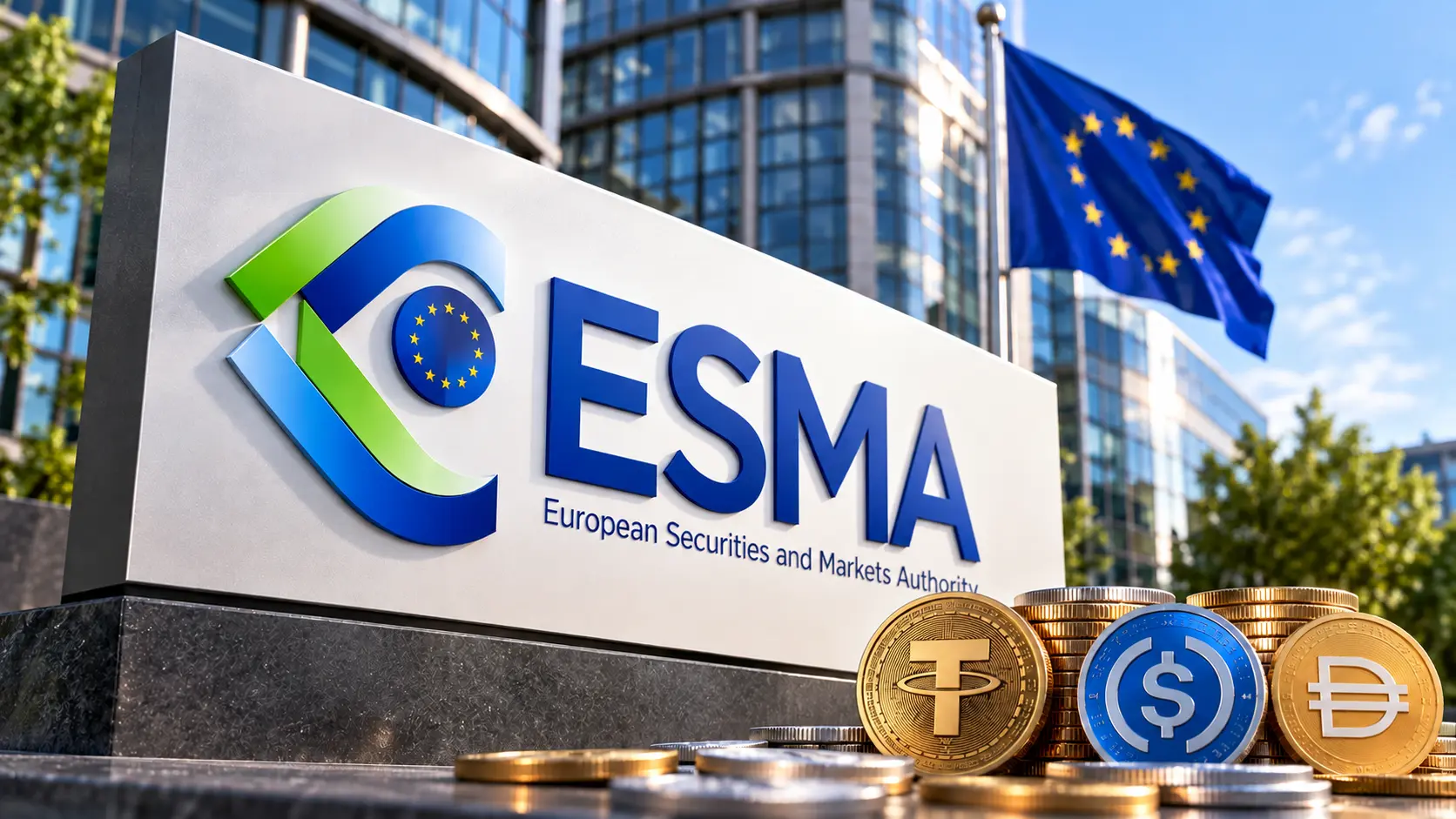
On 10 September 2026, the European Securities and Markets Authority (ESMA) published its second risk monitoring report of the year. Its in-depth analyses include the study “Tokenisation of equities: From visibility to viability?”, which looks at the issuance and representation of shares on distributed ledger technologies. The study does not lay down new obligations, but it identifies the main legal, operational and market risks associated with the models currently in use. This brief reviews ESMA’s findings and the controls that the parties concerned, such as issuers, market infrastructures, custodians, investment firms and, where MiCA applies, crypto-asset service providers, need to put in place according to the legal characterisation and the architecture of the token.
The TRV Risk Monitor No. 2 of 2026 is ESMA’s half-yearly assessment of trends, risks and vulnerabilities in EU financial markets. Beyond its macro-financial risk drivers, the report reviews market developments during the first half of 2026 and offers in-depth analyses of selected topics, including prediction markets. In its “Financial innovation” section, ESMA describes tokenisation applied to equities as nascent but gaining adoption and notes that recent attacks in DeFi have revived concerns about market interconnection.
The overall framing is one of contagion, rather than crypto-native risk alone. ESMA observes that the sharp fall in crypto-asset prices since the October 2025 peak has mechanically reduced vulnerabilities by shrinking the sector, but warns that this effect may be temporary, as interconnections with traditional finance continue to grow through institutional participation, crypto investment products, stablecoins and the integration of blockchain infrastructure into financial services. In the absence of effective regulatory safeguards, as ESMA points out, these connections could facilitate the transmission of shocks from crypto markets to the wider financial system, which warrants continued monitoring. Tokenised equities are among these connections.
The striking figure is the pace of growth. The public data reviewed by the regulator puts the value of tokenised equities in circulation at around €1.9 billion at the end of June 2026, compared with some €300 million at the end of 2024. That is a 6.5-fold increase in eighteen months. Activity remains concentrated in large technology companies listed in the United States, whose capitalisation, liquidity and profile among investors make them natural candidates for tokenisation products, and the total remains negligible against global equity markets. The market therefore remains limited compared with traditional equity markets, but this 6.5-fold increase in eighteen months, together with recent institutional initiatives, calls for heightened vigilance.
ESMA quantifies neither the share of European investors in the €1.9 billion outstanding, nor the concentration of holdings across wallets and platforms. It merely cites, by way of example, offerings that give EU investors access to economic exposures to mainly US shares. Any conclusion about a significant proportion of European investors, or about the market being dominated by a few wallets, would therefore need separate data to support it.
The most useful contribution of ESMA’s study is a simple taxonomy. As a general rule, a tokenised equity can either be issued natively or rely on so-called wrapped structures. In a native issuance, the share itself is issued and recorded on distributed ledger technology (DLT). In a wrapped structure, the token represents a claim on a share, or a mere economic exposure to it, with the share held off-chain by an intermediary. Wrapped products account for most of the activity in tokenised equities. This second model predominates because it avoids reworking company law, the shareholder register or the conventional issuance process. That simplicity, however, adds new dependencies.
ESMA warns that wrapped equity tokens can fragment liquidity, since transfers on the blockchain often do not transfer legal ownership of the underlying share. The investor’s rights then depend on the contractual documentation and the structure chosen: whether voting or financial rights exist at all, how dividends are paid, and what happens if the tokenisation platform or the custodian fails. Because ownership of the underlying share sits off-chain, no single on-chain source of truth exists; self-custody can only be achieved indirectly through the structure, and the tokenisation arrangement adds layers of intermediaries that carry their own complexity and risks.
This last point turns the usual tokenisation narrative on its head. The promise was disintermediation. In the dominant wrapped model, the interposition of a tokenisation platform and a custodian may add new counterparty dependencies instead of removing them. For a CASP supporting such a token, the question “who is behind this asset?” is no longer rhetorical: it has a contractual answer and, potentially, an answer under insolvency law.
ESMA is equally measured about the operational benefits. The regulator recalls the potential gains of tokenisation, including wider investor access, programmability and atomic settlement, but questions how many of these benefits can actually be observed within wrapped structures. Even where the token transfer takes place on-chain, the cash leg is often settled separately, by bank transfer or through other channels, so that the promised atomic settlement, in which securities and cash change hands simultaneously, is not yet a reality for some transactions.
This hybrid architecture requires reconciliation between two systems and limits the reduction in settlement risk. It also creates a fragmentation problem. ESMA notes that issuing several tokenised versions of the same share can fragment liquidity. Where several non-fungible representations of the same share coexist on different platforms and chains, price formation, market depth and execution quality can all deteriorate, particularly in periods of stress. Because smart contracts execute automatically and many blockchains are designed to be immutable, a coding error can lead to an erroneous transfer or misallocation of rights, with consequences that are lasting and difficult to correct.
The regulatory perimeter depends on the instrument's characteristics and the rights attached to it. Article 2(4)(a) of MiCA excludes from its scope crypto-assets that qualify as financial instruments. ESMA’s guidelines call for a case-by-case, technology-neutral analysis based on substance rather than form. A crypto-asset conferring rights equivalent to those of shares must be classified as a transferable security where it belongs to a class of securities, is negotiable on the capital market and does not constitute an instrument of payment.
The DLT Pilot Regime governs certain market infrastructures that handle crypto-assets qualifying as financial instruments. It does not turn every tokenised product into a compliant financial instrument, nor does it remove the need to analyse issuance, trading, settlement, custody and investor protection.
An asset marketed as a “tokenised equity” therefore does not automatically fall under MiCA, and the technology used, whether a public blockchain or a settlement stablecoin, does not on its own determine the applicable law. Characterisation must rest on the rights attached to the token and on its economic substance, in accordance with MiFID II and ESMA’s guidelines on the classification of crypto-assets as financial instruments.
In practice, this gives regulated firms a short list of control points before issuing, listing, holding in custody or screening a tokenised equity:
A note of caution applies when reading the report. The TRV Risk Monitor is a risk analysis publication and does not, by itself, impose new obligations. The applicable requirements continue to flow from existing European and national texts, notably MiFID II, MiCA, MAR and, where relevant, the DLT Pilot Regime.
Depending on its architecture, a wrapped equity token may be issued using a standard such as ERC-20 and circulate on one or more public blockchains. This configuration is not universal, however: some issuances rely on permissioned infrastructures or include transfer restrictions, notably through whitelisting. Where a token circulates on networks supported by Scorechain, on-chain analysis can provide visibility into its holders, flows, and interactions. Legal rights, meanwhile, remain determined by the contractual documentation and applicable law.
Scorechain’s approach is to treat the asset, and not only the wallet or the transaction, as the unit of risk. Asset-level intelligence aggregates the holders and deployments covered and displayed by the platform in order to provide a structural reading of risk. Coverage extends to many EVM and non-EVM networks, but it is not universal; conclusions should therefore be confined to the networks and deployments actually analysed.
The Asset Directory is the entry point. As at 31 July 2026, it covered more than 40,000 assets, including over 2,000 tokenised real-world assets and around 350 stablecoins, with counters updated as coverage expands. Opening an asset gives a per-asset snapshot on a single screen: the issuer and the contract address, the chains on which the asset is deployed, the number of holders, exposure to high-risk and critical-risk holders expressed as a share of supply, the recent trend in risky flows over the past 30 days, and the main holders with entity labels and classification.
Set against the risks identified by ESMA, this snapshot performs specific functions:
ESMA's Risk Monitor does not create a new regime for tokenised equities. Its significance lies in the control and supervision questions it places at the centre of the market’s next phase. Institutions must demonstrate what the token represents legally, where the underlying share is held, how cash and securities settle, how rights are exercised and how risks are monitored across on-chain and off-chain infrastructures.
ESMA’s TRV Risk Monitor No. 2, 2026, published on 10 September, reports that the value of tokenised equities in circulation rose from around €300 million at the end of 2024 to around €1.9 billion at the end of June 2026, concentrated in large US technology stocks and dominated by wrapped structures. It flags liquidity fragmentation, hybrid settlement and the fact that token transfers often do not transfer legal ownership. It does not propose new rules.
In a native issuance, the share itself is issued and recorded on DLT. In a wrapped structure, the token represents a claim on a share, or an economic exposure to it, with the share held off-chain by an intermediary. Wrapped structures predominate today, and in those structures the investor’s rights depend on the contractual documentation rather than on the token itself.
Not automatically. MiCA excludes crypto-assets that qualify as financial instruments. Characterisation depends on the rights attached to the token and on its economic substance, assessed under MiFID II and ESMA’s classification guidelines, and not on the commercial label or the technology used.
The need for screening and the applicable obligations depend on the token's characterisation, the activity carried out, and the status of the party concerned. Where an instrument circulates on a public blockchain, on-chain analysis can support AML/CFT, sanctions and risk management controls by providing visibility of wallets, counterparties and flows. However, a crypto-asset qualifying as a financial instrument is excluded from the scope of MiCA, and ESMA’s study does not introduce a general obligation requiring the issuer to screen all holders. Controls must be determined based on the legal regime and operating model that actually apply.