Quick overview
By Scorechain
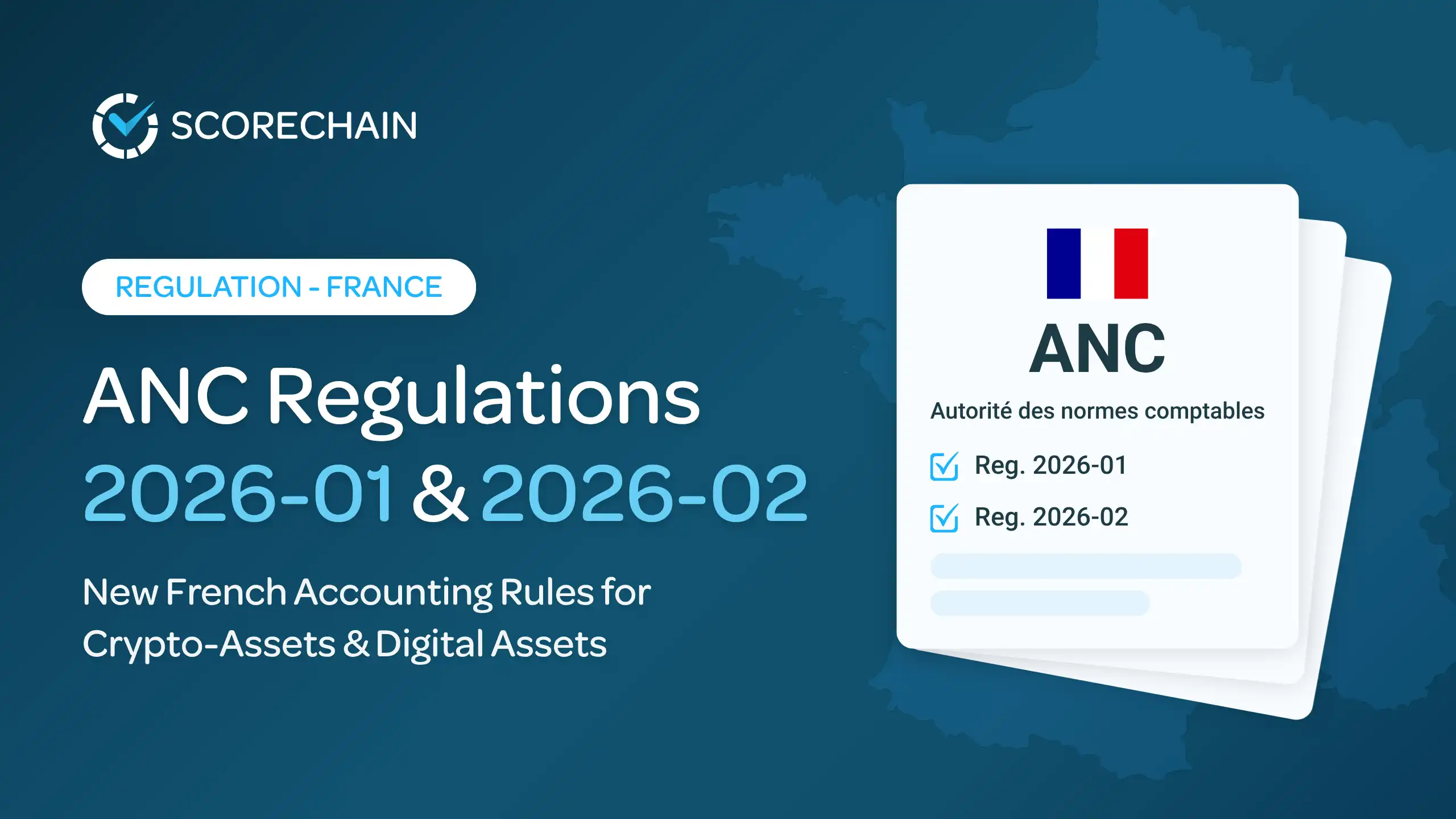
What ANC Regulations No. 2026-01 and No. 2026-02, approved by the ministerial order of 12 August 2026, mean for holding companies, issuers, crypto-asset service providers (CASPs) and banking institutions
By Cécile Henry, Compliance Expert & Regulatory Partner, Scorechain, October 2026
If your company applies French accounting standards and holds or lends crypto-assets, or holds client crypto-assets, its accounts for financial years opening from 2027 will look different.
A ministerial order of 12 August 2026, published in the Official Journal of 3 September 2026, approves four regulations of the French accounting standards authority, the Autorité des normes comptables (ANC). Two of them update the accounting treatment of crypto-assets: Regulation No. 2026-01 amends the French General Chart of Accounts (Plan comptable général) and certain sectoral frameworks, while Regulation No. 2026-02 adapts the rules applicable to entities governed by the French banking accounting framework.
The reform adopts the notion of “crypto-assets and similar assets”, articulated with the MiCA definitions but covering a broader accounting perimeter. It extends a logic already present in the earlier texts: the accounting treatment depends on the characteristics of the asset, the rights and obligations attached to it and, for certain holdings, the use the entity intends to make of it. The dates from which the rules apply are set out in the next section.
The ministerial order of 12 August 2026 (NOR ECOT2617843A) approves four regulations adopted by the ANC’s board between January and May 2026. Regulations No. 2026-01 and No. 2026-02, adopted on 9 January 2026, concern crypto-assets. The first overhauls the accounting treatment of crypto-assets and similar assets in the General Chart of Accounts (ANC Regulation No. 2014-03), and the second adapts that treatment to the accounts of the banking sector (ANC Regulation No. 2014-07). Regulations No. 2026-03 and No. 2026-04, for their part, deal with other accounting matters.
Regulations No. 2026-01 and No. 2026-02 apply to financial years beginning on or after 1 January 2027. Their respective Articles 9 and 12 allow early application to the financial year in progress at the time of their publication in the Official Journal. A company closing its accounts on 31 December 2026 may therefore, if it so wishes, apply the new framework from that financial year.
France has had accounting rules on “tokens” since ANC Regulation No. 2018-07 of 10 December 2018, adopted in the context of the growth of token fundraising, or ICOs. That framework was supplemented in 2020 for digital-asset services. The 2026 reform updates existing rules to adapt them to the various operations in crypto-assets and to the European MiCA framework.
The new General Chart of Accounts uses the expression “crypto-assets and similar assets”. It includes the crypto-assets defined by MiCA, as well as other assets using the technologies referred to in the French Monetary and Financial Code. The ANC’s commentary mentions NFTs in particular. An asset may have to be treated under these accounting rules even if it falls outside the scope of MiCA: the accounting perimeter and the regulatory perimeter are not one and the same. The wider EU timeline is covered in the MiCA roadmap.
The reform clarifies the treatment of issuances, holdings, and the lending and borrowing of crypto-assets. It also updates the rules applicable to service providers such as CASPs, in particular those relating to the custody of client assets, as well as the information to be presented in the notes to the annual financial statements.
Before choosing an accounting treatment, the company must identify the nature of the asset. Two categories benefit from specific rules:
For other crypto-assets, the analysis continues by examining the rights they confer on their holders and the use the company intends to make of them. These elements determine their accounting classification and the applicable measurement rules.
Apart from financial instruments and e-money tokens (EMTs), the treatment depends on two elements: the rights to a good or service conferred by the crypto-asset and the company’s intention to use them in its business. If both conditions are met, the asset is accounted for according to the nature of the rights: fixed asset, inventory or prepaid expense. Otherwise, it is recorded in account 522, “Crypto-assets and similar assets held”. Buying a token with a view to reselling it is not enough, on its own, to justify classification as inventory. EMTs fall under account 513, while tokenised securities follow the rules of the corresponding financial instruments.
The company must document the rights and the intended use at the time of acquisition. A later change does not allow free reclassification: Article 619-11 regulates transfers and prohibits reclassifying to account 522 assets accounted for under Article 619-9.
Crypto-assets in account 522 are measured at their market value at each closing date. Changes are recorded in transitional accounts: unrealised gains are not immediately recognised in profit or loss, while unrealised losses give rise to a provision, taking account of the applicable hedging rules.
For disposals of fungible crypto-assets recorded in accounts 522 and 523, the result is calculated using FIFO or the weighted average cost method. An exchange may also generate a result if it has commercial substance. The notes specify the price sources and the valuation time adopted.
For issuances other than EMTs, the documents provided to subscribers and the obligations assumed by the issuer guide the treatment. Instruments with the characteristics of financial securities, financial contracts or savings notes follow their own accounting regime. For other issuances, a repayable debt leads to the recognition of a loan or similar liability; goods to be delivered or services to be performed lead to deferred income.
Within the latter framework, the sums received are recognised directly in income only in the absence of explicit or implicit obligations towards subscribers and holders. A composite issuance requires its components to be analysed separately. Deferred income is then released to profit or loss as the services are performed or the goods delivered. The white paper and the contractual commitments form part of the accounting file.
The lender tracks the crypto-assets lent in a dedicated sub-account. The borrower records the assets received in account 524, with a restitution liability as the counterpart.
The ANC’s commentary attaches to this regime certain staking operations accompanied by an obligation of restitution, as well as collateral involving a transfer of ownership. Contributions to liquidity pools without a guarantee of identical restitution are, in the example described by the ANC, treated as exchanges. The treatment depends on the contractual terms, not on the commercial name of the operation alone.
To remain off the provider’s balance sheet, the assets held in custody must satisfy three cumulative conditions:
If one condition is missing, the assets are recorded on the balance sheet with a restitution liability. This mechanism already existed in 2020 for PSANs (French digital-asset service providers); the reform updates it for crypto-asset services. The notes must also present the quantities and values of the assets held in custody off balance sheet.
ANC Regulation No. 2026-02 adapts the treatment of crypto-assets for entities governed by the French banking accounting framework. E-money tokens (EMTs) held are presented among receivables from credit institutions and similar entities. For their issuer, EMTs in circulation give rise to a liability corresponding to their redemption value.
In the general case, crypto-assets held are recorded at acquisition cost and then impaired in the event of an unrealised loss, with no recognition of unrealised gains. Specific rules also apply to assets representing rights to goods or services that the entity intends to use in its business.
Measurement at market price, with changes recognised in profit or loss, is provided for trading crypto-assets. This category is reserved for tokens referencing one or more assets (ARTs) whose holding meets the conditions of Articles 2321-1 and 2321-2: the intention to resell quickly is therefore not enough to classify just any crypto-asset in it.
The new accounting framework rests on data that companies did not always keep in a structured way: the exhaustive inventory, by address and by network, of the crypto-assets held, lent, borrowed, pledged as collateral or held in custody on behalf of third parties, together with the record of their movements. The accounting characterisation remains a legal and accounting analysis based on the asset’s documentation and the entity’s intention; the evidence of flows and counterparty exposure, by contrast, can draw on on-chain analysis.
Applying the accounting rules means gathering the information needed to identify the assets, understand the transactions and justify the treatments adopted. The analysis of blockchain data can contribute to this work, alongside contracts, internal registers and accounting records.
Digital Asset Intelligence provides information on the distribution of holders, flows and an asset’s exposure to risky entities. Wallet & Transaction Screening makes it possible to analyse the risk associated with an address and its counterparties, in particular their exposure to sanctioned actors or risky activities.
This information can enrich internal controls and the review of transactions. Using it for accounting purposes nevertheless requires reconciling it with the entity’s own data. It is not sufficient, on its own, to determine the accounting classification of an asset, to establish the completeness of positions or to demonstrate compliance with all the conditions for custody on behalf of third parties.
The reach of the analyses also depends on the networks and assets actually supported. Accounting characterisation and measurement remain based on the applicable rules, the contractual documentation and the entity’s judgement.
The reform updates the French accounting framework for crypto-assets and its articulation with MiCA. It extends principles already present in the earlier texts: analysing the rights and obligations attached to the assets and determining the conditions for presenting assets held in custody for clients on the balance sheet.
For companies and service providers, preparation consists of identifying the rules applicable to each transaction, documenting the classifications adopted and organising the data needed for measurement and for the disclosures in the notes. The implementation timetable depends on the opening date of the financial year and on any decision to apply early.
To see holder, flow and counterparty data for the crypto-assets your company holds, book a demo with the Scorechain team.
They apply on a mandatory basis to the accounts of financial years beginning on or after 1 January 2027. The ministerial order of 12 August 2026 approved them, and it was published in the Official Journal of 3 September 2026. They may be applied early to financial years in progress at that date, so a company closing its accounts on 31 December may apply them from the 2026 financial year.
Regulation 2026-01 updates, in particular, the General Chart of Accounts: crypto-assets recorded in account 522 are measured at their market value at each closing date. Regulation 2026-02 concerns the banking accounting framework. In the general case, it provides for measurement at cost less impairment, with specific treatments for EMTs, assets accounted for according to the rights they represent, and trading crypto-assets.
An e-money token, or EMT, is a category of crypto-asset that aims to stabilise its value by reference to an official currency. In the General Chart of Accounts, its holding falls under account 513. Other stablecoins are classified according to their characteristics.
No, provided three conditions are met: segregation of client assets with permanent matching of on-chain quantities, no use without the client’s express consent with multiple validation of transactions, and the putting in place of means of restitution. If one of these conditions is missing, the assets are recorded on the provider’s balance sheet with a restitution liability as the counterpart. The notes separate the two groups. For assets held in custody off balance sheet, they indicate the number and market value. For assets recorded on the balance sheet, they present the amount of the indexed restitution liabilities.