Quick overview
By Scorechain
Protection of lent assets, client consent and sharing of the yield, with ESMA’s positions and the European reform options
By Cécile Henry, Compliance Expert & Regulatory Partner - Scorechain
Crypto-asset lending and borrowing, commonly called crypto lending and borrowing, are not among the services covered by the MiCA authorisation. A crypto-asset service provider (CASP) may nevertheless offer lending alongside its authorised services. It must then distinguish these activities for its clients and explain what changes for them when their assets are lent: the regulation’s safeguarding mechanisms cease to apply, the client bears the counterparty risk and the provider’s remuneration must remain proportionate to its costs.
These requirements stem from the reading that the European Securities and Markets Authority (ESMA) gives of Regulation (EU) 2023/1114, especially in its answer No. 2883 of 18 June 2026 and in its statement of 11 July 2025 on unregulated services. They form part of a broader debate: the European Commission consulted until 30 September 2026 on the MiCA review, and the European Banking Authority (EBA), ESMA and the French authorities have each proposed a way of regulating lending and borrowing.
Recital 94 of MiCA states that the regulation does not address the lending and borrowing of crypto-assets, including e-money tokens, and that it applies without prejudice to applicable national law. It adds that the feasibility and necessity of regulating these activities should be the subject of a later assessment. The exclusion is therefore not an oversight: the legislator referred the question to a subsequent review, organised by Article 142. That article asked the Commission, before 30 December 2024 and after consulting the EBA and ESMA, for a report examining especially the necessity and feasibility of a framework for lending and borrowing. Article 140 separately provides for an interim report by 30 June 2025 at the latest and a report on the application of MiCA by 30 June 2027 at the latest, accompanied where appropriate by a legislative proposal.
Two practical consequences follow. First, crypto lending does not benefit from the passport attached to crypto-asset services by Article 65. A provider offering lending in several Member States must examine the structure and the applicable law in each target market. Second, certain programmes may, depending on their characteristics and contractual terms, fall under another European regime: ESMA points to the definition of an alternative investment fund given in Article 4(1)(a) of Directive 2011/61/EU, which may apply to arrangements pooling the assets of several clients according to a defined investment policy.
This limit does not remove the CASP’s obligations. Article 66 requires it, among other things, to act honestly, fairly and professionally, in the best interests of its clients and prospective clients. It must communicate in a fair, clear and not misleading manner, including in its marketing communications, and warn its clients of the risks associated with transactions in crypto-assets. Where it holds clients’ crypto-assets or the means of access to them, Article 70(1) requires it to make adequate arrangements to safeguard their ownership rights, especially in the event of insolvency, and to prevent the use of those assets for its own account.
Articles 40 and 50 complete this foundation for stablecoins. They prohibit issuers of asset-referenced tokens (ARTs) and e-money tokens (EMTs) from granting interest, and extend this prohibition to CASPs when they provide services related to these tokens. Any remuneration or other benefit linked to the length of time the token is held is treated as interest, including where it comes from a third party. This point is examined further below, as it determines the viability of many yield programmes.
The EBA and ESMA published a joint report on 16 January 2025, requested by the Commission on 9 February 2024 under Article 142. They noted that lending and borrowing services are offered by a number of CASPs in the Union, with apparently limited engagement from European consumers and financial institutions. In their factsheet of 24 January 2025, the EBA and ESMA indicated that they had identified crypto-asset lending or borrowing offerings in 16 Member States. For decentralised finance alone, they estimated the size of the European lending and borrowing market at around EUR 1.8 billion. This figure was extrapolated from global data and the estimated share of European users.
The risks identified are those that still shape the debate: insufficient information on fees, yields and changes to collateral; excessive leverage; collateral chains, where reused collateral exposes several players to the same default; no verification of borrowers’ creditworthiness; liquidation and commingling risks. On the basis of the data then available, the authorities had not identified any risk to financial stability.
In its answer No. 2883 of 18 June 2026, ESMA explains how it interprets the obligations of a CASP offering lending. The answer concerns crypto-assets, not securities lending. It creates no new authorisation and refers to Recital 94; it recalls that the provider must follow the statement of 11 July 2025 when it offers lending alongside its authorised services, and that Article 66 continues to apply to the activity.
The asset safeguarding mechanisms provided for by MiCA do not apply to crypto-assets committed to a lending programme. The client is exposed to counterparty default, to insufficient collateral and to the risk of losing access to its assets if the CASP fails. These risks must be presented to the client in a fair, clear and not misleading manner. According to ESMA, the provider should also confirm that collateral is adequate and assess the robustness of the lending arrangement, including where it relies on a decentralised protocol.
According to ESMA, the use of client assets for lending requires prior, express and specific consent, given for clearly defined terms. A clause buried in the general terms and conditions, without prominence, is not enough. ESMA does not, in this answer, require a separate document: what matters is the clarity and specificity of the consent. That consent does not, however, lift the prohibition imposed on the CASP by Article 70(1) on using for its own account the assets it holds for the client. Lending a client’s assets with their agreement and using them for its own needs are two different things.
For ESMA, the yield from lending should go to the client, since the client bears the risk. The CASP may charge a fair and proportionate fee reflecting its operational costs; retaining additional income would, according to the authority, be incompatible with the obligation to act in the best interests of the client. MiCA sets no numerical cap on this fee, which means the provider must be able to justify its level by the costs of the service. Programmes in which the provider retains a substantial share of the yield are the most directly affected by this reading.
In its statement of 11 July 2025, ESMA warns against a halo effect: a client may believe that the authorisation displayed for custody extends to the lending offered on the same platform. The regulation’s protections, such as the management of conflicts of interest, complaints handling, asset safeguarding and supervision by national authorities, do not cover this service. ESMA recommends that the regulatory status of each product be communicated at every stage of the sales journey. It also recommends that the sections devoted to unregulated activities be separate from those devoted to regulated activities, and that a warning window, with a tick box, precede access to the service. A mention confined to the general terms and conditions or the use of regulated status for promotional purposes are among the practices to avoid.
These are recommended presentation arrangements, not obligations laid down in the regulation. They are not to be confused with the consent required by answer No. 2883: acknowledging that a service is not covered by MiCA and consenting to lend one’s assets are two distinct decisions that the client journey must keep apart.
MiCA prohibits issuers of e-money tokens (EMTs, Article 50) and asset-referenced tokens (ARTs, Article 40) from granting interest on these tokens. This stablecoin interest prohibition also applies to CASPs when they provide services related to the tokens concerned. The decisive criterion is the link with the holding period: any remuneration or other benefit linked to that period is treated as interest, including where it is paid by a third party. To assess a lending programme, the first step is to examine what gives rise to the yield: holding the token, or actually making it available to a borrower. The classification depends on the terms of the programme and does not follow from its commercial name alone.
The Commission’s targeted consultation on the MiCA review opened on 20 May 2026. Initially set for 31 August, its closing date was postponed to 30 September. The consultation document recalls that staking, lending and borrowing are not currently covered by MiCA. Question 67 asks whether lending and borrowing should be regulated and, if so, what the main elements of such regulation should be. Questions 20, 63 and 66 deal respectively with the prohibition of interest, the certification of protocols and smart contracts, and staking. Certification is an option in the questionnaire, not a settled direction. The responses are to guide the Commission when it prepares, if it deems appropriate, a formal proposal.
The three contributions converge on one point: the obligations target the identifiable intermediary, that is, the CASP that offers, facilitates or gives access to the service, and not the protocols themselves. They diverge on the technique. The EBA envisages an authorised service, hence a passportable one, accompanied by suitability tests and leverage limits. ESMA and the French authorities prefer conduct rules without a new authorisation; a conduct rule can be common to the whole Union without creating a new service with a passport, which leaves the question of cross-border offerings entirely open.
ESMA bases its position on the observation that crypto-asset lending can lead to cascading failures when a provider borrows its clients’ assets, sometimes without collateral, to lend them on to third parties. Where the provider retains part of the yield, the risk is heightened: the custody and segregation requirements cease to apply once the assets are lent, and clients are often unaware of the identity and creditworthiness of the end borrowers, the allocation of loans, the collateral and the gross yield generated. The information that ESMA wishes to make mandatory for crypto borrowing covers collateral, liquidation mechanisms, the reuse of assets, affiliated counterparties, protocol risks and treatment in the event of insolvency, with a clear explanation of the risk of automatic liquidation and of losses exceeding the collateral deposited.
As regards stablecoins, the EBA notes that two tokens dominate lending and borrowing activities, one being an EMT issued by an authorised institution, the other meeting the definition of an EMT without being able to be offered to the public in the Union. It examines the prohibition on facilitating loans involving ARTs or EMTs for which the required authorisation has not been obtained. It identifies a risk of the interest prohibition being circumvented through certain EMT loans and, on question 20, comes out in favour of maintaining this prohibition. For EMTs, the French authorities propose maintaining the prohibition for the issuer while regulating certain indirect remuneration paid by third parties such as CASPs, and specify that maintaining the prohibition reinforces the need to ensure that yield-generating arrangements are not used to circumvent it. Finally, the EBA notes that some CASPs lend or borrow on their own balance sheet, which exposes them to credit, market and leverage risks not covered by the current prudential regime. These are reform positions.
The report expected by 30 June 2027 at the latest may be accompanied by a legislative proposal. That date determines neither the outcome of the review nor the entry into application of new obligations: adoption by the European Parliament and the Council would follow, where applicable, and then application periods. Until then, the framework remains the one described in the first part.
The requirements already set out by ESMA and those taking shape in the review concern the same matters. A provider can therefore organise the review of its programmes now around three questions.
Check that the client can identify who holds its assets, to whom it is lending them and what risks it is accepting. Lending must be presented as a service not covered by the authorisation, in a section separate from regulated services, with a prior warning. Consent to lending must be collected separately, for defined terms, and a record of it kept together with the version of the terms accepted. The costs on which the fee is based must be documented, so that its fair and proportionate nature can be demonstrated. The display of a balance in the interface must not give the impression that the lent assets remain segregated.
ESMA’s contribution of September 2026 invites an examination of the identity of the end borrower, the collateral, the liquidation mechanisms and the gross yield. For an existing programme, this means knowing at all times to whom the assets have been lent, against what collateral, under what recall terms, and whether those assets have been reused by the borrower. The EBA also highlights the credit, market and leverage risks where a CASP lends or borrows on its own balance sheet. A provider in this situation should measure these exposures and report on them to its management body, even in the absence of a specific prudential requirement.
On DeFi regulation, ESMA proposes a separate regulated service for providers that act as a gateway to decentralised finance (DeFi). It would carry obligations of transparency on the selection of protocols, management of conflicts of interest, due diligence and operational security proportionate to the degree of control exercised. The EBA envisages the certification of lending protocols. The French authorities propose ongoing due diligence and monitoring, proportionate certification of protocols and CASP liability for certain incidents where it has actively facilitated access; they do not rule out, subject to conditions, access to a non-certified protocol. Staking should not automatically be treated as lending, even though ESMA accepts that the two can converge where the provider reuses client assets to generate a yield. Answer No. 2883 already requires the robustness of the protocol to be examined before client assets are committed to it: this due diligence can be formalised without delay.
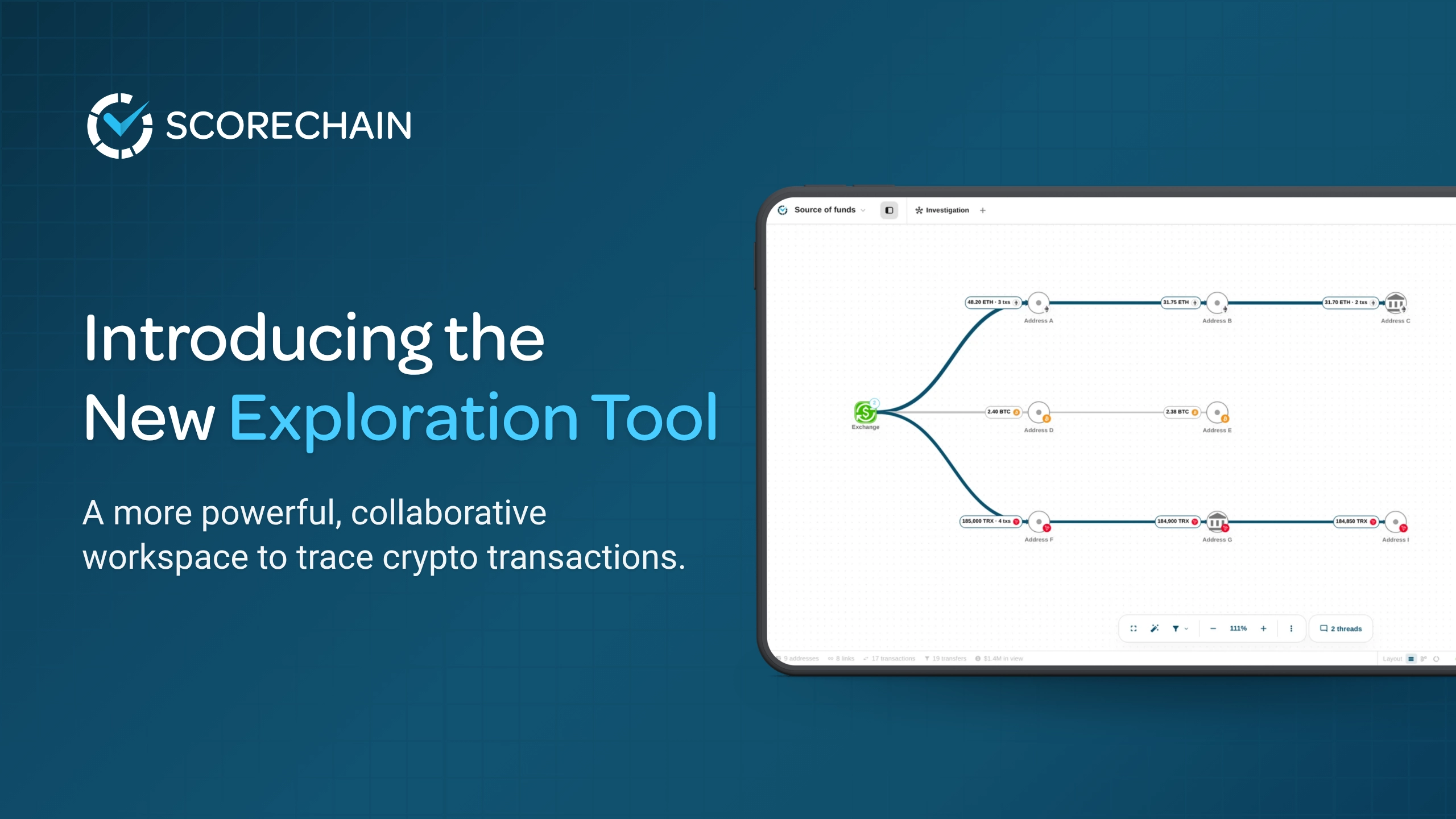
The checks described above rely in part on on-chain data: where the lent assets go, which addresses receive them, which services or contracts are involved. Wallet & Transaction Screening provides information on an address’s risk exposures, direct and indirect, based on explainable scores. Transaction Monitoring tracks transactions over time and lets users configure alerts, for example on movements of lent assets to and from a counterparty or a contract. Flux Analysis helps to visualise the relationships between addresses and services. For the stablecoins covered, including USDT, USDC, EURC and EURCV, Token & Stablecoin Monitoring can bring out an unusual velocity of circulation or series of transfers likely to conceal the origin of funds.
These observations guide the checks and keep a record of them. They are not sufficient to identify the end borrower, to establish its creditworthiness or to prove the continuity of a flow through a mixer. Rights over collateral, the robustness of the protocol, client consent and the calculation of the fee require separate legal and contractual checks, which remain the responsibility of the provider.
To see how these tools document crypto lending flows on your own data, book a demo with the Scorechain team.
It does not confer a MiCA passport for lending itself. The provider must examine the target States, the applicable national law and the classification of the programme, which may fall under another European regime.
No. The client must be able to consent expressly to the lending of its assets under defined terms. Mere acceptance of the general terms and conditions or of a warning about the unregulated nature of the service is not enough: these are two distinct decisions.
According to ESMA, only a fair and proportionate fee reflecting its operational costs. MiCA sets no numerical cap; ESMA proposes writing a limit on the yield retained into the regulation.
The token must be classified, and it must be identified who is remunerating the client and why. For an EMT, examine Article 50; for an ART, Article 40. Remuneration linked to the holding period is treated as interest, even when paid by a third party. The commercial name of the programme does not determine its treatment.