Tracing Crypto Transactions
Crypto transaction tracing follows the movement of funds across wallets and blockchains to identify sources, destinations, and suspicious activity for investigations and compliance
Crypto transaction tracing follows the movement of funds across wallets and blockchains to identify sources, destinations, and suspicious activity for investigations and compliance

















Every move made on a blockchain leaves a permanent, unalterable record. No transaction can be hidden, deleted, or quietly reversed. This is what makes blockchain uniquely powerful for financial investigations.
Tracing crypto transactions is the process of following the movement of digital assets across wallet addresses, blockchains, and entities to establish where funds originated, where they traveled, and where they ultimately ended up. It is the foundation of blockchain forensics, AML investigations, and crypto asset recovery.
Tracing follows the on-chain trail left by every transfer. The process typically involves:
Even when bad actors attempt to obscure their trails using mixers, chain hopping, or privacy coins, skilled investigators using advanced analytics tools can often reconstruct meaningful portions of the transaction path.
Crypto transaction tracing is used across a wide range of scenarios:
Transaction tracing is not always straightforward. Several factors complicate the process:
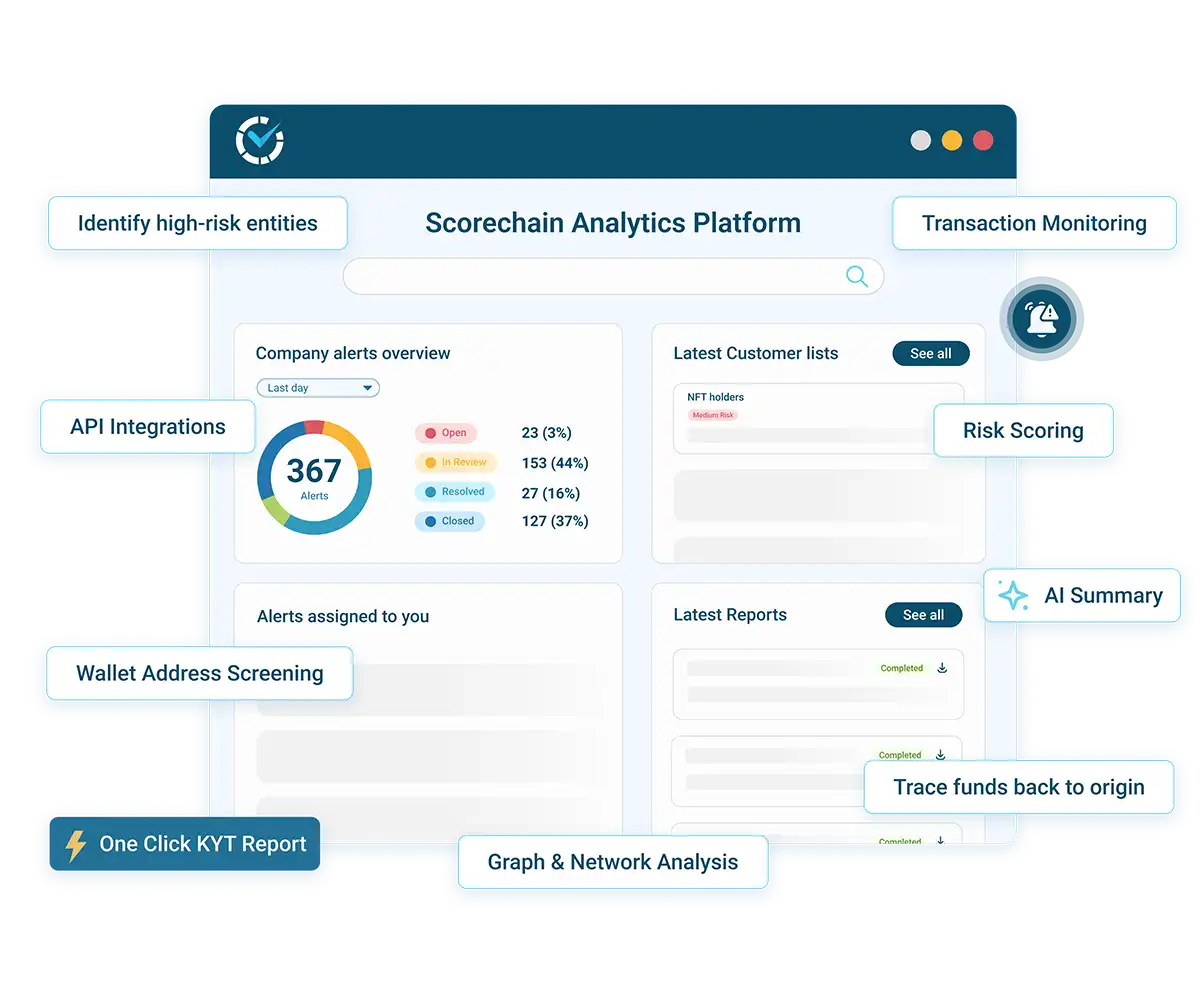
Scorechain's blockchain analytics platform is built for exactly this kind of work. Here is what it brings to transaction tracing:
Flux Analysis maps complete fund flows visually across wallets and blockchains, turning complex multi-hop transactions into a clear, readable investigation trail.
Multi-chain coverage across 21 plus blockchains means investigators can follow funds even when they cross networks, without losing the thread.
Entity attribution identifies whether a wallet belongs to a known exchange, mixer, darknet market, ransomware group, or sanctioned entity, providing critical context at every step of the trace.
AI-powered risk scoring goes beyond basic rule matching to detect behavioral anomalies and hidden risk exposure that standard tools miss.
Wallet screening instantly checks every address in the transaction trail against global sanctions lists including OFAC, EU, and UN databases.
Audit-ready reports convert investigation findings into structured, defensible documentation suitable for regulatory submissions, legal proceedings, and law enforcement requests.
With coverage of 10,000 plus crypto assets and a VASP directory of 1,000 plus entities, Scorechain gives investigators and compliance teams the depth of intelligence needed to trace transactions with confidence, regardless of how complex the fund flow is.
Not sure where to start? Scorechain makes it easy to run your first wallet check at no cost and with no credit card required.
There are two ways to get started. Paste any wallet address into the Scorechain AML Bot on Telegram for an instant risk score delivered directly within the app. Or use Scorechain AI for a deeper, AI-generated wallet intelligence report covering entity classification, exposure breakdown, and compliance-ready signals that give your team the full picture before making any compliance decision.
Both tools are free to try and require no commitment, making them the fastest way to experience the power of Scorechain's transaction tracing and wallet intelligence capabilities firsthand.
Visit scorechain.com to explore the full investigation toolkit, or book a demo to see how Scorechain handles real-world transaction tracing cases.
From wallet screening and KYT monitoring to deep-dive investigations, Scorechain gives you everything you need to stay compliant, secure, and audit-ready.