Security Tokens
Security tokens are blockchain-based digital assets that represent ownership or financial interest in real-world assets like equity, debt, or real estate, and are regulated under securities laws.
Security tokens are blockchain-based digital assets that represent ownership or financial interest in real-world assets like equity, debt, or real estate, and are regulated under securities laws.














The traditional financial world and blockchain technology have been converging for years. Security tokens sit right at that intersection.
A security token is a digital asset issued on a blockchain that represents ownership or economic interest in a real-world asset. This could be equity in a company, a share of real estate, a bond, or a fund. Unlike utility tokens, which grant access to a platform or service, security tokens are explicitly tied to financial value and are therefore subject to securities laws in most jurisdictions.
In simple terms, if a traditional financial instrument can be represented as a digital token on a blockchain, the result is a security token.
Security tokens are issued through a process called a Security Token Offering (STO). An STO is similar to an Initial Public Offering (IPO) in traditional finance, but the ownership stakes are recorded on a blockchain rather than in a centralized registry. Once issued, security tokens can represent:
Because each token maps directly to a real financial instrument, smart contracts handle key functions like dividend distribution, interest payments, voting rights, and transfer restrictions automatically and transparently.
The distinction between security tokens and utility tokens is one of the most debated topics in crypto regulation. The line between them can be blurry, but the core difference lies in purpose and expectation.
A utility token is designed to be used within a specific ecosystem. A security token is designed to generate returns for the holder. Regulators, particularly the US Securities and Exchange Commission (SEC), apply tests like the Howey Test to determine whether a crypto asset qualifies as a security. If it does, the issuer must comply with full securities regulations. Getting this classification wrong has serious legal consequences, which is why many projects work closely with legal counsel before issuing any token.
Security tokens bring real advantages to both issuers and investors:
Transparent audit trail every ownership transfer is recorded immutably on the blockchain
Security tokens are among the most heavily regulated assets in the crypto space. Because they represent real financial instruments, they fall under existing securities frameworks in most countries.
Key regulatory considerations include:
Platforms dealing in security tokens must maintain strict compliance programmes or risk significant regulatory penalties.
While the programmable nature of security tokens simplifies some compliance tasks, it introduces new challenges too.
Tracking secondary market transfers of security tokens across wallets, exchanges, and custodians requires continuous transaction monitoring. Identifying whether a wallet interacting with a security token contract is linked to a sanctioned entity, a politically exposed person (PEP), or a high-risk jurisdiction is not always straightforward without dedicated on-chain analytics.
Additionally, the rise of tokenized real-world assets (RWAs) a closely related trend means that compliance teams are increasingly dealing with complex, multi-layered ownership structures that span both on-chain and off-chain records.
For exchanges, custodians, and issuers operating in the security token space, compliance is not optional. Every wallet interaction, every transfer, and every investor relationship needs to be screened, monitored, and documented.
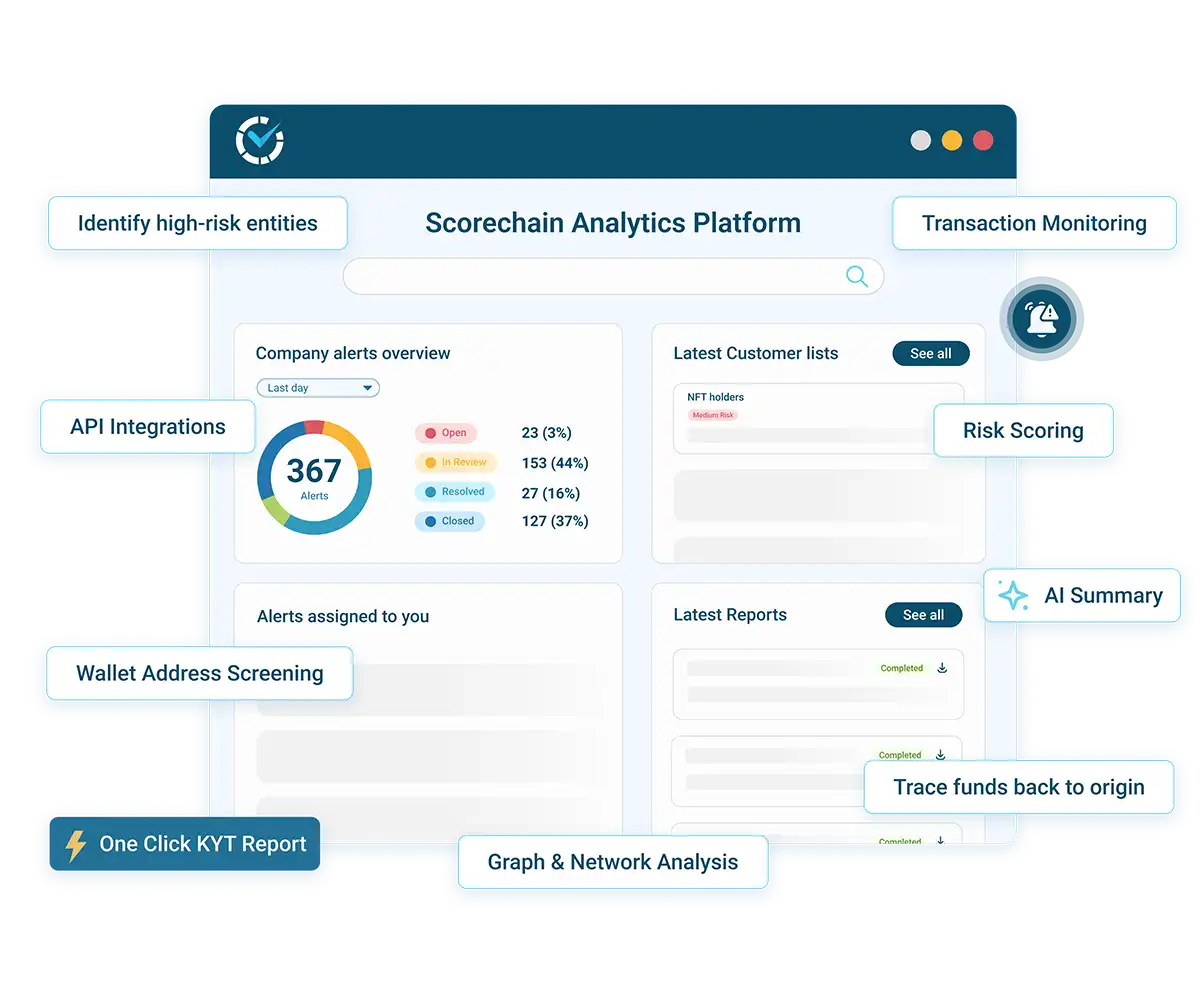
Scorechain's blockchain analytics platform gives compliance teams the visibility they need to manage security token risk effectively. From wallet screening and sanctions detection to real-time transaction monitoring and risk scoring across major blockchains, Scorechain helps regulated businesses meet their AML and KYC obligations without adding operational friction.
If you are working with security tokens and want to strengthen your compliance framework, explore what Scorechain has to offer at scorechain.com or book a demo to see the platform in action.
From wallet screening and KYT monitoring to deep-dive investigations, Scorechain gives you everything you need to stay compliant, secure, and audit-ready.