Canada’s Crypto Regulations for Banks
The new rules for banks to manage cryptocurrency in Canada come from three sources. OSFI sets the capital and liquidity treatment of crypto-asset exposures, FINTRAC sets AML reporting and Travel Rule duties, and the Stablecoin Act adds a federal regime for stablecoin issuers, supervised by the Bank of Canada. The Canadian Securities Administrators (CSA) also set interim terms for platforms that offer value-referenced crypto assets.
This page explains what each rule requires, who it applies to, which dates matter, and what a bank or crypto platform should have in place. It also answers the questions compliance teams ask most often, and it states where a rule is proposed or not yet in force.
Overview of Canada Crypto Rules for Banks
- Capital: OSFI’s crypto-asset guideline sets capital and liquidity treatment for banks. The revised version applies from 1 November 2026 or 1 January 2027, depending on year-end.
- Approach: Banks use the simplified approach (all exposures deducted from CET1) or the comprehensive approach (Groups 1a, 1b, 2a and 2b).
- Limit: OSFI expects total gross Group 2 exposure to stay within 5% of Net Tier 1 capital.
- Stablecoins: The Stablecoin Act received Royal Assent on 26 March 2026 but is not yet in force. Banks are excluded from issuer registration.
- AML: FINTRAC requires large virtual currency transaction reports for CAD 10,000 or more within five working days, plus Travel Rule information on transfers.
Who Regulates Crypto for Banks in Canada
| Regulator |
Role |
Applies to |
| OSFI |
Sets capital and liquidity rules for crypto-asset exposures |
Banks, federal credit unions, bank holding companies, federally regulated trust and loan companies |
| FINTRAC |
Supervises AML and counter-terrorist financing duties, including large virtual currency transaction reports and the Travel Rule |
Reporting entities, including financial entities and money services businesses |
| Bank of Canada |
Registers and supervises stablecoin issuers once the Stablecoin Act is in force |
Stablecoin issuers (banks are excluded) |
| CSA |
CSA Staff Notice 21-333 (5 October 2023) sets interim terms for trading value-referenced crypto assets with clients, and says these assets may constitute securities and/or derivatives |
Crypto asset trading platforms operating in Canada, and issuers of fiat-backed crypto assets |
Canada’s Crypto Regulatory Rules for Banks
OSFI’s Capital and Liquidity Treatment of Crypto-asset Exposures (Banking) Guideline took effect on 1 November 2025 for institutions with an October year-end and on 1 January 2026 for those with a December year-end, and follows the Basel Committee standard. It applies to banks (including federal credit unions), bank holding companies, and federally regulated trust and loan companies.
- Exposures covered: The guideline covers direct crypto-asset exposures, tokenised traditional assets, and indirect exposures whose value or risk is significantly determined by crypto-asset values, such as derivatives, funds and ETFs. Central bank digital currencies are excluded.
- What it does not decide: The guideline sets capital and liquidity treatment. It does not decide whether an institution may issue a crypto-asset or hold a controlling stake in an entity that does.
- Other risks: All institutions must consider credit valuation adjustment, counterparty credit, operational, leverage and large exposure risks, whichever approach they use.
- Documentation: Banks document the information used to classify each exposure and give it to OSFI on request. OSFI can override a bank’s classification.
How OSFI Classifies Crypto-Asset Exposures and Their Liquidity Treatment
Under the comprehensive approach, each exposure falls into one of four groups, and each group has its own treatment.
| Group |
What it covers |
Liquidity treatment |
| 1a, tokenised traditional assets |
Dematerialised securities issued through distributed ledger technology that meet OSFI’s conditions, including the same credit and market risk as the non-tokenised asset |
HQLA only if both the underlying asset and its tokenised form meet HQLA criteria. Otherwise treated like the non-tokenised equivalent |
| 1b, value-referenced crypto-assets |
Crypto-assets with an effective stabilisation mechanism, including stablecoins, that pass OSFI’s conditions and redemption risk test. Banks run due diligence at acquisition and quarterly after, and give stabilisation test results to OSFI on request |
Not HQLA. For stablecoins, issuers recognise 100% LCR outflows if redeemable within 30 days, and holders apply an NSFR required stable funding factor of at least 85% |
| 2a, hedging-eligible crypto-assets |
Assets that fail the Group 1 conditions but meet OSFI’s hedging recognition criteria |
Not HQLA. Other Group 2 crypto-assets carry a 100% required stable funding factor, with no inflows recognised |
| 2b, all other crypto-assets |
Assets that fail both sets of criteria. Group 2 is the default, so an asset is classed as 2b unless the bank shows OSFI it meets the hedging criteria |
Not HQLA. Same factors as 2a. Certain Group 2 stablecoins follow the stablecoin factors above |
Simplified or Comprehensive Approach
|
Simplified approach |
Comprehensive approach |
| Who it suits |
Banks with limited crypto-asset exposures, or banks that prefer not to classify |
Banks that do not take the simplified approach |
| Classification |
None. All exposures are treated as Group 2b |
Exposures sorted into Groups 1a, 1b, 2a and 2b |
| Capital |
All crypto-asset exposures deducted from CET1 capital |
Treatment depends on the group |
| Liquidity |
Non-HQLA |
Depends on the group (see the table above) |
| OSFI notice |
Notify OSFI when switching approaches |
Notify OSFI when opting for it or switching |
| Other risks |
Credit valuation adjustment, counterparty credit, operational, leverage and large exposure risks apply under both approaches |
Same |
The 5% Group 2 Exposure Limit
- The limit: Total gross Group 2 exposure should not exceed 5% of Net Tier 1 capital. Derivatives from client clearing, where the bank intermediates between a client and a qualifying central counterparty, are excluded.
- How exposure is measured: For each crypto-asset, the bank takes the higher of the absolute long or short exposure. Derivatives use a delta-equivalent method.
- If the limit is breached: The bank reports the breach to OSFI immediately and corrects it quickly. While gross exposure is above 5%, all Group 2 exposures are subject to Group 2b capital requirements.
- Early warning: A bank notifies OSFI if its net short Group 2 positions approach 1% of Net Tier 1 capital.
Key Dates for Banks and Crypto Platforms in Canada
| Date |
Event |
| 1 June 2021 |
FINTRAC’s large virtual currency transaction reporting and Travel Rule requirements for virtual currency transfers took effect |
| 1 November 2025 and 1 January 2026 |
OSFI’s crypto-asset exposure guideline took effect for institutions with an October or December year-end. A revision published on 29 October 2025 set the 5% gross Group 2 limit from the same dates |
| Fiscal Q1 2026 reporting period |
OSFI’s Pillar 3 crypto-asset disclosure requirements apply to domestic systemically important banks (D-SIBs) and small and medium-sized deposit-taking institutions (SMSBs) |
| 26 March 2026 |
The Stablecoin Act received Royal Assent. It takes effect on a date set by the Governor in Council |
| 10 September 2026 |
OSFI published the revised guideline |
| 24 October 2026 |
The proposed Stablecoin Regulations were published for comment |
| 1 November 2026 |
The revised OSFI guideline took effect for institutions with an October 31 year-end |
| 23 December 2026 |
Comments on the proposed Stablecoin Regulations are due |
| 1 January 2027 |
The revised OSFI guideline takes effect for institutions with a December 31 year-end. Until then, the 2026 version applies to them |
| Fall 2027 |
The Canada Gazette notice states the intention for the proposed Stablecoin Regulations to come into force in fall 2027. It is an intention, not a confirmed commencement date |
Canada’s Stablecoin Act Explained
The Stablecoin Act creates a federal regime for fiat-backed stablecoins, supervised by the Bank of Canada. It is not yet in force, and several details below come from the proposed regulations, which can still change after consultation.
| Area |
What the rules say |
| Who must register |
Issuers in scope register with the Bank of Canada before issuing. |
| Reserves |
In the reference currency, with a market value at least equal to the par value of outstanding stablecoins, measured at each day’s end. Eligible assets: demand deposits, government debt maturing within three months, qualifying money market funds and certain overnight reverse repos |
| Custody |
Segregated and bankruptcy-remote, held with Canadian qualified custodians, which excludes institutions not incorporated in Canada. This matters most for foreign issuers that hold reserves abroad |
| Redemption |
At par on request with no minimum amount, within three business days of the request. Fees are capped at 1% of the redeemed amount, with at least seven days’ website notice before an increase |
| Yield ban |
No interest or yield for holding stablecoins, directly or indirectly. Rewards tied to using a stablecoin in transactions are permitted |
| Banks |
Banks, trust and loan companies, insurers and credit unions are excluded from the issuer registration regime. They remain subject to OSFI’s guideline for any stablecoin exposure |
| Penalties |
Proposed administrative monetary penalties reach up to CAD 1 million for serious violations and CAD 10 million for very serious violations |
The monitoring implications are covered under stablecoin compliance.
FINTRAC Rules for Crypto: Reporting and the Travel Rule
OSFI’s guideline and the Stablecoin Act do not replace AML duties. Banks and crypto platforms that are reporting entities still follow FINTRAC’s requirements, which have applied since 1 June 2021.
| Obligation |
Trigger |
Detail |
| Large virtual currency transaction report |
Receipt of virtual currency worth CAD 10,000 or more in a single transaction |
Submit within five working days after the day of receipt. Receipt counts once the transaction can no longer be reversed or cancelled. Keep a copy for at least five years |
| 24-hour rule |
Two or more amounts totalling CAD 10,000 or more within a consecutive 24-hour window, where you know they share the same conductor, third party or beneficiary |
Same report and deadline |
| Exchange rate |
Converting virtual currency to Canadian dollars |
Use the rate set in your normal course of business, documented in your policies, because the Bank of Canada does not publish virtual currency rates |
| Travel Rule |
Virtual currency transfers by financial entities, money services businesses and foreign money services businesses |
Prescribed information must accompany virtual currency transfers under the Travel Rule. FINTRAC’s Travel Rule guidance sets the details |
| Transfer policies |
Your compliance program |
Written, risk-based policies to decide whether to suspend or reject an electronic funds transfer or virtual currency transfer |
| Registration |
Money services businesses operating in Canada, including those dealing in virtual currency through exchange or value transfer services, and foreign money services businesses that direct and provide services to clients in Canada |
Register with FINTRAC before they begin to operate. Registration does not mean FINTRAC endorses or licenses the business |
| Responsibility |
Using a service provider to file |
The provider can submit or correct a report, but you remain responsible and cannot delegate that |
Crypto Compliance Checklist for Canadian Banks
- Decide whether the simplified or comprehensive approach fits your crypto-asset activity, and notify OSFI of the choice or any switch.
- Classify each exposure into Group 1a, 1b, 2a or 2b, and document the evidence OSFI may ask for.
- Run quarterly due diligence and stabilisation checks on Group 1b assets.
- Monitor gross Group 2 exposure against the 5% limit and set an internal escalation trigger well below it.
- Check the effective date that applies to your year-end, 1 November 2026 or 1 January 2027.
- Screen counterparties and wallets, and monitor flows for AML risk using a documented risk-based approach.
- Check that large virtual currency transaction reporting and Travel Rule procedures work on crypto client flows.
- Track the Stablecoin Regulations through the consultation that closes on 23 December 2026.
Crypto platforms and stablecoin issuers prepare differently, with Bank of Canada registration, reserve and custody arrangements, and redemption processes to arrange once the Stablecoin Act is in force. Banks serving these clients should ask how each client plans to meet these rules.
Why Compliance Matters for Canadian Banks
- Meet supervisory expectations: OSFI expects prudent classification, documented evidence and early notice of changes, including when a bank moves to the comprehensive approach.
- Avoid penalties: Once in force, the Stablecoin Act lets the Bank of Canada issue notices of violation with administrative monetary penalties.
- Reduce exposure risk: A breach of the 5% Group 2 limit must be reported to OSFI immediately and moves all Group 2 exposures into the harshest treatment.
- Keep reporting accurate: FINTRAC treats the reporting duty as yours even when a service provider files for you, so the data behind each report needs to be right.
How Scorechain Supports Canadian Banks and Crypto Platforms
Founded in 2015, Scorechain is used by 200+ organisations and is ISO/IEC 27001:2022 certified. It supports AML and risk controls with data and workflow. It does not calculate regulatory capital, classify exposures under the OSFI guideline, file FINTRAC reports for you or verify customer identities.
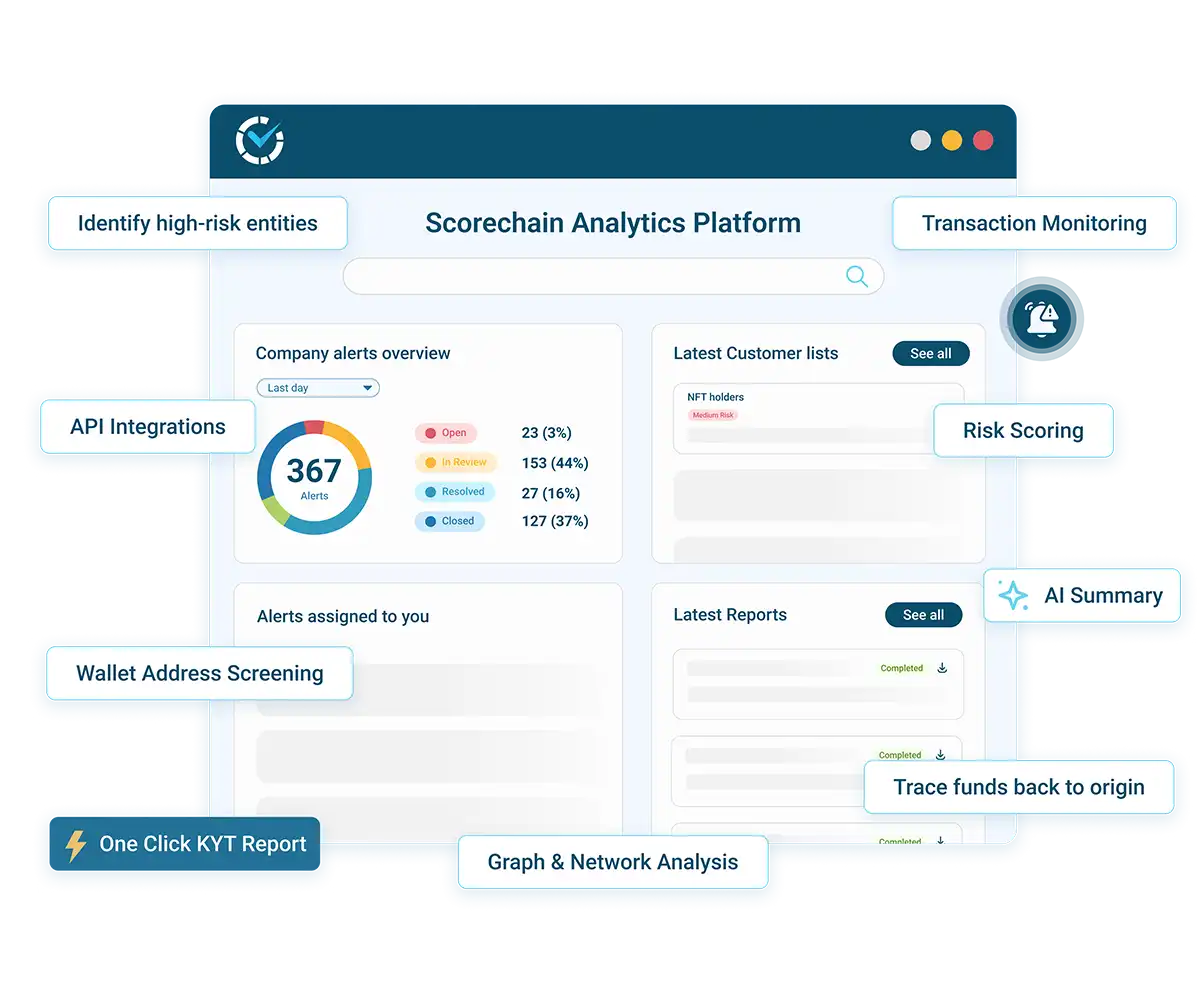
- Transaction monitoring: Build scenarios from amount, direction and triggered risk indicators, with real-time alerts and an audit trail, through transaction monitoring.
- Screening and counterparties: Each address gets a risk score from 1 to 100 for incoming and outgoing funds across 25+ blockchains with wallet and transaction screening. VASP risk assessments cover a counterparty’s regulatory status, countries of operation and fund flows.
- Case records and reporting evidence: Investigate in Case Manager with an owner, comments and files, and export case reports for internal records or authorities.
- Stablecoin flows: Stablecoin Transaction Monitoring covers stablecoin flows, which matters for crypto platforms and for banks serving them.
How to Prepare Before Speaking to a Compliance Provider
Blockchain analytics works best when your own rules and records are in order. Before you speak to a provider, prepare four things.
- Your approach and exposures: The OSFI approach you have chosen, and the crypto-asset exposures you hold or expect to hold.
- Your crypto flows: The exchange, stablecoin and counterparty flows you want monitored.
- Your alert rules: The amounts, directions and risk levels that should trigger a review, including flows near the CAD 10,000 reporting threshold.
- Your case process: Who investigates an alert, which records you keep, and how you retain copies of reports for the five years FINTRAC requires.
Scorechain works with financial institutions that need blockchain analytics behind their AML controls, including banks that serve crypto clients. To see alerts and case records applied to a Canadian exchange or stablecoin flow, book a demo and bring one real scenario.
Canada Crypto Compliance FAQ
Can Canadian banks hold crypto-assets?
OSFI’s guideline sets the capital and liquidity treatment for banks’ crypto-asset exposures. It does not decide whether an institution may issue a crypto-asset or hold a controlling stake in an entity that does. A bank with exposure applies the simplified or comprehensive approach.
Who does the OSFI guideline apply to?
It applies to banks (including federal credit unions), bank holding companies, and federally regulated trust and loan companies.
Which version of the guideline applies now?
The revised guideline took effect on 1 November 2026 for institutions with an October 31 year-end. It takes effect on 1 January 2027 for institutions with a December 31 year-end, and until then the 2026 version applies to them.
Are stablecoins treated differently from other crypto-assets?
Yes. Stablecoins that pass OSFI’s conditions fall in Group 1b. Group 1b and Group 2 assets are not HQLA, and stablecoins have specific liquidity factors. Under the Stablecoin Act, issuers also need Bank of Canada registration once the Act is in force.
What happens if a bank exceeds the 5% Group 2 limit?
The bank reports the breach to OSFI immediately and corrects it quickly. While the limit is exceeded, all Group 2 exposures face Group 2b capital requirements.
Does the Stablecoin Act apply to banks?
Banks are excluded from the issuer registration regime. OSFI’s guideline still governs a bank’s own crypto-asset and stablecoin exposures.
Is the Stablecoin Act in force?
Not yet. It received Royal Assent on 26 March 2026 and takes effect on a date set by the Governor in Council. The proposed regulations are open for comment until 23 December 2026, and the Canada Gazette notice states the intention to bring them into force in fall 2027.
When must we report a virtual currency transaction to FINTRAC?
Submit a large virtual currency transaction report within five working days of receiving virtual currency worth CAD 10,000 or more, including amounts that total that figure within 24 hours under the 24-hour rule.
Does the Travel Rule apply to crypto transfers in Canada?
Yes, for financial entities, money services businesses and foreign money services businesses sending or receiving virtual currency transfers. FINTRAC’s Travel Rule guidance sets the information required.