Governance Tokens
Governance tokens are cryptocurrencies that give holders voting power to influence decisions in decentralized protocols and dApps, enabling community-driven governance.
Governance tokens are cryptocurrencies that give holders voting power to influence decisions in decentralized protocols and dApps, enabling community-driven governance.













Decentralized protocols need a way to make decisions without a central authority calling the shots. Governance tokens are the mechanism that makes this possible. A governance token is a type of cryptocurrency that gives holders the right to participate in the decision-making process of a blockchain protocol or decentralized application (dApp). Holding these tokens means holding a vote. The more tokens you hold, the more influence you carry over proposals that shape the future of the platform.
Think of it as owning shares in a company except instead of voting at an annual general meeting, you're voting on-chain, in real time, with full transparency.
Most governance systems follow a similar pattern. Token holders can submit proposals anything from adjusting protocol fees to launching new product features or allocating treasury funds. Other holders then vote on these proposals within a set timeframe. If a proposal reaches the required quorum and approval threshold, it is automatically executed via a smart contract.
This entire process happens on-chain, meaning every vote and proposal is recorded permanently on the blockchain. There's no board of directors, no closed-door meetings, and no single entity with overriding control. The community governs itself through code.
Popular governance token examples include:
Governance tokens are central to the concept of decentralized autonomous organizations (DAOs). DAOs are community-run entities where rules are encoded in smart contracts and decisions are made collectively by token holders rather than executives or investors.
Beyond voting rights, governance tokens often carry additional utility. Some protocols distribute a share of platform revenue to governance token holders. Others use token holdings to determine eligibility for early access to new features or boosted rewards within the ecosystem.
This combination of voting power and economic incentive has made governance tokens a significant part of the broader DeFi (Decentralized Finance) landscape.
Governance tokens sit in a regulatory grey area that compliance professionals need to pay close attention to.
In several jurisdictions, regulators have begun questioning whether governance tokens qualify as securities under existing financial law. If a token grants economic rights alongside voting power, regulators may argue it resembles an investment contract triggering registration and disclosure requirements.
Beyond classification risk, governance tokens are actively traded on both centralized and decentralized exchanges, making them subject to the same AML (Anti-Money Laundering) and KYC (Know Your Customer) obligations that apply to any crypto asset. Wallets holding large governance token positions can be linked to high-risk entities, sanctioned addresses, or illicit fund flows and those connections aren't always obvious without proper on-chain analysis.
DAOs themselves present a further challenge. Without a clear legal entity or identifiable ownership structure, attributing responsibility for compliance obligations can be genuinely complex under frameworks like FATF guidelines and MiCA.
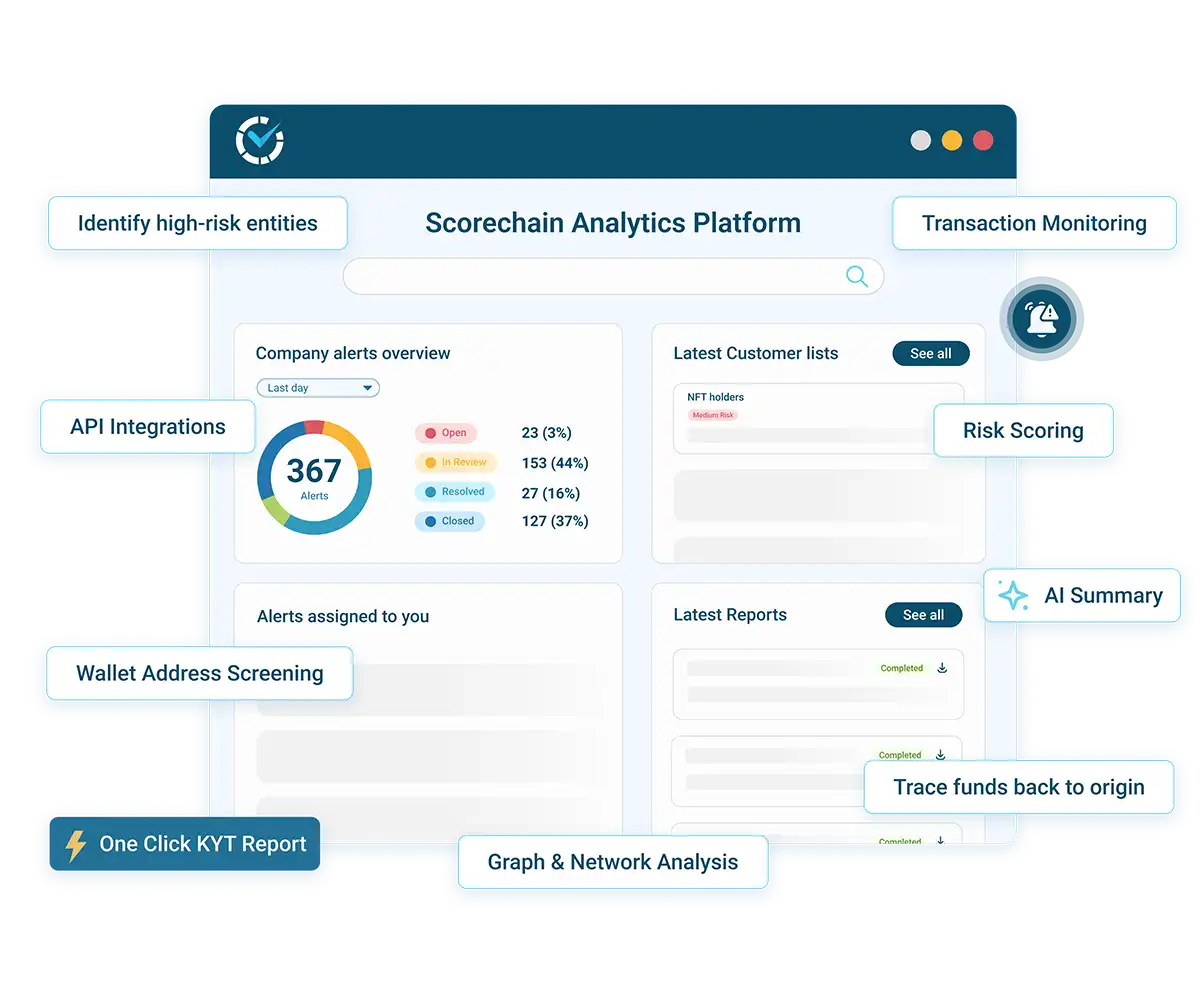
As governance tokens become more prominent across DeFi protocols and DAO ecosystems, the need for reliable on-chain visibility grows with them. Scorechain's blockchain analytics platform helps compliance teams screen wallets interacting with governance token contracts, trace fund flows across DeFi protocols, and detect risk exposure in real time.
Whether you're a regulated exchange listing governance tokens or an institution assessing DeFi exposure, Scorechain provides the tools to stay ahead of compliance obligations without slowing down your operations.
Learn more at scorechain.com.
From wallet screening and KYT monitoring to deep-dive investigations, Scorechain gives you everything you need to stay compliant, secure, and audit-ready.