Crypto Arbitrage
Crypto arbitrage profits from crypto price differences across exchanges. While lucrative, it requires fast execution and faces risks like fees and complex compliance/AML tracking.
Crypto arbitrage profits from crypto price differences across exchanges. While lucrative, it requires fast execution and faces risks like fees and complex compliance/AML tracking.
















Markets are rarely perfectly efficient. Price differences for the same asset across different platforms create opportunities for traders to buy low in one place and sell high in another. In cryptocurrency, this practice is called crypto arbitrage.
Crypto arbitrage is the strategy of simultaneously buying and selling the same cryptocurrency across different exchanges or markets to profit from temporary price discrepancies. Because crypto markets operate 24 hours a day across hundreds of exchanges globally, price differences occur regularly and can be exploited by traders with the right tools and speed.
While arbitrage is a legitimate and widely practised trading strategy, it also raises important compliance considerations that exchanges and financial institutions need to be aware of.
The core mechanics are straightforward. A trader identifies a price difference for the same asset across two or more exchanges, executes a buy order on the exchange where the price is lower, and simultaneously sells on the exchange where the price is higher, pocketing the difference as profit after fees.
For example, if Bitcoin is trading at $60,000 on Exchange A and $60,300 on Exchange B, an arbitrageur buys on Exchange A and sells on Exchange B, capturing a $300 difference per Bitcoin before transaction and withdrawal fees.
In practice, these windows close within seconds as other traders and automated bots react to the same opportunity.
Several distinct arbitrage strategies exist in the crypto market:
Despite its appeal, crypto arbitrage is not risk-free:
From a compliance perspective, crypto arbitrage creates specific challenges for exchanges and regulated businesses that need to monitor for suspicious activity.
High-frequency movement of funds across multiple exchanges is a characteristic of both legitimate arbitrage and certain money laundering techniques. Compliance teams need to distinguish between the two through careful transaction pattern analysis.
Key compliance considerations include:
Under FATF guidelines and MiCA, exchanges are expected to monitor for suspicious transaction patterns regardless of whether the underlying activity is legitimate arbitrage or illicit fund movement.
For exchanges and compliance teams dealing with high-frequency trading activity, distinguishing legitimate arbitrage from suspicious fund movements requires accurate, real-time on-chain intelligence.
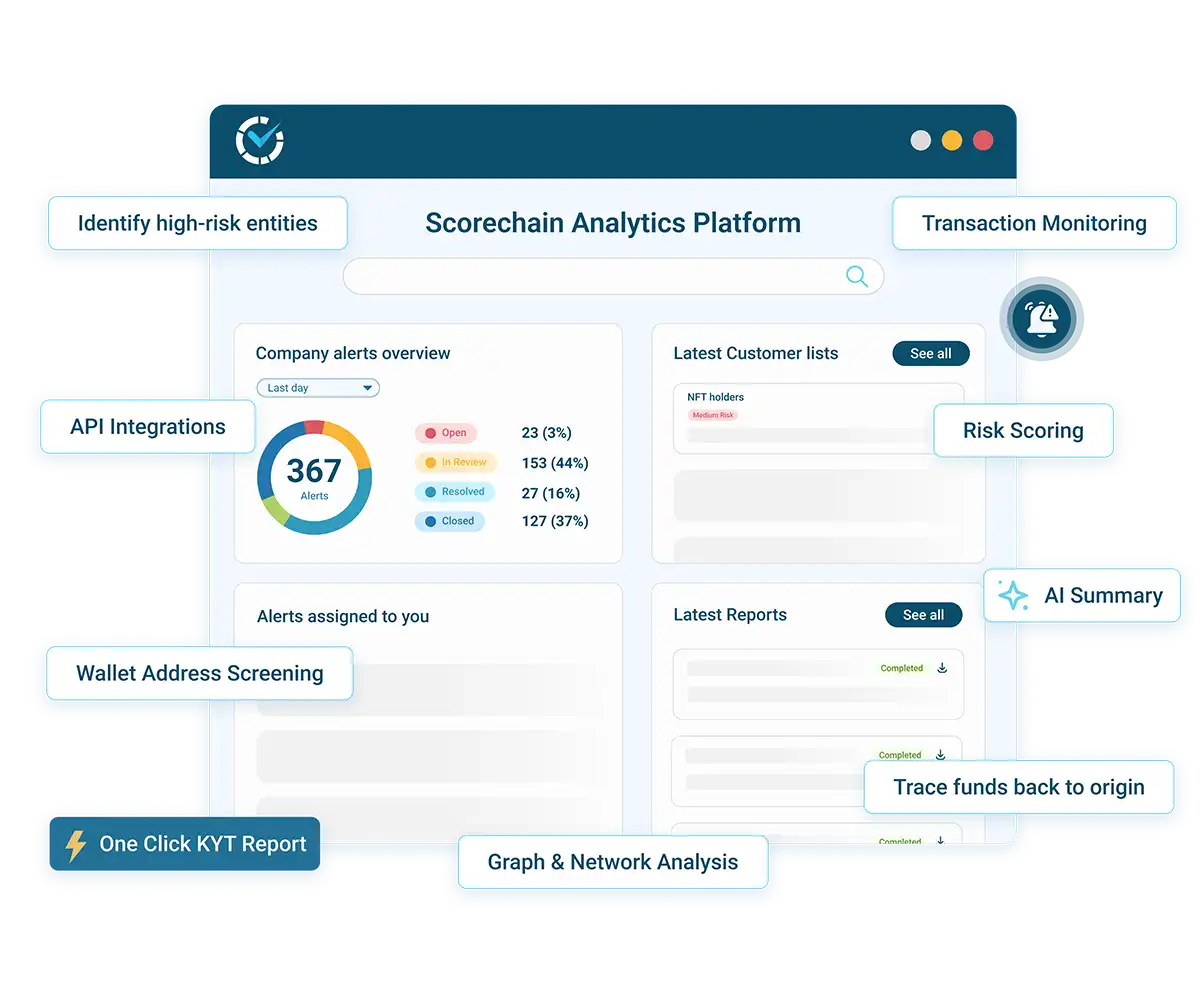
Scorechain's Transaction Monitoring solution enables compliance teams to apply customizable detection rules that account for legitimate high-frequency trading patterns while flagging genuine AML red flags. Wallet and Transaction Screening checks every counterparty address involved in arbitrage-related transfers against live sanctions databases and risk intelligence in real time.
For cases requiring deeper fund flow analysis, Flux Analysis maps the complete movement of funds across exchanges and wallets, giving investigators and compliance teams a clear visual picture of how assets moved and through which entities.
For crypto businesses and financial institutions managing compliance across high-volume trading environments, Scorechain provides the intelligence and speed needed to maintain regulatory standards without disrupting legitimate trading activity.
Scorechain offers two free ways to screen any wallet address involved in crypto trading activity with no credit card required.
Paste any address into the Scorechain AML Bot on Telegram for an instant risk score. For a deeper assessment, Scorechain AI generates a comprehensive wallet intelligence report covering entity classification, exposure breakdown, behavioral risk signals, and compliance-ready outputs built for regulatory decision-making.
Visit scorechain.com to explore the full compliance platform or book a demo to see how Scorechain supports compliance across high-frequency crypto trading environments.
From wallet screening and KYT monitoring to deep-dive investigations, Scorechain gives you everything you need to stay compliant, secure, and audit-ready.