CASP License Netherlands
Crypto license in the Netherlands means a CASP licence from the AFM under MiCA. See who must apply, capital, fees, review times and how to check the register.
Crypto license in the Netherlands means a CASP licence from the AFM under MiCA. See who must apply, capital, fees, review times and how to check the register.







In the Netherlands, the Netherlands Authority for the Financial Markets (AFM) authorises crypto-asset service providers (CASPs) under MiCA. A registration with De Nederlandsche Bank (DNB) is not a MiCA licence, and the Dutch transition for DNB-registered firms ended on 30 June 2025.
Dutch crypto firms used to register with DNB. Under MiCA, a firm that provides crypto-asset services to Dutch clients needs an AFM licence, a licence from another EU regulator, or a MiCA notification where one applies.
A CASP licence is the AFM’s authorisation to provide crypto-asset services in the Netherlands under MiCA. It is the Dutch crypto licence that replaced the DNB registration. A licensed firm can provide services across the EU through passporting.
A crypto exchange needs a CASP licence. Exchanging crypto-assets for funds or for other crypto-assets sits in capital Class 2 (EUR 125,000), and operating a trading platform sits in Class 3 (EUR 150,000). Custody and exchange firms also have to protect client assets, handle complaints and meet the ICT and continuity rules that apply to every CASP.
There is no fixed price. The AFM publishes these fees:
Actual hours depend on the quality of the application, the complexity and risk of the services, and whether the firm needs significant organisational changes. A clear, complete file keeps the hours down. Capital comes on top, as set out above.
Work out which MiCA rules apply to your services, and contact the AFM at crypto@afm.nl if you need guidance. The AFM also offers an optional pre-scan for firms that are certain to apply to the AFM. It is a one-hour online meeting, and you send a slide deck at least one working day before. The deck covers topics such as fit and proper persons, ICT and DORA, client asset protection, and your AML/CFT plan and any blockchain monitoring tools. The pre-scan is not a substitute for the AFM’s formal review, and its feedback is general.
Complete the AFM’s licence application form and the checklist, add the other AFM forms the application needs, and send a full application with a clear overview of the enclosed documents. You submit by email through Cryptshare, following the AFM’s naming conventions.
The AFM acknowledges receipt within 5 working days. It checks completeness for up to 25 working days and may ask for missing information, which you then supply within 5 to 20 working days. After the AFM confirms the application is complete, it has 40 working days to assess it (MiCA Article 63), and it may ask for further information within a maximum of 20 working days. The AFM sends its decision within 5 working days. The statutory maximum adds up to about 105 working days, roughly 5 months, and the AFM says it often takes longer. Expect about one to three supervisory meetings.
Credit institutions and certain other financial institutions can provide crypto-asset services by notifying their regulator at least 40 working days before they start (MiCA Article 60). The AFM handles these notifications in the Netherlands, and a CASP notification is open only to firms already authorised for certain financial services.
The AFM’s register also has a separate, expired section for firms that registered with DNB. Their transition ended on 30 June 2025, so an entry there does not allow a firm to operate.
The AFM can take enforcement action against a firm that provides crypto-asset services without a licence or a required notification, and it publishes public warnings, for example against MEXC Global on 24 September 2025. A DNB registration no longer allows a firm to operate.
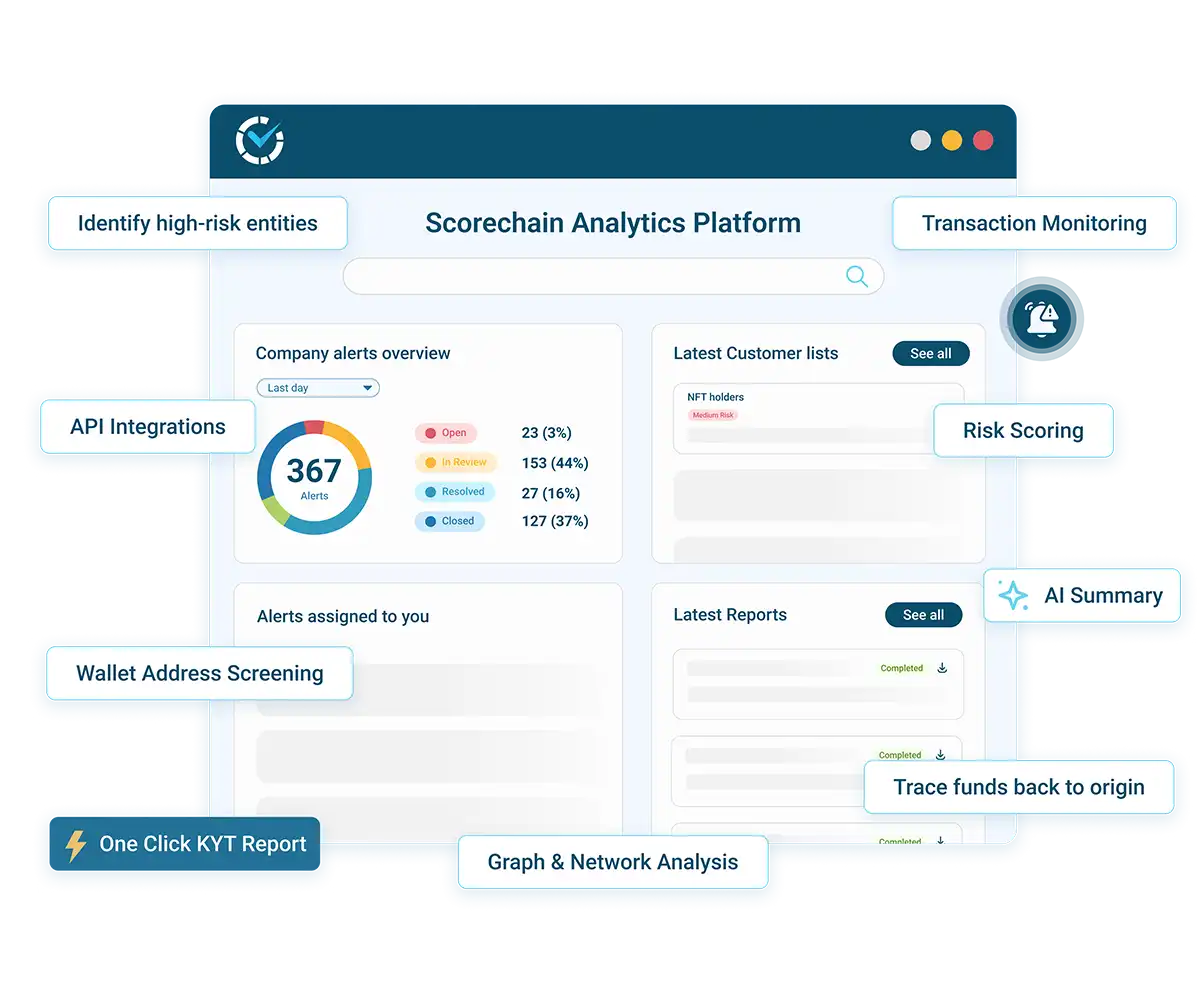
The AFM looks at AML controls twice. The licence pre-scan asks which blockchain monitoring tools you use. After you are licensed, the Wwft and Sanctions Act questionnaire asks what measures you have in place. Scorechain covers the on-chain part of those answers.
Transaction Monitoring raises alerts by transaction direction, amount and risk indicator, and keeps an audit trail for each one. Wallet screening gives an address a score from 1 to 100, where a lower score means higher risk. For transfers under the Transfer of Funds Regulation, the Travel Rule API passes originator and beneficiary data through partner infrastructure, and the VASP Directory shows a counterparty VASP’s jurisdiction and KYC policies. Exposure to sanction lists appears as a flag and not a block, so your own controls decide what happens next.
Scorechain does not verify customer identities, file reports or replace the AFM’s assessment. If you need to show where funds came from, the Source of Funds advisory service covers the origin of crypto assets and transactions.
To see how transaction monitoring and wallet screening could fit your Dutch CASP application, book a demo with the Scorechain team.
The Netherlands Authority for the Financial Markets (AFM) processes CASP licence applications under MiCA and supervises licensed CASPs for AML and sanctions compliance. De Nederlandsche Bank (DNB) handles prudential supervision and assesses proposed qualifying holdings.
The AFM charges EUR 200 per hour for processing an application, capped at EUR 100,000, plus EUR 700 per person for the properness assessment and EUR 2,900 per person for the suitability assessment. Minimum capital is EUR 50,000, EUR 125,000 or EUR 150,000 by class, or a quarter of the previous year’s fixed overheads if higher.
The AFM says the statutory maximum is about 105 working days, roughly 5 months, and that it often takes longer. The best case is at least 5 months overall.
Yes. Exchanging crypto-assets for funds or for other crypto-assets needs a CASP licence, and operating a trading platform does too. The AFM can take enforcement action against firms that provide these services without a licence or a required notification.
From wallet screening and KYT monitoring to deep-dive investigations, Scorechain gives you everything you need to stay compliant, secure, and audit-ready.