What a CASP License in Malta Requires After the MiCA Transition
Malta, known as the “Blockchain Island”, licensed crypto businesses under its own VFA framework before MiCA. Under the Markets in Crypto-Assets Regulation (MiCA), crypto businesses in Malta had to move from their Malta Financial Services Authority (MFSA) VFA licence to a CASP (crypto-asset service provider) licence to keep operating in the EU. That transition period ended on 30 June 2026. A firm without a CASP licence can no longer provide crypto-asset services in the EU.
CASP License Timeline in Malta (H2)
- 30 December 2024: MiCA’s rules for crypto-asset service providers apply.
- 30 June 2026: the transitional period for Malta VFA licence holders ended, according to the MFSA letter of 25 June 2026. Malta used the full 18 months MiCA allows.
- 1 July 2026: the MiCA transitional period expired across the EU, according to ESMA.
What Is a CASP License in Malta?
A CASP licence is the MFSA’s authorisation to provide crypto-asset services in Malta under MiCA. It replaces the MFSA VFA licence, and an authorised firm can passport its services across the EEA.
CASP-Regulated Crypto Services Include (H3)
- Custody and administration of crypto-assets
- Operating a crypto trading platform
- Exchange of crypto-assets for funds or for other crypto-assets
- Execution of orders on behalf of clients
- Transfer services for crypto-assets
- Advice on crypto-assets and portfolio management
MiCA & CASP License Compliance Requirements in Malta
To obtain a CASP licence in Malta, a business must meet these requirements:
- Authorisation: an MFSA authorisation before providing services.
- Local presence: a registered office in a member state where services are provided, effective management in the EU and at least one director resident in the EU (MiCA Article 59). The MFSA assesses whether board members meet its fit-and-proper requirements.
- Capital: EUR 50,000 (Class 1), EUR 125,000 (Class 2) or EUR 150,000 (Class 3), or one quarter of the previous year’s fixed overheads if higher, depending on the services offered.
- AML and KYC: policies that meet customer due diligence requirements. The FIAU’s revised Implementing Procedures for CASPs apply from 30 December 2024.
- Travel Rule and monitoring: the Travel Rule under the Transfer of Funds Regulation (EU) 2023/1113 applies from 30 December 2024, with no minimum threshold for CASP-to-CASP transfers, alongside ongoing transaction monitoring.
- Reporting: suspicious money laundering and terrorist financing transactions must be reported to the FIAU, according to the MFSA and FIAU letter of 25 June 2026.
Once an application is complete, MiCA gives the MFSA 40 working days to decide, after a 25 working day completeness check (Article 63).
Benefits of a CASP License in Malta
- Regulatory Stability: Malta has regulated virtual financial assets since its Virtual Financial Assets Act came into force on 1 November 2018.
- EU Passporting Benefits: a CASP licence in Malta lets an authorised firm provide services across the EEA after notifying the MFSA (MiCA Article 65).
- Regulatory Experience: the MFSA has supervised VFA service providers since 2018 and authorises CASPs under MiCA.
How Scorechain Helps with a CASP License in Malta
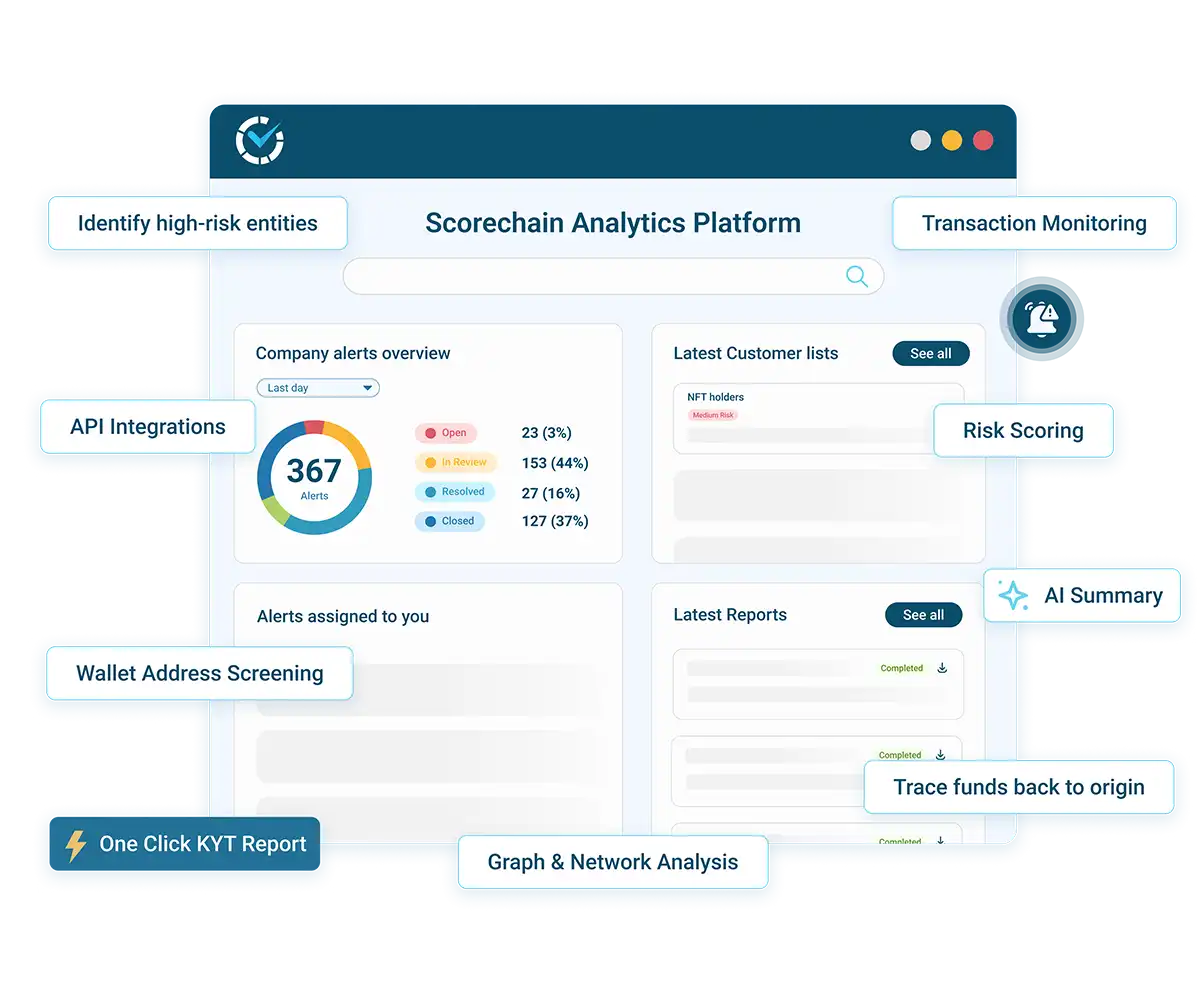
Scorechain’s blockchain analytics supports a CASP’s AML work through transaction monitoring, wallet risk scoring and exported case reports. Scorechain does not make a firm MiCA compliant on its own, and the MFSA decides authorisation applications.
Automated Crypto Transaction Tracking
- Risk scores from 1 to 100 for transactions and addresses, where a lower score means higher risk, with separate scores for incoming and outgoing funds
- Wallet screening for exposure to sanctioned, illicit or high-risk entities
- Alerts for suspicious activity, set by amount, direction and risk indicator
FATF Travel Rule Compliance
- Send and receive originator and beneficiary data through one Travel Rule API endpoint
- Exchange data securely between VASPs through partner infrastructure. Scorechain does not run its own Travel Rule protocol.
- Assess counterparty VASPs in the VASP Directory, which shows jurisdiction, compliance and security risk, and KYC policies, and set alerts for risky counterparties
Blockchain Risk Analytics & KYT
- Monitor on-chain activity and produce KYT and KYA reports
- Flag high-risk transactions linked to darknet markets, fraud and sanctions
- Export case reports for internal records or for authorities
Sanctions & Blacklist Monitoring
- Flag transactions from sanctioned wallets and high-risk addresses, so your team can decide whether to block them
- Flag direct and indirect (multi-hop) exposure to illicit entities
- Keep an audit trail of screening decisions
Scorechain for Your CASP License in Malta
Scorechain is used by 200+ organisations, including crypto businesses and financial institutions, and its screening and monitoring tools support the AML controls an MFSA application covers. To see how these checks would work on your own flows, book a demo with the Scorechain team.