CASP License Lithuania
Lithuania’s transition ended on 31 December 2025, so providers now need a Bank of Lithuania CASP license or an EU passport. Scorechain supports CASP AML compliance.
Lithuania’s transition ended on 31 December 2025, so providers now need a Bank of Lithuania CASP license or an EU passport. Scorechain supports CASP AML compliance.







The Markets in Crypto-Assets (MiCA) regulation applies in full across the EU, and the Bank of Lithuania is the competent authority for crypto-asset service providers in Lithuania. The national transition period ended on 31 December 2025, so any company providing crypto-asset services in or from Lithuania now needs a CASP (Crypto-Asset Service Provider) license, or another valid basis under MiCA, to operate legally. The EU-wide transition ended on 1 July 2026.
Lithuania has long been an active hub for crypto businesses, but the Bank of Lithuania has been selective: it granted its first CASP license in May 2025 and had issued four by February 2026. This page covers the current requirements, capital rules, timelines and the AML obligations that apply once you are licensed. Scorechain provides blockchain analytics, transaction monitoring and AML tools that help CASPs meet them.
A CASP license allows a business to offer regulated crypto-asset services under the EU MiCA framework. The former national VASP registration no longer applies. The Bank of Lithuania treats providing these services without a license as illegal financial activity, which can carry criminal liability. A Lithuanian CASP license can be passported to other EU member states by notification.
Banks, investment firms, e-money institutions and certain other regulated financial entities may offer specific crypto-asset services without a separate license by notifying the Bank of Lithuania under Article 60 of MiCA at least 40 working days before they start.
A CASP license can cover one, several or all ten MiCA services: custody and administration; operating a trading platform; exchange of crypto-assets for funds; exchange of crypto-assets for other crypto-assets; execution of orders; placing; reception and transmission of orders; advice; portfolio management; and transfer services.
To obtain a CASP license in Lithuania, businesses must meet specific regulatory requirements:
MiCA sets the minimum capital by the services you offer:
Your own funds must always be the higher of the class minimum and one quarter of the previous year’s fixed overheads.
The Bank of Lithuania has 25 working days to check that an application is complete and then 40 working days from a complete application to decide. It can request additional information during the assessment, which pauses the clock for up to 20 working days. Preparation and incomplete submissions usually extend the real-world timeline well beyond these statutory periods.
In 2025 the Bank of Lithuania received 102 applications from 55 companies. Applications tend to fail when they show:
Verifying how funds were sourced is a core part of the review, so source of funds verification is useful early in preparation.
By 29 September 2026, the Bank of Lithuania’s register showed four CASP licenses: Robinhood Europe (the first, in May 2025), CoinGate (UAB Decentralized) and Nuvei Liquidity (both December 2025), and Micar assets (26 February 2026). More than 370 companies were registered as VASPs before the deadline, although only about 120 were operating, so the Bank has been selective. Check the Bank of Lithuania’s licence list or ESMA’s interim MiCA register to confirm a provider’s status. The VASP Directory can support counterparty due diligence.
The Bank of Lithuania licenses and supervises CASPs. The FNTT supervised the sector until the model changed on 1 January 2026 and works with the Bank on joint inspections under a cooperation agreement. VASPs filed 13,023 suspicious transaction reports with the FNTT in 2025, up from 8,390 in 2024. Confirm the current split of AML/CFT supervision with your counsel before you file. MONEYVAL’s schedule has Lithuania’s next evaluation on site in October 2027, with plenary discussion in May 2028.
In practice, CASPs need risk-based transaction monitoring, wallet screening, sanctions screening and Travel Rule data exchange through a Travel Rule API.
The Bank of Lithuania treats certain crypto-asset services involving e-money tokens (EMTs) as payment services, including transfers and custody of EMTs for clients. CASPs that planned to offer them had to hold a payment institution licence by 1 March 2026, and could apply through a simplified process together with their CASP application.
This table links each expectation to the proof you can show and the Scorechain tool that produces it.
Scorechain’s tools support your compliance program and do not replace your own policies or compliance officer.
If you are preparing a CASP application in Lithuania, the Bank of Lithuania will expect to see how you monitor transactions, screen counterparties against sanctions lists, run the Travel Rule and document your source of funds checks. Scorechain brings these controls together in one platform, so you can show a consistent AML framework instead of stitching tools together. To see how it works on real transaction data and how each control maps to your application, book a demo with the Scorechain team.
No. The transition period ended on 31 December 2025, and a CASP license is now required.
The Bank of Lithuania, under MiCA and the Law on Markets in Crypto-Assets.
The statutory clock is 25 working days for completeness and 40 working days for assessment, but it can pause when information is requested.
Not necessarily. Certain regulated entities can notify the Bank of Lithuania under Article 60 of MiCA instead.
CASPs follow MiCA, EU AML rules and the Travel Rule under Regulation (EU) 2023/1113.
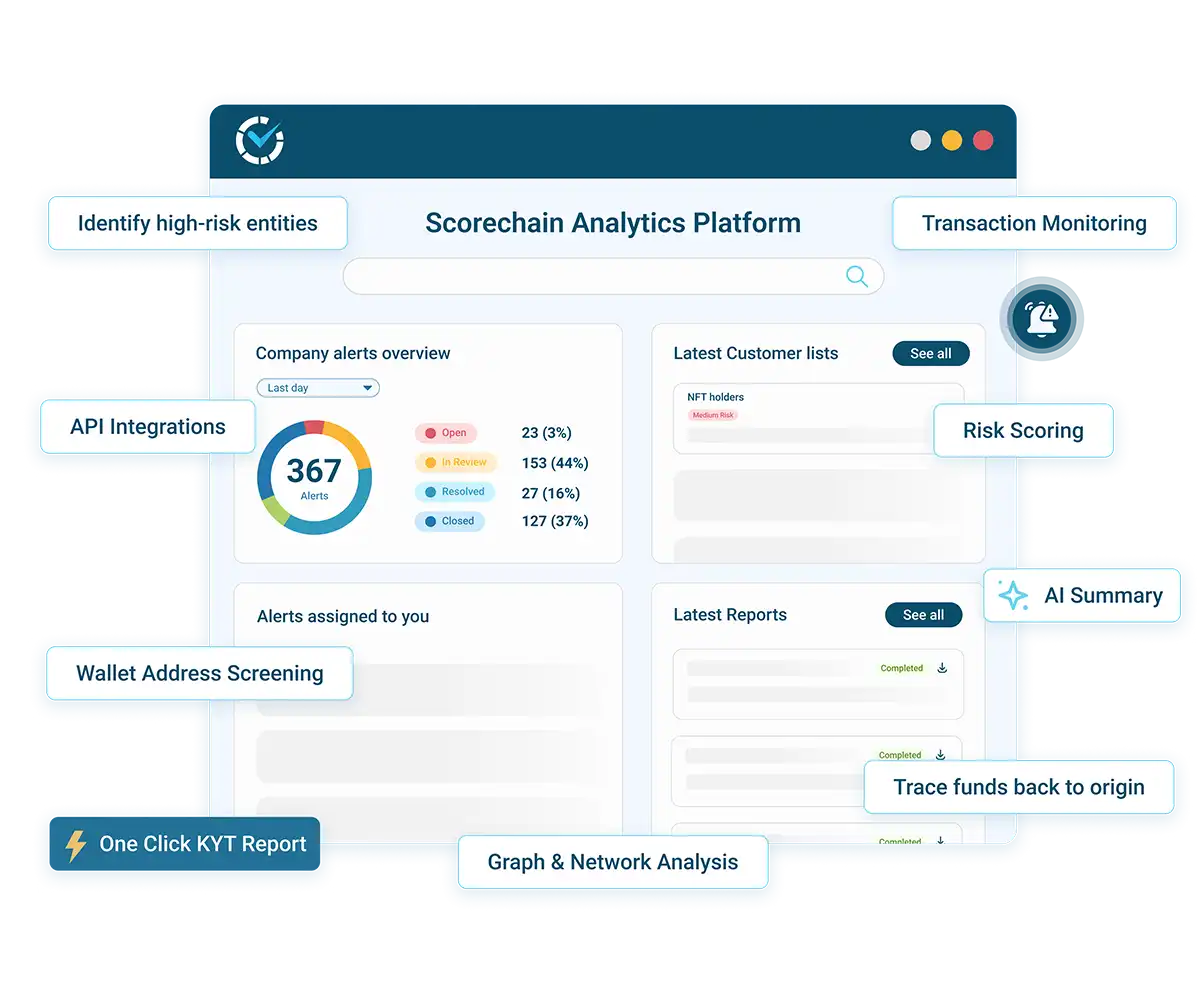
From wallet screening and KYT monitoring to deep-dive investigations, Scorechain gives you everything you need to stay compliant, secure, and audit-ready.