MiCA Compliance for Czech Crypto Businesses and What Changed on 1 July 2026
The Czech National Bank (ČNB) is the competent authority for MiCA in the Czech Republic. It has been able to decide on CASP authorisations since 15 February 2025, under Act No. 31/2025 Coll., and the MiCA transition period ended on 1 July 2026.
Firms without a CASP authorisation can no longer provide crypto-asset services. Providing them is a MiCA breach, and the ČNB can impose penalties with an upper limit above CZK 100 million. According to the ČNB, such a firm must end its activity in the Czech Republic, move client crypto-assets and funds to an authorised provider or to self-hosted wallets controlled by the client, and keep meeting AML duties until it closes.
By 1 July 2026 the ČNB had authorised 11 entities and assessed 251 applications, a figure that includes notifications from existing financial market entities. In its review three months after the deadline, the ČNB still listed 11 domestic CASPs and reported five new applications since 1 July.
Some regulated financial entities, such as banks and investment firms, can provide crypto-asset services after notifying their home supervisor under MiCA Article 60, at least 40 working days before they start, without a separate CASP authorisation.
CASP License Timeline in the Czech Republic
- 30 December 2024: MiCA rules for crypto-asset service providers apply across the EU
- 15 February 2025: the ČNB can decide on CASP authorisations under Act No. 31/2025 Coll., and the previous national trade regime ends
- 31 July 2025: deadline for Czech firms with a pre-MiCA trade licence to file a CASP application if they wanted to keep operating while the ČNB decided. New entrants could not rely on that route and had to meet MiCA from the start
- 11 February 2026: the ČNB issues its first six MiCA authorisations
- 1 July 2026: the transition period ends, with 11 entities authorised
To check a provider’s status, use the ESMA register or the ČNB list of regulated institutions.
What Is a CASP License in the Czech Republic?
A CASP license is an authorisation from the ČNB under MiCA to provide crypto-asset services to clients in the Czech Republic and, through the EU passport, in other member states. Before MiCA, Czech virtual asset providers operated under a trade licence (an unqualified trade under the Trade Licensing Act). A CASP remains subject to anti-money laundering and counter-terrorist financing rules.
CASP-Regulated Crypto Services Include
| Service |
Capital class |
Minimum capital |
| Execution of orders on behalf of clients |
Class 1 |
EUR 50,000 |
| Transfer services for crypto-assets on behalf of clients |
Class 1 |
EUR 50,000 |
| Investment advice and portfolio management for crypto-assets |
Class 1 |
EUR 50,000 |
| Custody and administration of crypto-assets for clients |
Class 2 |
EUR 125,000 |
| Exchange of crypto-assets for funds or for other crypto-assets |
Class 2 |
EUR 125,000 |
| Operating a crypto trading platform |
Class 3 |
EUR 150,000 |
MiCA & CASP License Compliance Requirements in the Czech Republic
To obtain a CASP license in the Czech Republic, you must meet these requirements:
- Authorisation: MiCA Article 59 requires authorisation, and you apply to the ČNB. The ČNB has 25 working days for the completeness check and 40 working days to decide, and the clock can stop for up to 20 working days while it requests information
- Substance: a registered office in a member state where you carry out part of your services, your place of effective management in the EU, and at least one director resident in the EU. The ČNB noted that many applicants had registered offices at virtual addresses
- Capital: EUR 50,000, EUR 125,000 or EUR 150,000 depending on the service class, or one quarter of the previous year’s fixed overheads if higher
- AML and KYC: written policies built on customer due diligence and KYC. CASPs are obliged entities under the Czech AML Act (No. 253/2008 Coll.) and report suspicious transactions to the Financial Analytical Office (FAU), which accepts reports in Czech or Slovak
- Travel Rule: the Travel Rule under Regulation (EU) 2023/1113 has applied since 30 December 2024, and the EBA Travel Rule Guidelines apply from the same date. For transfers above EUR 1,000 to a self-hosted address, the CASP must take adequate measures to assess whether its customer owns or controls that address (Article 14(5))
- Transaction monitoring: ongoing transaction monitoring of customer activity for suspicious patterns
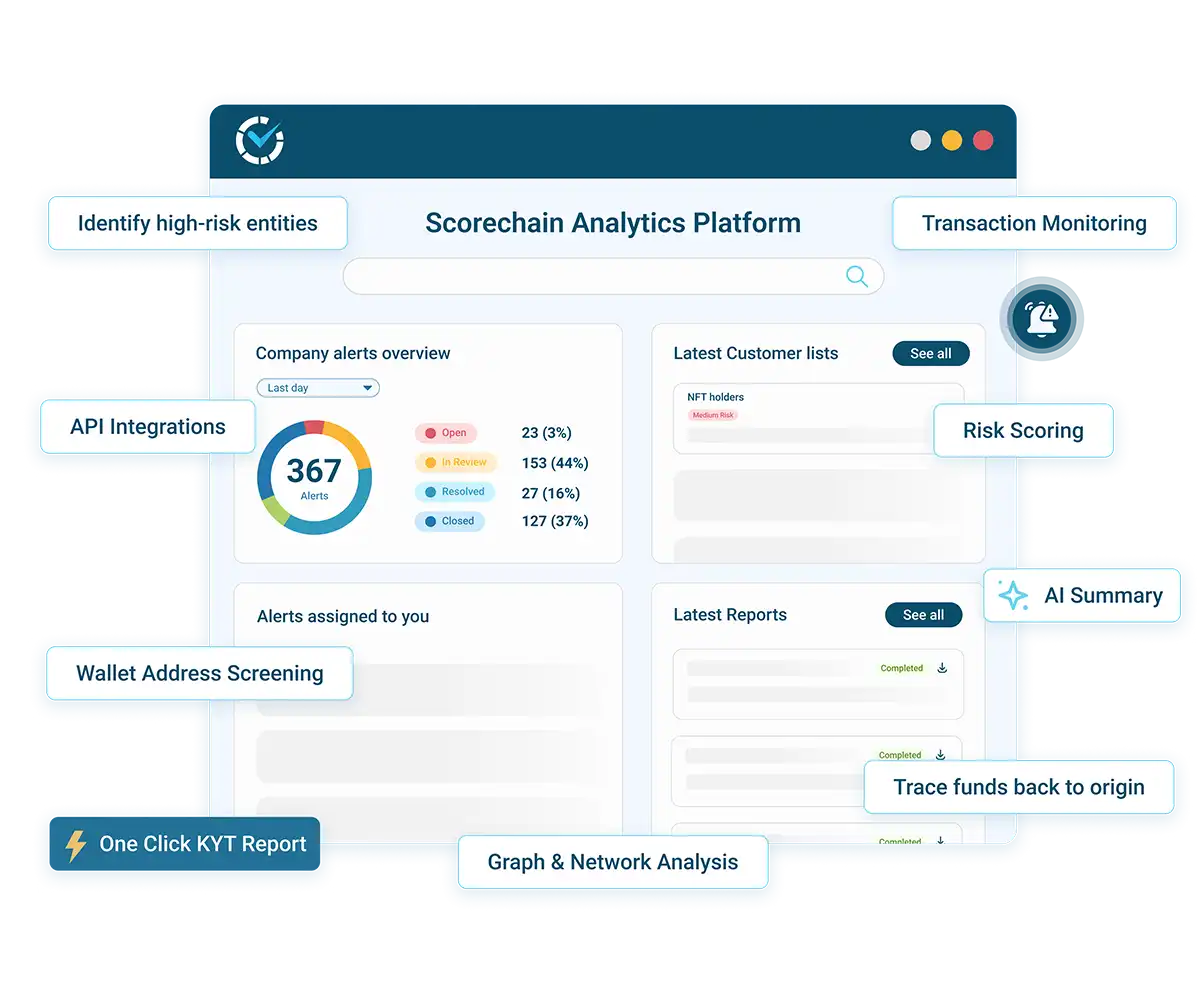
Scorechain’s tools cover the monitoring and screening part of these duties. Your team keeps customer identification, Travel Rule decisions and reporting to the FAU.
How the ČNB Assesses a CASP Application
MiCA Article 63 sets the timetable, and the ČNB runs it in this order:
- The ČNB acknowledges receipt within five working days.
- It checks completeness within 25 working days. If the file is incomplete, it sets a deadline for the missing information.
- Once the file is complete, it has 40 working days to decide.
- Requests for further information must come by the 20th working day of that period and stop the clock until you answer, for up to 20 working days.
- The ČNB notifies you of its decision within five working days of making it.
The ČNB said many applications were wholly insufficient in content, so a complete AML and governance file matters more than speed.
How Scorechain Supports CASP Compliance in the Czech Republic
| Capability |
What it covers |
| Crypto Transaction Monitoring |
Risk scores for addresses and transactions; alert scenarios built from transaction direction, amount and triggered risk indicators; real-time alerts across 25+ blockchains
|
| Travel Rule Compliance |
One endpoint in the Travel Rule API to exchange originator and beneficiary data through partner infrastructure; counterparty VASP intelligence through the VASP Directory and risk screening of counterparty addresses; customer identification stays in your own KYC process, and the API does not guarantee regulatory approval
|
|
Blockchain Risk Analytics and
KYT
|
Risk indicators by entity type, country and transaction behaviour; flags for exposure to darknet markets, scams and sanctioned entities; KYA and KYT reports with transaction details, risk scores, entity attribution and red flags (KYA reports export as PDF or CSV)
|
| Sanctions and Blacklist Monitoring |
Wallet screening for exposure to sanctioned, illicit and high-risk wallets; a free Sanctions Screening API that checks addresses against OFAC, OFSI, MOFA and NBCTF lists, so keep your EU sanctions checks separate; Scorechain flags the risk and your team decides whether to proceed
|
Why Get Your CASP License in the Czech Republic
- EU passport: a CASP authorised by the ČNB can serve clients in other member states by notifying the ČNB under MiCA Article 65. It can start on receiving the ČNB’s communication or by the 15th calendar day after the notification, whichever comes first
- Competition: providers authorised in other member states can also serve Czech customers, so a licence alone does not secure a local market. See the country-by-country CASP guide to compare routes
Prepare Your Czech CASP File with Scorechain
Your AML file should show how you will screen wallets, monitor transactions and exchange Travel Rule data from day one. Scorechain, which has supported more than 200 organisations with AML compliance and blockchain analytics, covers the screening and monitoring parts. Your team keeps customer identification and reporting to the FAU.
To see wallet screening and transaction monitoring on your own flows before you file, book a demo with the Scorechain team.
Frequently Asked Questions
Do I need a CASP authorisation to offer crypto services in the Czech Republic?
Yes, since 1 July 2026, unless you hold a CASP authorisation from another EU member state or are a regulated financial entity that has notified its supervisor under MiCA Article 60. Providing services without authorisation is a MiCA breach.
Can I use a CASP licence from another EU country in the Czech Republic?
Yes. A CASP authorised in another member state can serve Czech customers after notifying its home authority under MiCA Article 65, and a ČNB authorisation works the same way in the other direction. No second authorisation is needed for this.
Which AML rules apply to Czech CASPs?
CASPs are obliged entities under the Czech AML Act (No. 253/2008 Coll.). They run customer due diligence, monitor transactions and report suspicious transactions to the Financial Analytical Office (FAU), in Czech or Slovak. The Travel Rule under Regulation (EU) 2023/1113 has applied since 30 December 2024.
Can I apply for a Czech CASP licence with a virtual office?
It is a high risk. MiCA expects a registered office in a member state where you carry out part of your services, effective management in the EU and at least one director resident in the EU. The ČNB noted that many applicants had registered offices at virtual addresses.