What is Blockchain Transaction Tracking?
Blockchain transaction tracking is the process of locating, following and analyzing the movement of digital assets across one or more blockchain networks. It uses public ledger data to reveal who sent what, when, to whom, and through which intermediaries.
It is worth distinguishing four related terms that are often used interchangeably:
- Tracking is the act of following a single transaction or wallet over time.
- Tracing is the forensic reconstruction of a fund flow, often across many hops or chains.
- Monitoring is continuous, automated surveillance of transactions for risk and policy violations.
- Analysis is the broader discipline that includes clustering, attribution and pattern detection.
Modern compliance teams need all four. A wallet screening check at onboarding, a real time monitor on every deposit, a tracing investigation when an alert fires, and ongoing analysis to refine risk rules.
How Blockchain Transactions Work
To track a transaction you first need to understand what you are looking at. Blockchains use two main accounting models.
UTXO model (Bitcoin, Bitcoin Cash, Litecoin, Dogecoin)
Every transaction consumes one or more Unspent Transaction Outputs and produces new ones. There is no balance on a Bitcoin address; the balance is the sum of UTXOs that point to it. Tracking a Bitcoin transaction means following UTXOs through inputs and outputs.
Account based model (Ethereum, BSC, Polygon, Tron, Solana)
Each address holds a running balance, like a bank account. Transactions debit and credit balances directly, and smart contracts can move funds between contract accounts and externally owned accounts in the same transaction.
Key data points on every transaction
- Transaction ID (TXID or transaction hash): the unique fingerprint of a transaction.
- Sender and receiver addresses: public keys hashed into wallet addresses.
- Amount and asset: native coin or token contract address.
- Fee or gas paid: miner or validator reward.
- Block number and timestamp: when the transaction was finalized.
- Confirmations: how many blocks have been added on top of the one containing the transaction. Bitcoin best practice is 6 confirmations; Ethereum is typically 12 to 30 depending on value.
- Internal transactions and event logs (account based chains): smart contract calls that move value without a top level transfer.
How Do I Track a Blockchain Transactions?
Tracking a blockchain transaction means following the movement of funds between wallets on a public ledger. Here is how to do it:
- Use a Blockchain Explorer: Tools like Etherscan for Ethereum or Blockchain.com for Bitcoin allow you to search for transactions using a wallet address or transaction ID (TXID).
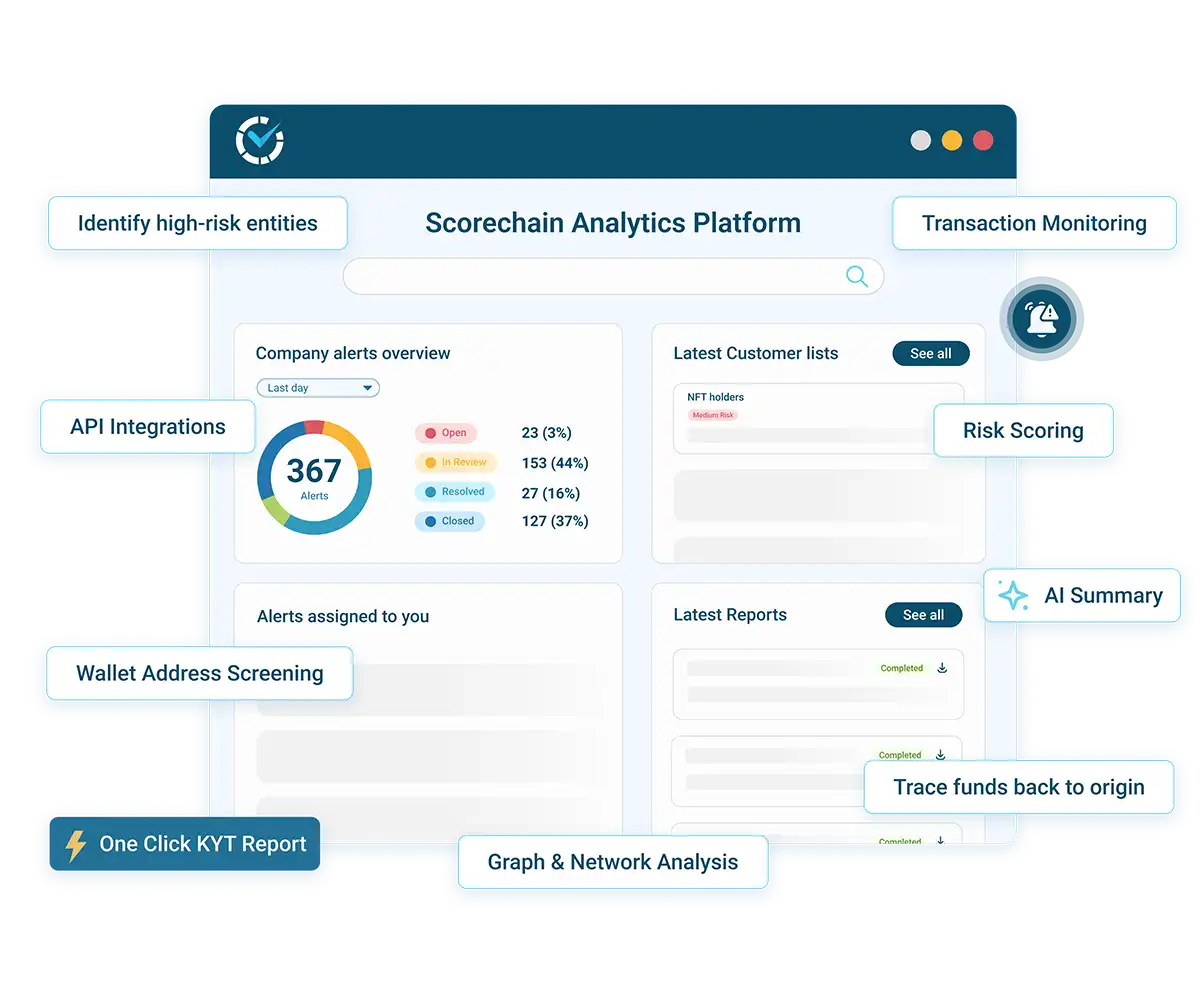
- Leverage Analytics Platforms: Advanced tools like Scorechain provide detailed insights, including risk scoring and wallet connections.
- Monitor in Real-Time: Stay updated on the status and progress of a transaction.
Scorechain simplifies transaction tracking with a user friendly interface and support for 21+ blockchains, including Bitcoin, Ethereum, Tron, Polygon.
Can You Be Tracked on the Blockchain?
Yes. Blockchain activity is inherently transparent, which makes it possible to track transactions and wallet addresses. The identities behind those wallet addresses stay pseudonymous unless they are linked through KYC (Know Your Customer) processes, exchange records or other off chain data.
Scorechain enhances this transparency by:
- Identifying connections to high risk or known illicit wallets such as sanctioned entities, darknet markets, mixers and ransomware addresses.
- Providing insights into wallet activity, transaction history and counterparty exposure.
- Ensuring compliance with AML, CTF, FATF Travel Rule and MiCA regulations.
Verifying a transaction on the blockchain is straightforward:
- Locate the Transaction ID (TXID). This is the unique fingerprint of the transaction, available in your wallet, exchange or custody platform.
- Use a Blockchain Explorer. Enter the TXID into the explorer for the relevant chain to view details such as sender, receiver, amount, fee or gas paid, block number and confirmation status.
- Check Confirmations. Make sure the transaction has the recommended number of confirmations before treating it as final. The standard is 6 confirmations on Bitcoin, 12 to 30 on Ethereum depending on the value moved, and 32 slots on Solana.
Scorechain's tools let businesses verify transactions while assessing the associated risks and compliance requirements in the same workflow, instead of switching between explorers and spreadsheets.
What is a Blockchain Tracker?
A blockchain tracker is a tool or platform that monitors and analyzes blockchain transactions. These tools are used to:
- Trace the flow of funds between wallets, including across chains and through bridges.
- Monitor network activity and wallet behavior over time.
- Detect and flag suspicious or high risk transactions linked to sanctions, fraud, mixers or stolen funds.
Why Scorechain?
Scorechain is a leading European blockchain tracker that combines:
- Multi chain transaction monitoring across 21+ networks, including dedicated coverage for stablecoins like USDT, USDC and DAI.
- Advanced risk scoring with a transparent 0 to 100 score so compliance teams can see exactly why a wallet was flagged.
- Visual graph analysis through Flux Analysis, which lets investigators trace funds across many hops in a single interactive view.
- Real time alerts with rules you can customize for your own typologies and thresholds.
- AI powered intelligence through Scorechain AI, which surfaces suspicious patterns automatically.
- User friendly dashboards designed for compliance officers, not just data scientists.
Use Cases for Blockchain Transaction Tracking
- AML and CTF compliance at exchanges, custodians, banks and on/off ramp providers.
- Fraud investigation and asset recovery by law enforcement and private investigators.
- Internal treasury monitoring by token issuers and stablecoin operators to spot misuse.
- Tax reporting and audit by accountants reconstructing client portfolios.
- DeFi protocol risk management to block sanctioned wallets at the smart contract level.
- VASP due diligence to verify counterparties before sending Travel Rule data.
How Scorechain Tracks Blockchain Transactions
Scorechain is a European, MiCA aligned blockchain analytics platform trusted by 350+ compliance and digital asset teams worldwide. The platform combines several products into a single workflow:
- Wallet Screening: real time risk checks at customer onboarding and at the point of every transfer.
- Transaction Monitoring: continuous, rule based and AI assisted surveillance of every deposit and withdrawal.
- Flux Analysis: interactive graph tracing for investigators who need to follow funds visually across many hops.
- Stablecoin and Token Monitoring: dedicated coverage of USDT, USDC, DAI and other tokens across all supported chains.
- Customisable Alerts: define your own thresholds, typologies and risk rules.
- VASP Directory: verified counterparty database for Travel Rule and due diligence.
- Scorechain AI: AI powered risk intelligence engine that surfaces suspicious patterns automatically.
- Free Sanction Screening API: zero cost OFAC, EU and UN sanctions checks for any wallet address.
Why Choose Scorechain for Blockchain Transaction Tracking?
Scorechain offers advanced tools for tracking, analyzing and verifying blockchain transactions. Key benefits include:
- Comprehensive Analytics. Monitor transactions across major blockchains like Bitcoin, Ethereum, BNB Smart Chain, Tron, Polygon and Solana, plus 30+ others.
- Real Time Tracking. Stay updated on transaction progress, confirmations and risk levels as activity happens.
- Customizable Reports. Generate detailed reports for audits, compliance reviews, internal investigations or law enforcement requests.
- Compliance Driven Tools. Adhere to AML, KYC, FATF Travel Rule and MiCA requirements out of the box, with a free Sanction Screening API for OFAC, EU and UN lists.
- Made in Europe. MiCA aligned and trusted by 350+ compliance and digital asset teams worldwide, including exchanges, banks, on/off ramp providers, regulators and law enforcement agencies.
Schedule a free demo with Scorechain to see how our tools can strengthen your blockchain tracking and compliance program.
Book your demo now!