Quick overview
The case for AI in crypto compliance starts with arithmetic. A mid-sized virtual asset service provider (VASP) can process millions of on-chain transactions a month, and each one is a potential match against a sanctions list, a high-risk typology, or exposure to a designated entity several hops away. Manual review does not scale to that. Rules-only systems do, but they bury analysts under false positives and miss behaviour no one has written a rule for yet.
That gap is where automation has moved from pilot to production. First came rule-based automation, then machine learning, which learned the patterns of illicit flows rather than waiting for a threshold to trip. Now agentic AI, software that can reason through an alert, gather its own context, and take bounded actions, is pushing the boundary again. This guide covers what the shift actually involves: how far the AML workflow can be automated, how the technology works, where it meets regulatory expectations under the Markets in Crypto-Assets Regulation (MiCA) and the Financial Action Task Force (FATF), and where the compliance team still has to make the call.
What is AI in crypto compliance?
The term covers three distinct things that are often blurred together, and the distinction matters when you are answering a regulator. Rules-based automation is the oldest layer: deterministic logic that flags a transaction when it crosses a set threshold or matches a known typology. It is transparent and easy to defend, but it only catches what someone has already described.
Machine learning sits above it. Trained on labelled on-chain data, it classifies addresses, scores risk, and surfaces anomalies that no fixed rule would catch, a sudden change in a counterparty's behaviour, a structuring pattern spread across dozens of wallets. It is probabilistic, so it needs governance, but it adapts as laundering techniques evolve.
Agentic AI is the newer layer and the source of most of the current interest. An agent is a goal-directed system, usually built on a large language model, that can plan a short sequence of steps, call tools, reason over the context it collects, and take actions inside limits the compliance team sets. In an AML setting that might mean enriching an alert with a counterparty's transaction history, tracing an exposure path across chains, or drafting the narrative for a suspicious activity report, then handing the result to a human. Scorechain AI applies this layer on top of its Digital Asset Intelligence rather than in place of the analyst.
None of this changes the underlying obligation. FATF sets AML standards for virtual assets and the firms that handle them regardless of the tools used, so the question is never whether AI is allowed, but whether the controls it runs are effective and explainable. For the current standard, see the FATF guidance on virtual assets and VASPs.
Crypto also raises the difficulty in ways traditional AML tools were not built for. Blockchains are pseudonymous, so the identity behind an address has to be inferred from behaviour and labelling rather than read off an account. Funds cross chains through bridges, pass through mixers built to break the trail, and settle in minutes at any hour, with no correspondent bank in the middle. That combination of scale, speed, and deliberate obfuscation is what makes pattern-learning and multi-hop tracing worth the investment.
The four levels of AML automation
Automating compliance is not one decision, it is a ladder, and knowing which rung you are on is the first step to climbing it deliberately rather than by accident.
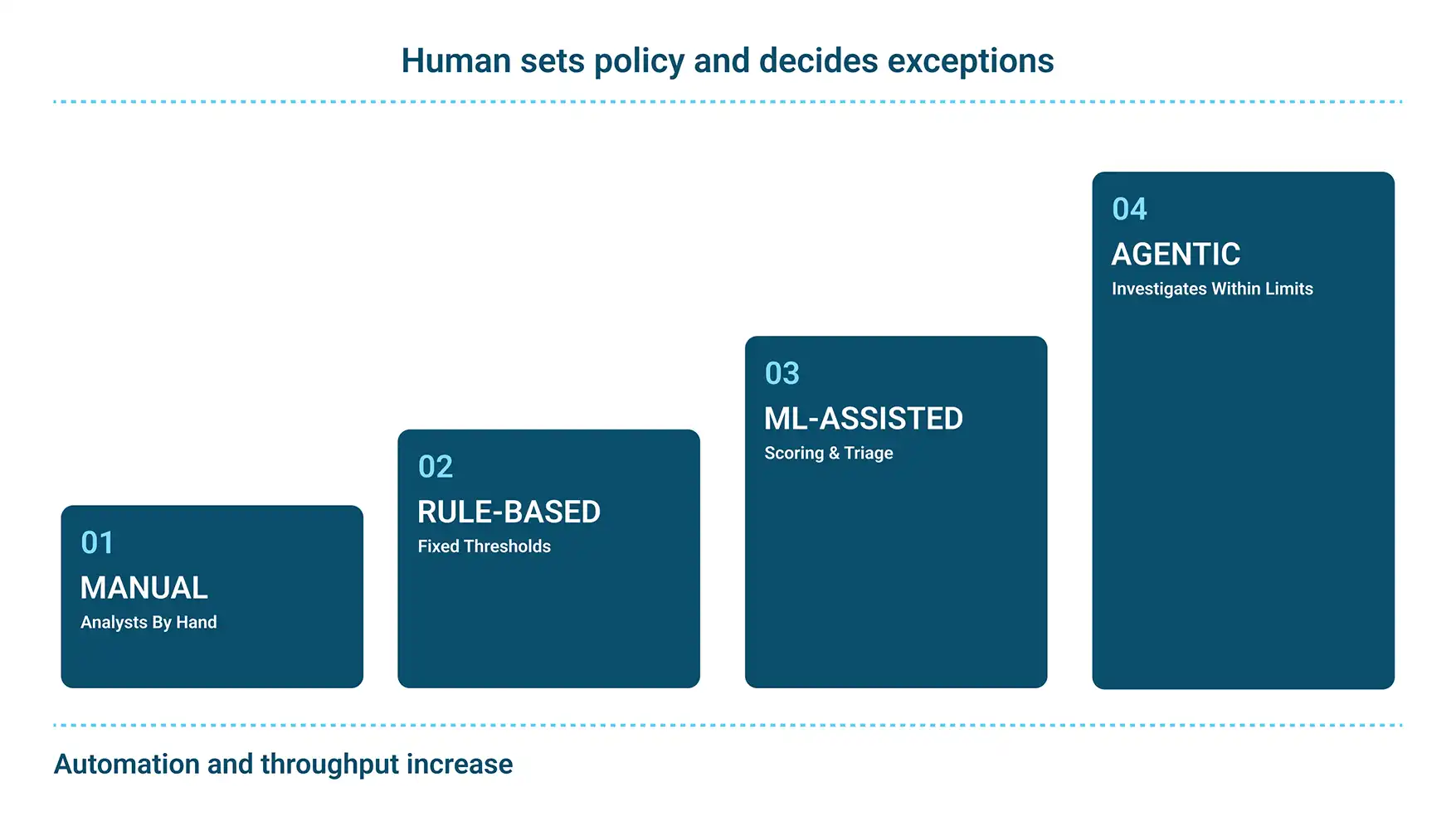
At the base is manual review, where analysts screen and monitor by hand. It does not scale, and it is where alert backlogs come from. The first rung up is rule-based automation: fixed thresholds and typologies flag transactions automatically, which is fast and transparent but noisy. Next is machine-learning-assisted automation, where models score risk and prioritise alerts, cutting false positives and catching patterns no rule describes. At the top is agentic automation, where an AI agent does not just score but investigates, gathering context and preparing a case, up to the point a human decides.
Two things hold across every rung. Automation raises throughput, and the higher rungs raise it most. And the analyst's job changes shape rather than shrinking, less time on triage, more on judgment, policy, and the exceptions the machine escalates. A programme that treats automation as a way to remove people usually finds the audit trail removed with them; one that treats it as a way to redirect people tends to pass inspection and clear more work at once.
How do AI agents work for AML compliance?
The mechanics are easier to follow as a lifecycle than as a definition. A signal arrives, a deposit, a withdrawal, or an onboarding check, and the system scores it on a scale of 0 to 100, where a lower score means higher risk, across 47 risk categories. A high-risk score does not close the case. It starts the agent's work.

In triage the agent does the work an analyst would otherwise do by hand. It pulls the counterparty's history, checks whether the funds touch a sanctioned address directly or through intermediaries, maps the exposure path, and cross-references Scorechain's base of more than 939,000 labelled on-chain entities. It then assembles that evidence into a case rather than a raw flag.
A concrete example shows why the tracing earns its place. A customer deposits from an address that screens clean at the direct level. Two hops back, though, the funds passed through a wallet linked to a sanctioned exchange. A direct-counterparty check clears the deposit; indirect exposure tracing catches it. The agent surfaces that path, attaches the evidence, and puts a prioritised case in front of a reviewer, which is the difference between a control that looks thorough and one that is.
The human-in-the-loop guardrail
What the agent does not do is decide. Clearing a customer, filing a report, or freezing an account is a judgment with legal weight, and it stays with the compliance team. This is not a limitation to design around, it is the design. Regulators expect a firm to understand and be able to explain how a decision was reached, and an audit trail that ends at an unaccountable model is a finding waiting to happen. Keeping analysts in control, with the AI doing the gathering and the reasoning up to the decision point, is what makes the automation defensible as well as fast.
Good automation does not shrink the compliance function; it moves it off the treadmill of triage and back toward judgment.
Pierre Gérard, CEO and co-founder, Scorechain, writing in Cryptopolitan, August 11, 2026
How do you automate crypto compliance checks?
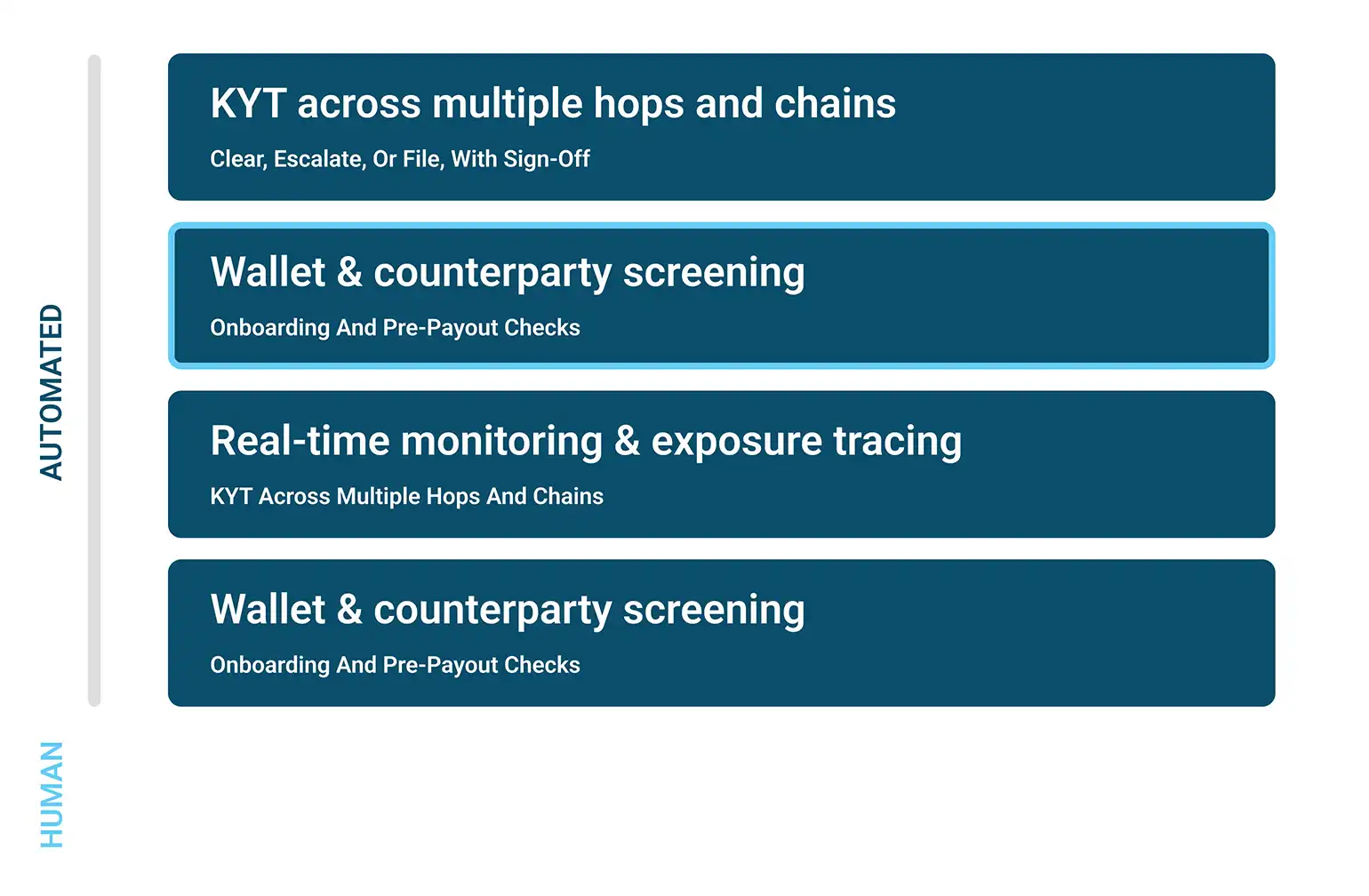
Automation is most useful when it covers the whole chain of checks, not a single step. A wallet screened cleanly at onboarding can still receive tainted funds a week later, so the pipeline runs continuously, not once. The stages below are the ones a crypto compliance programme automates, roughly in the order a transaction meets them.
- Wallet and counterparty screening. At onboarding and before payout, the address is checked for known risk and for its entity type, exchange, mixer, gambling service, or sanctioned party.
- Real-time transaction monitoring (KYT). Each transaction is scored against risk rules and models as it happens, not in a nightly batch.
- Indirect exposure tracing. The system follows funds across multiple hops and across chains to find exposure that is not visible at the direct counterparty.
- Sanctions and PEP screening. Addresses and the entities behind them are screened against sanctions lists and politically exposed person data.
- Risk scoring and alert triage. Signals are scored 0 to 100, where a lower score means higher risk, and the AI layer prioritises the alerts worth an analyst's time.
- Automated case management. A flagged transaction becomes a case with its evidence attached, ready for review rather than reconstruction.
- Regulatory reporting. Where a case warrants it, the workflow supports the suspicious activity or transaction report, with the audit trail intact.
Run well, this pipeline handles volume manual review cannot. Scorechain processes more than 1.5 million AML checks a day, returns risk decisions through an API in around 300 milliseconds, and monitors more than 470 stablecoins across over 45 countries, all under an ISO/IEC 27001:2022 certified information security management system. The point of that speed is not the number, it is that a real-time payout decision cannot wait for a batch job. You can read how the pieces fit in Scorechain's transaction monitoring and sanctions screening products.
AI-driven vs rules-based transaction monitoring
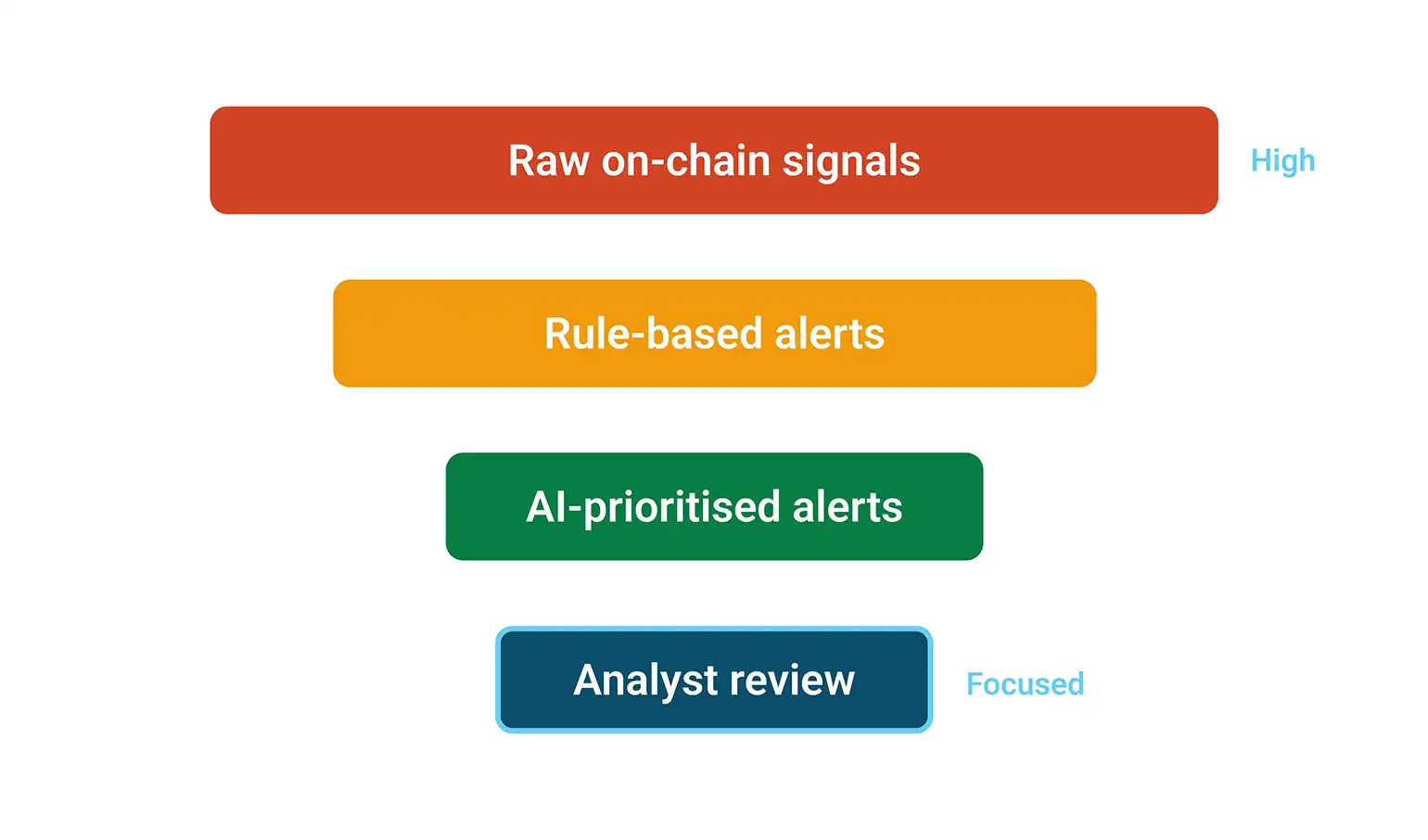
The honest framing is not a contest. Rules give you a defensible floor and catch the well-understood cases. Machine learning catches what the rules cannot describe. Agentic AI reduces the manual load of working the alerts that result. The table sets out where each layer earns its place.
Comparison: three layers of transaction monitoring
This is also where the analytics providers differentiate. Scorechain works in the same category as Chainalysis, Elliptic, and TRM Labs, and the ground it competes on is specific: depth of indirect, multi-hop exposure detection, breadth across blockchains and asset types including stablecoins and tokenized real-world assets, and a transparent, configurable risk methodology a compliance team can tune and explain rather than accept as a black box. The visual below shows the mechanism behind the false-positive claim.
Does AI-driven AML meet regulatory requirements?
Regulators do not certify software. They set obligations and test whether your controls meet them, which means the burden with AI is not permission but proof: you have to show the model is governed, the decisions are explainable, and the record is complete. As Scorechain's CEO and co-founder Pierre Gérard put it in Cryptopolitan, "'the algorithm flagged it' is not a defence at an inspection, and 'the algorithm cleared it' is worse." Lead from the framework your firm answers to.
MiCA and the EU AML package
For crypto-asset service providers (CASPs) in the European Union, the Markets in Crypto-Assets Regulation, Regulation (EU) 2023/1114, has applied in full since December 30, 2024, with a transitional window for existing firms running to July 1, 2026. Alongside it, the EU's new AML package tightens the regime: the Anti-Money Laundering Regulation, Regulation (EU) 2024/1624, applies from July 10, 2027, and the Sixth Anti-Money Laundering Directive, Directive (EU) 2024/1640, is being transposed in stages toward the same date. Supervision is consolidating too: the new Anti-Money Laundering Authority (AMLA), based in Frankfurt, has been operational since July 1, 2025, and begins direct supervision of selected high-risk entities from January 2028. None of these instruments prescribes or prohibits AI. They raise the bar on the outcome.
FATF, the Travel Rule, and global standards
Internationally, FATF Recommendation 15 brings virtual assets and VASPs into the AML/CFT perimeter, and Recommendation 16, the Travel Rule, requires originator and beneficiary information to accompany transfers above the USD/EUR 1,000 threshold. FATF updated its payment transparency standards under Recommendation 16 in June 2025. The EU implements the crypto Travel Rule through the recast Transfer of Funds Regulation, Regulation (EU) 2023/1113, in force since December 30, 2024. AI does not change what has to travel with a transfer, but it does help identify the counterparties and exposure that make a transfer reportable in the first place. The current standard is on the FATF Recommendation 16 update.
FCA, OFAC, and FinCEN
Outside the EU the principle holds. In the United Kingdom, cryptoasset firms register with and are supervised by the Financial Conduct Authority (FCA) under the money laundering regulations. In the United States, the Office of Foreign Assets Control (OFAC) enforces sanctions on a strict-liability basis, so a screening miss is a violation regardless of intent, and the Financial Crimes Enforcement Network (FinCEN) sets the Bank Secrecy Act reporting expectations. In every one of these regimes, the recurring supervisory question about AI is the same: can you explain the decision. See the FCA's cryptoasset AML regime and OFAC for the source rules.
The same pattern repeats across the major digital-asset hubs. Singapore supervises service providers through the Monetary Authority of Singapore (MAS) under the Payment Services Act, the United Arab Emirates through the Virtual Assets Regulatory Authority (VARA), and Australia through AUSTRAC, each converging on the FATF baseline rather than diverging from it. A firm that can evidence explainable, well-governed AI controls in one market is usually well positioned in the others.
The governance point
An AI model that cannot show its reasoning is a compliance liability, not an asset. Model risk governance, documented logic, and a complete audit trail are what turn automation from a supervisory concern into a defensible control.
Benefits and limits of AI in crypto compliance
The benefits are real. AI cuts false positives, which frees analysts to work the alerts that matter, and it scales to volumes that defeat manual review. It detects indirect exposure a direct-counterparty check would miss, and applies the same standard consistently rather than varying with an analyst's fatigue. Investigations that took hours of manual tracing compress into a reviewable case.
The limits are just as real, and a serious programme designs for them. Machine learning carries model risk: it can drift, it can inherit bias from its training data, and it demands ongoing validation. Explainability is a duty, not a preference, so a model whose reasoning cannot be reconstructed does not belong on a decision path. Automation bias is another, where reviewers rubber-stamp what the machine suggests, which is why the human decision layer has to be a genuine review, not a formality. And laundering techniques adapt, so any model is a moving target that needs retraining.
Read together, benefits and limits point the same way. AI belongs on the gathering, scoring, and reasoning, where scale and consistency are the whole game. Judgment stays with the people accountable for it, compliance by design rather than bolted on afterward.
How Scorechain applies agentic AI to crypto compliance
Scorechain is a blockchain analytics and crypto AML compliance platform, headquartered in Luxembourg, that serves more than 350 clients across over 45 countries. Its approach reflects the argument of this guide: automate the analytical work, keep the compliance team in control of the decision.
Scorechain AI brings the agentic layer to the platform's Digital Asset Intelligence. It scores addresses and transactions on a 0 to 100 scale where a lower score means higher risk, across 47 risk categories, and draws on more than one million named counterparties and over 939,000 labelled on-chain entities to explain why a score is what it is. Coverage spans 23 blockchains and more than 470 stablecoins, so a team is not blind to activity that moves between assets or across chains. The methodology is transparent and configurable, which lets a team tune it to its risk appetite and defend the result to a supervisor.
Being European-native matters here in practice, not just in origin. Scorechain is built to be MiCA-ready and aligned with the General Data Protection Regulation (GDPR), which is the frame most of its clients are supervised against first. That is the messaging pillar the platform is built on: regulatory compliance by design, with the compliance team, not the model, holding the decision. You can see the platform in Scorechain AI and the wider crypto compliance resources.
For teams evaluating a tool, the selection criteria follow from the regulatory test: a transparent, configurable risk model rather than a black box, coverage across the chains and assets you actually handle, indirect exposure tracing rather than direct-counterparty screening alone, a complete and exportable audit trail, and a workflow that keeps analysts in the decision. A tool that scores well on speed but cannot explain a decision will not survive a supervisory review, whatever its demo detection rate.
How to automate Scorechain in your workflow
The right deployment depends on where a team's workflow already lives and how much control it needs over hosting and gating logic.
Comparison: ways to automate Scorechain risk scoring
No-code, with Zapier
Scorechain's Zapier app, currently in beta, exposes a "Get Risk Scoring Analysis" action that drops into any Zap after a trigger delivers an address, transaction, or wallet. The familiar patterns are a Typeform onboarding submission scored and posted to a compliance Slack channel, an analyst pasting an address into Slack for an in-thread result, a spreadsheet of counterparties re-screened row by row, and a CRM deal updated with the risk on its wallet field so sales sees exposure without pinging compliance. A Zapier filter or path branches on severity to gate an action such as holding a withdrawal, and the same action is reachable through Zapier MCP for AI assistants and the Zapier SDK for backend code.
Self-hosted, with n8n
For teams that want their data to stay on their own infrastructure, the open-source n8n community node, n8n-nodes-scorechain, published by Scorechain under an MIT licence, brings address and transaction scoring into a self-hosted n8n instance with no per-task pricing. Because it runs inside n8n, it sits alongside IF and Switch nodes for real approve, hold, or block logic, Postgres or MySQL nodes for logging, and AI nodes for turning a raw score into an audit-ready compliance memo. As a community node it installs on self-hosted n8n only, so the sensible practice is to review the source and pin a version before production.
Custom, with the API and SDK
Where a team already runs its own automation tooling, the Risk Scoring API and SDK wire the same scoring into any internal system directly, with Scorechain handling authentication and scoped permissions. That is the path for firms with a custom workflow engine rather than an off-the-shelf one. For an agent-native route, the Model Context Protocol server, covered next, lets an assistant call the same intelligence in natural language.
Scorechain MCP, connecting AI agents to compliance intelligence
This is where the argument stops being theoretical. The Model Context Protocol (MCP) is an open standard for connecting AI assistants to external data and tools, and Scorechain MCP uses it to expose the platform's Digital Asset Intelligence to an agent directly. Scorechain frames it as "AI agents for blockchain compliance, built on trusted intelligence": the agent reasons over live compliance data and can take multi-step investigative actions, rather than answering isolated questions from a static snapshot the way a general chatbot would.
The server exposes a defined set of read-only intelligence tools an agent can call, so its reach is bounded by design.

Those tools cover wallet risk assessment with explainable reasoning, source of funds analysis across multiple hops, fund flow tracing to surface hidden counterparties, suspicious activity report (SAR) narrative drafting, alert triage, and entity intelligence. ChatGPT and Claude are supported out of the box, and any licensed customer can connect the same server to a custom agent. Scorechain is also listed in the ChatGPT App Directory, putting the intelligence inside the assistant many analysts already work in.
The governance model is the same one this guide has argued for throughout. Scorechain sums it up plainly: "the agent assesses, the analyst decides." The AI drafts narratives and surfaces reasoning, but a human retains authority over case closure and regulatory filings. Access sits within existing licences, each tool call that queries Scorechain data draws on the account's credit balance, and per-tool approval can be required, so a team controls exactly what the agent may do rather than handing it the keys.
Frequently asked questions
What is agentic AI in AML compliance?
Agentic AI in AML compliance is a goal-directed system that can reason through an alert, gather on-chain and off-chain context, and take bounded actions the compliance team authorises, such as enriching a case or tracing exposure. It works up to the decision point, then routes the case to a human reviewer.
How do you automate crypto compliance checks?
You connect the AML workflow into one continuous pipeline: wallet and counterparty screening at onboarding, real-time Know Your Transaction monitoring, indirect exposure tracing across chains, and sanctions screening, feeding automated case creation. AI scores and triages the signals, and analysts review the alerts that carry genuine risk.
What is the difference between AI-driven and rules-based transaction monitoring?
Rules-based monitoring applies fixed thresholds and known typologies. It is transparent but rigid and produces many false positives. AI-driven monitoring learns patterns and weighs context, so it cuts noise and catches new behaviour. Most mature programmes run both, with agentic AI adding a reasoning and case-preparation layer on top.
Does AI-driven AML comply with MiCA and FATF requirements?
Yes. MiCA, the EU AML package, and FATF standards are technology-neutral. They require effective, explainable AML controls and a complete audit trail, not a specific tool. AI is permitted provided a firm governs its models, can explain how decisions are reached, and can evidence them to a supervisor on request.
How do AI agents work for AML compliance?
An AI agent ingests a transaction or alert, scores its risk on a 0 to 100 scale where a lower score means higher risk, gathers supporting context, and proposes or takes a next step within set permissions. Every action is logged, and material decisions such as filing a report route to a human.
Can ChatGPT or Claude connect to Scorechain?
Yes. Scorechain MCP, built on the Model Context Protocol, connects assistants including ChatGPT and Claude to Scorechain's blockchain risk intelligence through read-only tools, and licensed customers can connect a custom agent. The assistant assesses and drafts; the analyst keeps authority over case closure and regulatory filings.
What parts of crypto compliance can be automated?
Wallet screening, transaction monitoring, indirect exposure tracing, sanctions checks, risk scoring, alert triage, and case preparation can all be automated, and agentic AI can run multi-step investigations. What cannot be automated is accountability: clearing a customer, filing a report, or closing a case remains a human decision a regulator expects a named person to own.
How can I add Scorechain risk scoring to my existing tools?
Three ways, without a heavy build: a no-code Zapier app, a self-hosted n8n community node, and the Risk Scoring API or SDK for a custom integration. Each turns an address or transaction into a risk score, a severity level, and the entity behind it, so you can screen from a form, spreadsheet, Slack, CRM, or your own systems.