Scorechain Risk API
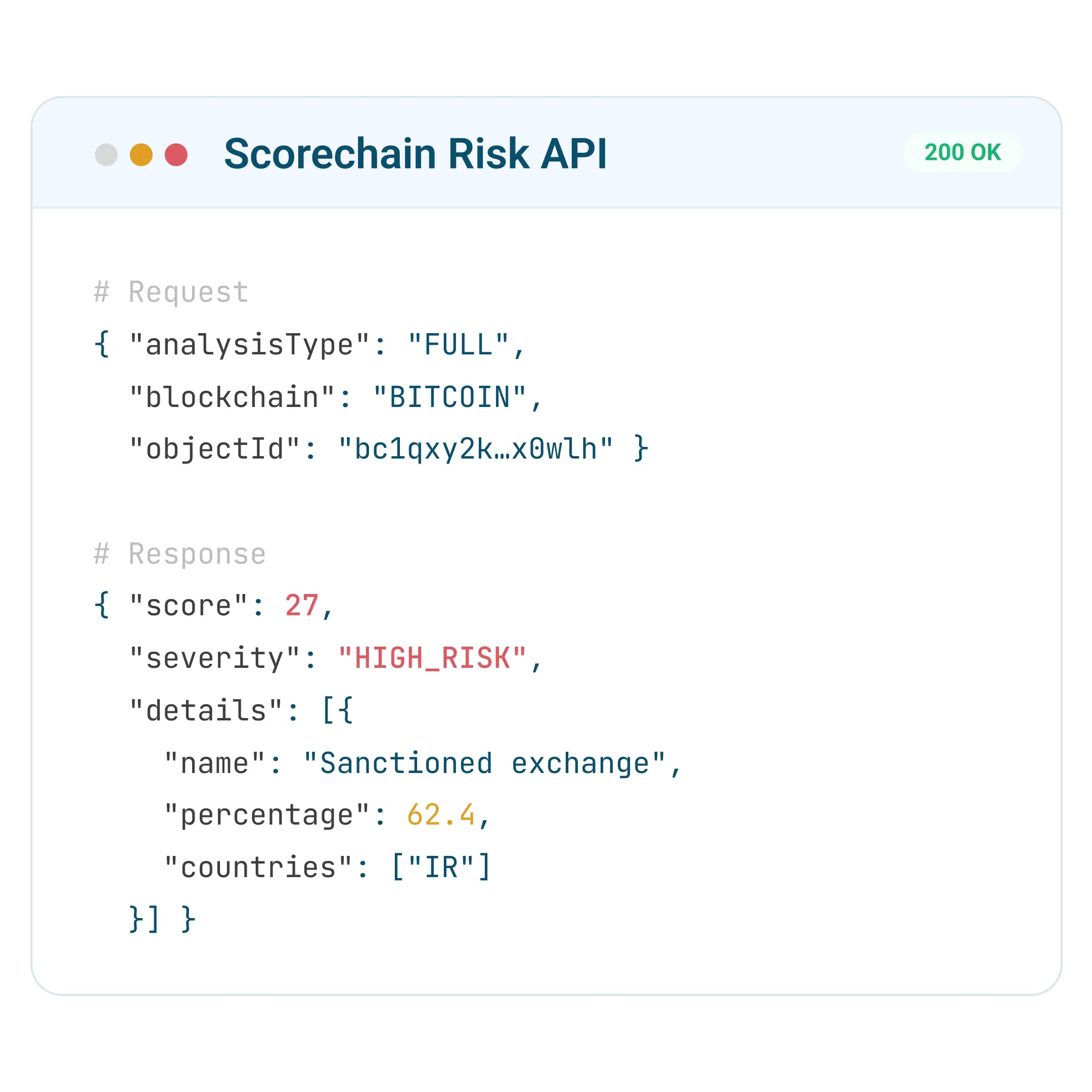
One call to /scoringAnalysis returns a 0 to 100 risk score with the named counterparties behind it, their share of value, country, and per-item score. Available across 25 blockchains and billed per check from prepaid bundles.































Our company provides all types of roof repairs, both residential and commercial, regardless of the damage level. We also offer partial tile replacement.
Request PricingSubmit an address, receive a scored assessment with the entities and categories behind it.
No dashboard to roll out and no seats to provision. Authentication is a bearer token.
Checks deduct per call. Unused checks never expire and carry forward indefinitely.
Luxembourg headquartered, MiCA ready, and GDPR aligned, with screening data under European rules.
One endpoint backed by Scorechain's Digital Asset Intelligence database, covering 25 blockchains, with prepaid checks that never expire.
risk score per call
average response time
blockchains supported
Every response tells you what the score means and why it was given. Managing your account takes two screens: one for balance and billing, one for API keys.
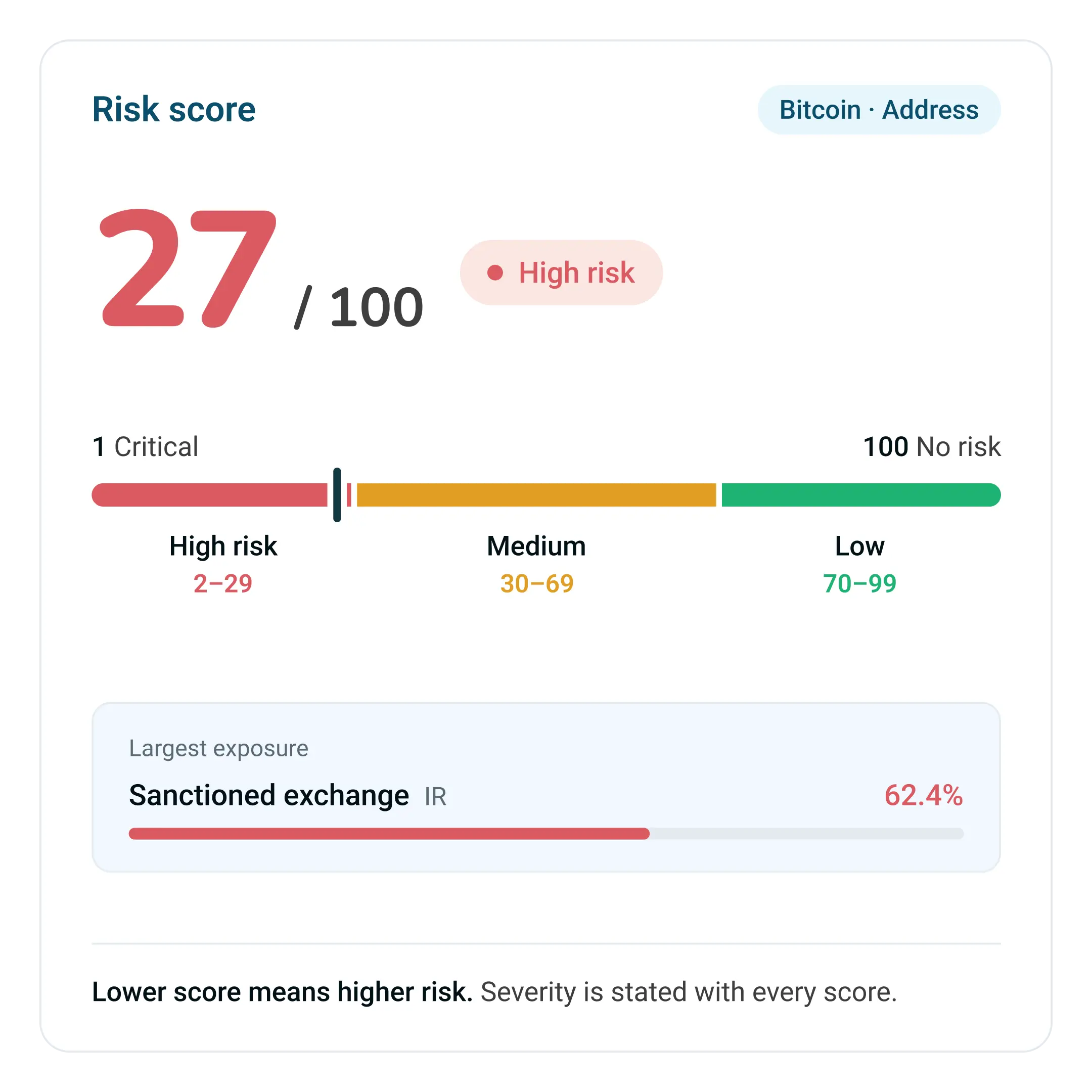
Scorechain scores from 0 to 100, where a lower score means higher risk. A reading of 27 sits deep in the high-risk band. The scale is inverted relative to some conventions, which is why the response names the risk level explicitly rather than leaving the number to interpretation.
Named entities, not opaque categories, wherever attribution exists
Share of value attributed to each exposure, so materiality is visible
Remaining balance in the response header, readable from your logs


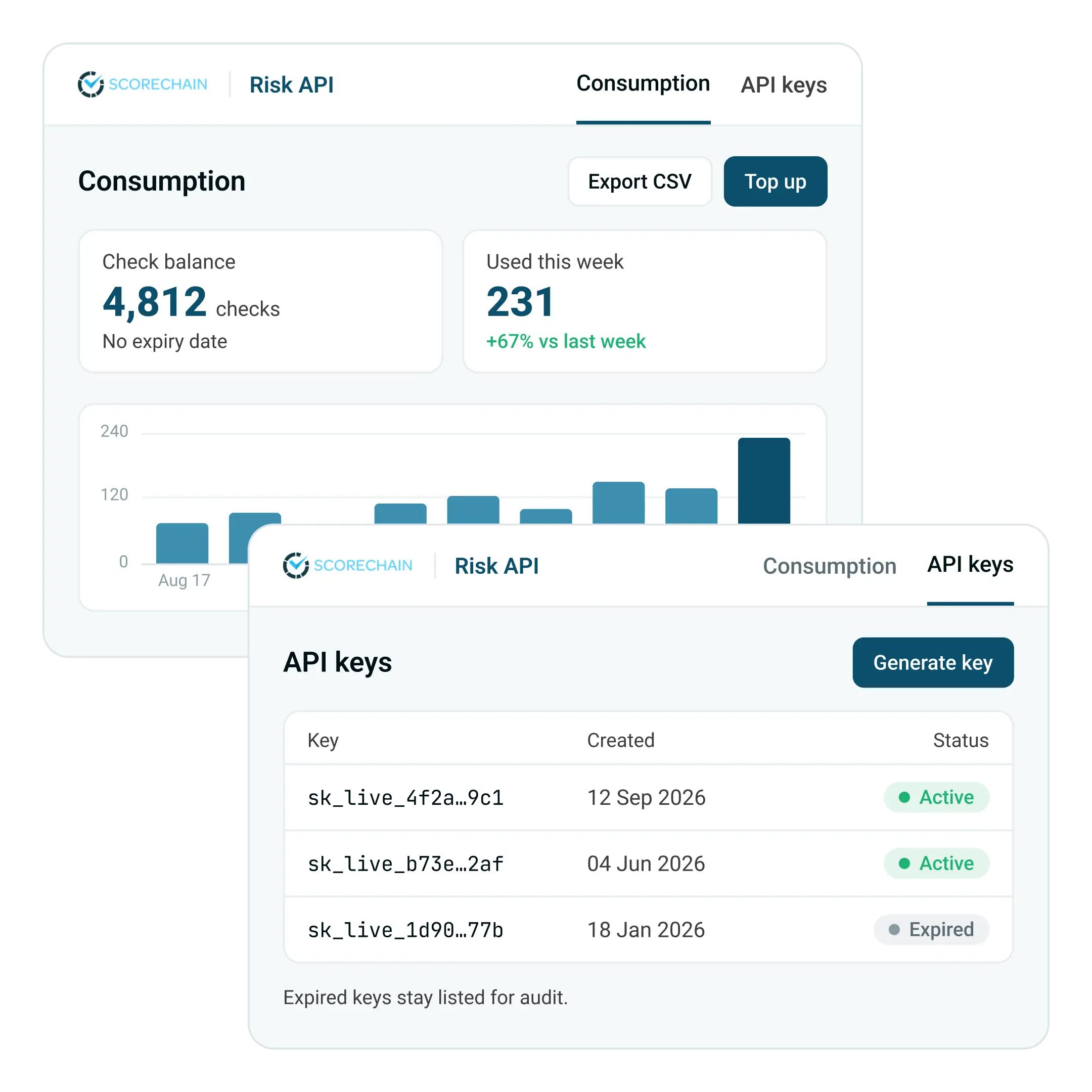
Your Risk API account has two screens. Consumption shows your check balance, usage history, and invoices, and lets you top up. API keys is where you create and manage credentials. There's nothing else to set up or learn.
Top up your balance in fiat or crypto, at any time
Export usage history for internal reporting and reconciliation
Download invoices from your complete billing history
Create and rotate API keys, with expired keys kept on record for audit

STEP 1
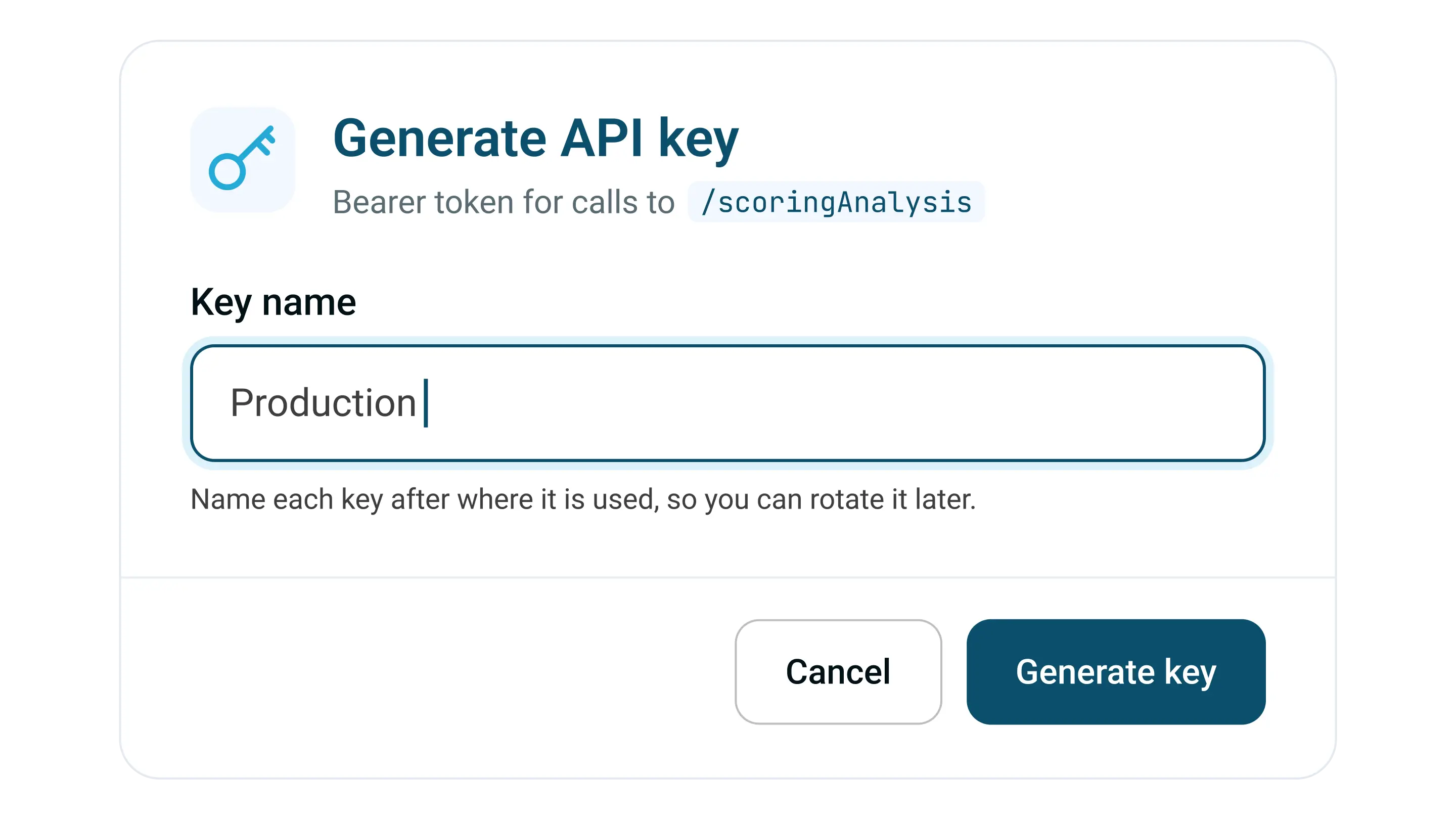
Open the API keys page, create a credential, and note it. Keys can be rotated, and expired keys stay listed for audit.

STEP 2
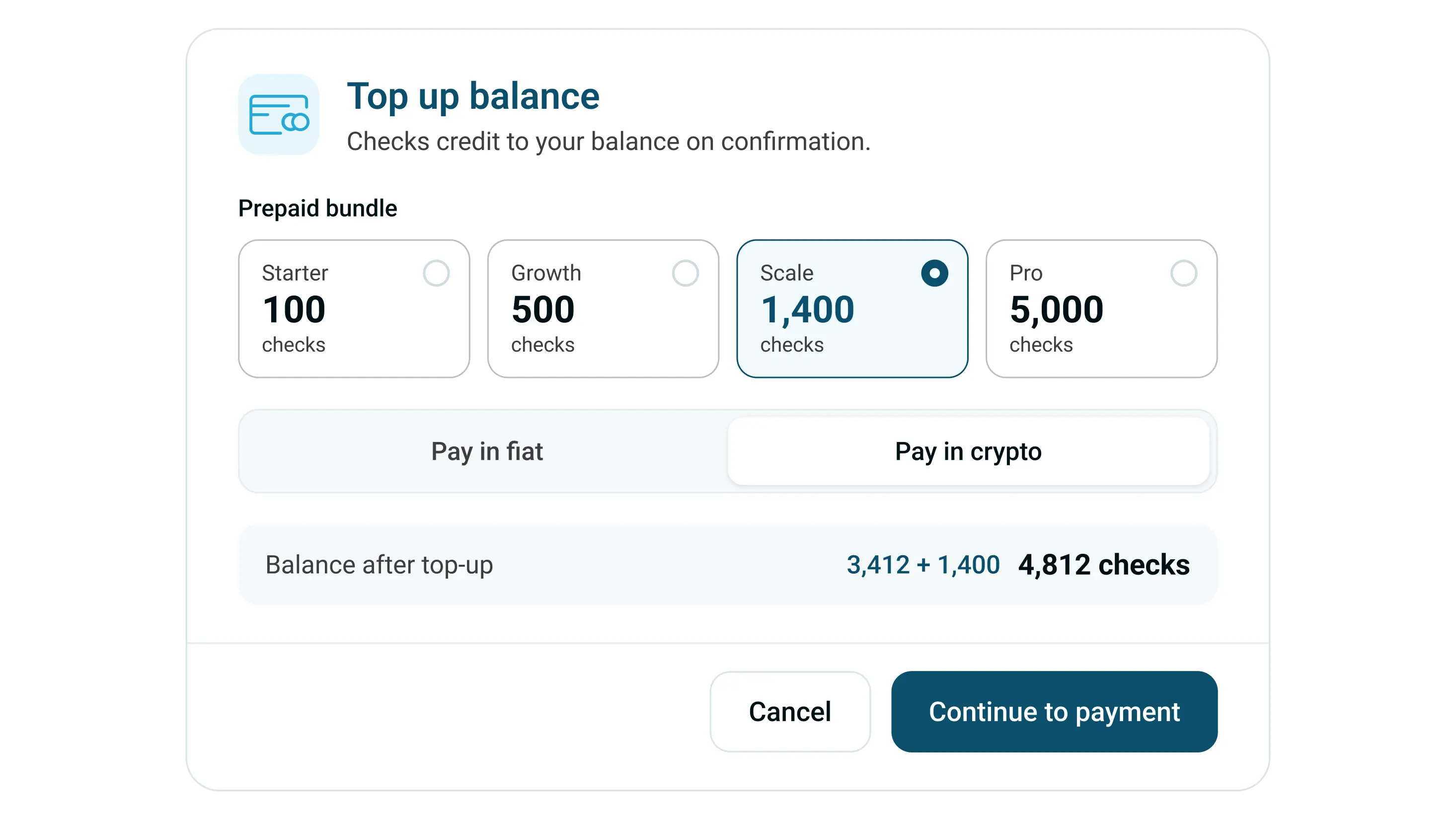
Choose a prepaid bundle sized to expected volume and settle in fiat or crypto. Checks credit to the balance on confirmation.

STEP 3
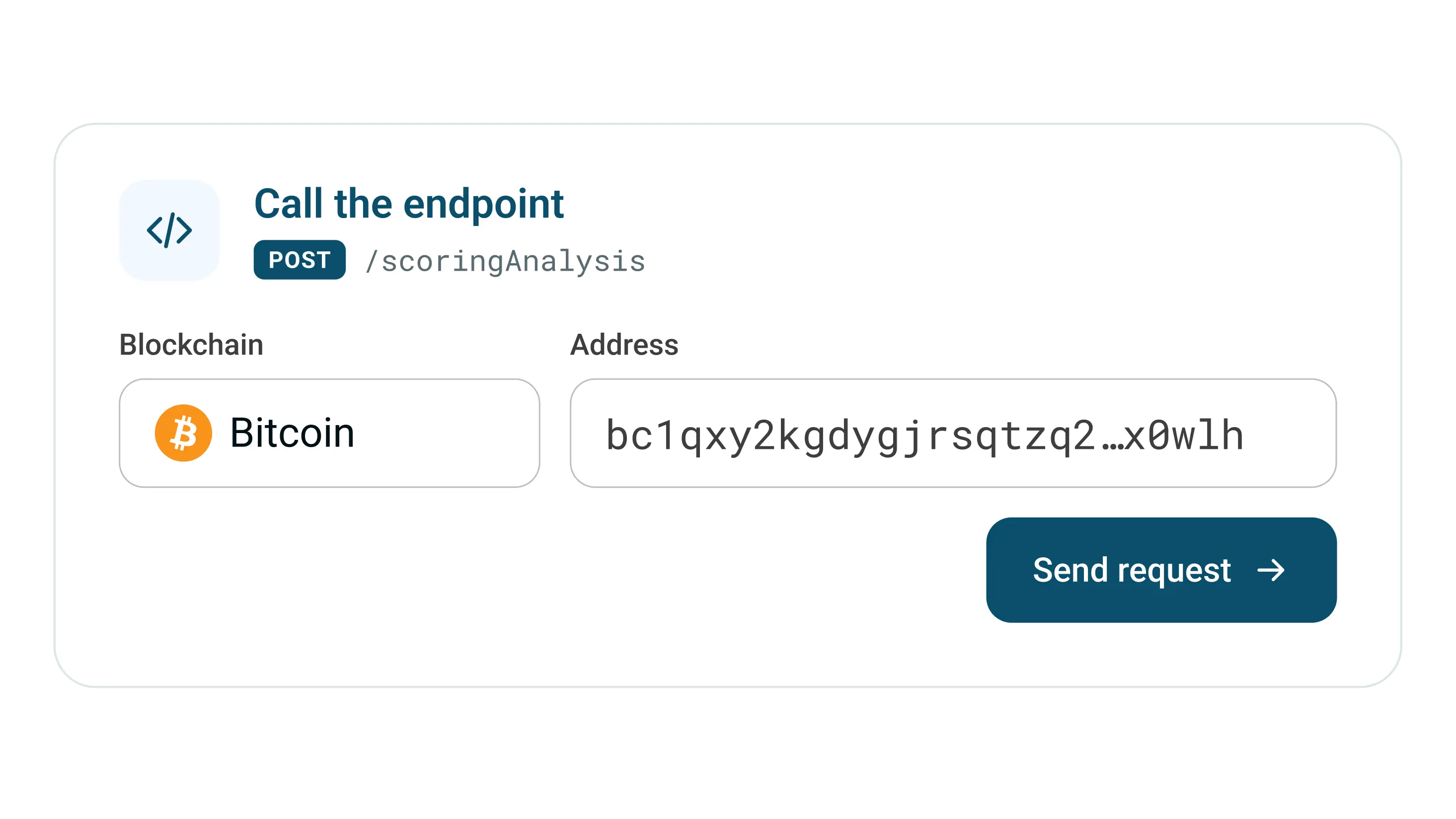
Send a blockchain and an address to /scoringAnalysis. One successful call deducts one check.
Set analysisType to control how far the assessment runs, with each type adding a layer to the one before it. The same endpoint scores a transaction, an address, a wallet, an NFT item, or an NFT collection.
analysisType: ASSIGNED
Scores the address or wallet on its own attribution, with no flow of funds traced.
analysisType: INCOMING
Adds the source of funds received, so you see exposure before you accept a deposit.
analysisType: OUTGOING
Adds the destination of funds sent, so you see exposure before you release a withdrawal.
analysisType: FULL
Combines the entity score with both incoming and outgoing exposure in a single assessment.
Four bundle sizes, scaled by volume. Checks never expire, so an unused balance carries forward until you use it.
Access to /scoringAnalysis
Direct and indirect exposure
Entity attribution
Fiat or crypto settlement
Checks that never expire
Consumption export and invoices
At that volume a platform licence costs less per check and adds transaction monitoring, case management, and the full API.
Both draw on the same Scorechain Digital Asset Intelligence database. What differs is how much of the compliance stack sits around it.
Capability
Risk API
Platform licence
Access route
API only
Full platform and API
Risk assessment
Included
Included
Endpoints
/scoringAnalysis
Full API
Transaction monitoring
Not included
Included
Case management
Not included
Included
Investigation tooling
Not included
Included
Interface
Consumption and API keys only
Full platform
Cost shape
Per check
Per volume and seats
Suited to
Embedded assessment at variable volume
Compliance operations and regulated reporting
Covers how scores are read, justified to an auditor, and acted on in your own systems, plus what happens when a request fails and when a platform licence becomes the better fit.
What counts as one check?
One successful call to /scoringAnalysis against one address. Failed and unauthenticated requests are not deducted from the balance.
What can be scored?
The endpoint scores five object types: a transaction, an address, a wallet, an NFT item, or an NFT collection. Four analysis types control the depth of reasoning: ASSIGNED scores the entity alone, INCOMING adds the source of funds received, OUTGOING adds the destination of funds sent, and FULL combines all three.
Do the checks expire?
No. Prepaid checks never expire. Any unused balance stays on the account until it is consumed.
What does the risk score mean?
Scorechain returns a score from 0 to 100 where a lower score means higher risk. The published bands are 1 for critical, 2 to 29 for high risk, 30 to 69 for medium, 70 to 99 for low, and 100 for no risk. The response returns the severity explicitly alongside the counterparties that produced it.
Can the balance be topped up in crypto?
Yes. Packs can be settled in fiat or crypto, and the balance can be topped up either way at any point.
What happens when the balance reaches zero?
Calls are rejected until the balance is topped up. Alerts are sent at 90% and 100% consumption, and the remaining balance is returned in a response header on every successful call.
How does this differ from a Scorechain licence?
The Risk API provides API access to one endpoint plus a restricted interface covering consumption and API keys. A licence provides the full platform, including transaction monitoring, case management, investigation tooling, and the wider API, and is lower per check at volume.
How many API keys can be created?
Keys are generated from the API keys page, which lists active and expired credentials so keys can be rotated without losing the audit record.
Can consumption be exported for reporting?
The consumption page shows the current balance and full usage history with export, alongside invoice history for the account.
Built on the same database as the Risk API, adding transaction monitoring, case management, investigation tooling, and full API access at a lower cost per check.