Seychelles Crypto License

Seychelles VASP licence guide: FSA fees from SCR 75,000, paid-up capital by class, local office rules, application steps and how to check a licensed VASP.
350+ COMPLIANCE &  DIGITAL ASSET TEAMS TRUST US

VASP Act Overview for Crypto License in Seychelles

Seychelles regulates crypto businesses under the Virtual Asset Service Providers Act, 2024 (the VASP Act). The Financial Services Authority (FSA) licenses virtual asset service providers (VASPs), and the transition period for existing providers ended on 31 December 2024.

Seychelles Crypto License: Key Facts, Fees and Timeline

Item Requirement
Regulator Financial Services Authority (FSA)
Law VASP Act, 2024, which applies from 1 September 2024
Licence classes Wallet providers, exchange, broking and investment providers
Application fee SCR 75,000
Annual fees SCR 75,000 base fee plus SCR 75,000 to SCR 375,000 per activity
Minimum paid-up capital (new entrants) USD 25,000 to USD 100,000, depending on the class
Processing time 3 months to 2 years, depending on the complexity of the application
Local presence A resident director, a fully manned physical office and a full-time compliance officer employed by the VASP

Seychelles Crypto License (VASP): FSA Requirements

The VASP Act requires a licence for anyone providing virtual asset services in or from Seychelles. The FSA says this includes Seychelles-incorporated entities that operate only from abroad, with no Seychelles office or staff.

Providers already operating on 1 September 2024 had to submit a complete application by 31 December 2024 to keep operating. New applicants need approval before they start business.

What Is a Seychelles VASP License?

A VASP licence is the FSA’s authorisation to provide virtual asset services. The Act sets four licence classes:

  • Virtual asset wallet providers
  • Virtual asset exchange
  • Virtual asset broking
  • Virtual asset investment providers

Only companies incorporated in Seychelles, including international business companies (IBCs), can apply. The FSA states that individuals are ineligible. Mining facilities, mixers and tumblers are prohibited activities.

Searches for a CASP licence in Seychelles usually mean the VASP licence. CASP is the term used in the EU’s MiCA regulation, while Seychelles licenses VASPs under its own Act.

Issuers of initial coin offerings (ICOs) and NFTs register each offering with the FSA. An offering can run for up to 12 months, with an extension of up to 6 months, and the registration application fee is SCR 22,500.

Crypto Exchange Regulation in Seychelles

An exchange needs the Virtual Asset Exchange licence. It carries the highest annual activity fee of the four classes, SCR 375,000, on top of the SCR 75,000 base fee. If the platform also provides wallet, broking or investment services, each activity adds its own annual fee.

A new exchange shows proof of USD 100,000 in paid-up capital when it pays its third annual licence fee. An exchange that holds client assets must keep reserve assets equal to 100% of its liabilities to clients. The FSA asks every applicant for an Institutional Risk Assessment, and it may ask for live demonstrations of customer verification, transaction monitoring and suspicious transaction reporting.

Benefits and Limits of a Seychelles Licence

  • Defined regime: one regulator, four licence classes and published fees.
  • Tax rate: the FSA’s licence application guidelines (section 16) say a licensed VASP can benefit from a tax rate of 1.5% on assessable income.
  • Perpetual licence: a licence stays valid unless it is suspended, revoked or surrendered, provided the holder pays the annual fee and lodges a compliance form by 1 January each year.
  • Banking: no Seychelles bank account is required, but capital must sit with a bank licensed under the Financial Institutions Act or a foreign institution from a country meeting at least Basel II standards. Institutions outside traditional banking, classed as alternative financial services, are excluded.
  • No EU access: a Seychelles licence does not authorise services to clients in the EU. Under MiCA, a person may not provide crypto-asset services in the Union unless authorised by an EU national competent authority or entitled under MiCA Article 60.

VASP License Classes and Requirements

Fees, capital and local presence depend on the class you apply for. A firm licensed for more than one activity meets the requirements for each.

Seychelles Crypto License Cost: FSA Fees

The FSA publishes these fees in the Second Schedule of the Act:

  • Licence application: SCR 75,000, forfeited if the application is refused or rejected.
  • Annual base fee: SCR 75,000, plus a fee for each activity.
  • Wallet providers: SCR 300,000 a year.
  • Exchange: SCR 375,000 a year.
  • Broking: SCR 150,000 a year.
  • Investment providers: SCR 75,000 a year.

A firm licensed for exchange and broking pays the base fee plus both activity fees. Licences granted between January and March pay the full annual fee, and later grants are pro-rated by quarter.

Capital and Insurance

The Schedule to the Virtual Asset Service Providers (Capital and other Financial Requirements) Regulations, 2024 (SI 72 of 2024), in force since 5 September 2024, sets minimum paid-up capital for firms that were not already operating as a VASP when the Act started:

  • Wallet providers: USD 75,000, with proof at application, and 2.5% of annual turnover from the beginning of the third year of operation.
  • Exchange: USD 100,000, with proof when the third annual licence fee is paid.
  • Broking: USD 50,000, with proof when the third annual licence fee is paid.
  • Investment providers: USD 25,000, with proof when the third annual licence fee is paid.

A provider that holds client assets must keep reserve assets equal to 100% of its liabilities to clients. Every licensee must hold professional indemnity insurance, and a quote is enough at application.

Local Presence and Management

  • Directors: at least two natural persons appointed as fit and proper directors.
  • Resident director: at least one, present in Seychelles for 183 days or more in any 12-month period. The FSA may make a licence conditional on the person relocating.
  • Office: a fully manned physical office in Seychelles, where core income-generating activities take place.
  • Compliance officer: a full-time employee of the VASP, not outsourced, plus an alternate compliance officer who is a different person.
  • Meetings: at least 2 board meetings and 4 management meetings in Seychelles each year.
  • Records and complaints: records accessible in Seychelles, and complaints handled in Seychelles.

Step-by-Step Guide: How to Get Your VASP License in Seychelles

Step 1: Pre-Application Preparation

Choose the licence class that matches your services, then incorporate a Seychelles company or IBC. Identify your resident director and compliance officer, and prepare an Institutional Risk Assessment. The FSA requires one from every applicant, including firms not yet operating, and it must cover virtual asset and VASP risks. Arrange a physical office (a provisional lease or letter of understanding is enough), an insurance quote and a proposed bank. A firm that already holds a Securities Act licence can apply through the same company if it keeps VASP activities segregated.

Step 2: Submitting Your Application

Send the application digitally, through the FSA website or by email, with the SCR 75,000 fee and proof of payment. The FSA guidelines list these documents:

  • A signed cover letter and the completed application form.
  • Certified copies of constitutional documents.
  • Personal questionnaires for directors, the compliance officer, the information security officer and key individuals, plus CVs for the compliance officer and alternate.
  • Questionnaires for shareholders and beneficial owners without management roles.
  • Audited financial statements for the past two years if the applicant already operated as a VASP before the Act, or a financial forecast for a new company.
  • Proof of source of funds or wealth, and proof of a physical place of business.
  • A detailed business plan, an insurance quotation and the proposed auditor’s credentials.
  • A service level agreement for technology solutions.
  • Manuals and policies, including the Institutional Risk Assessment.

The FSA starts processing only when all documents and the fee have arrived. Incomplete applications are refused and the fee is forfeited. Where an application is too deficient to review, it is rejected, the fee is forfeited and the applicant cannot resubmit for 6 months.

Step 3: Regulatory Assessment and Approval

The FSA says processing can take from 3 months to 2 years, depending on the complexity of the application. It advises within 90 working days whether an application is incomplete, if all documents were lodged at submission. The FSA may also ask for live demonstrations of your AML/CFT systems, including customer verification, transaction monitoring and suspicious transaction reporting.

Post-Licence Obligations and Compliance

  • Annual duties: pay the renewal fee and lodge the compliance form by 1 January each year. Failure is grounds for revocation.
  • Customer checks: licensed VASPs may not apply simplified due diligence under any circumstances. Your onboarding must meet customer due diligence requirements.
  • Travel Rule: the FSA bases its Travel Rule on FATF Recommendation 16, under which originating VASPs must obtain and hold required originator and beneficiary information on transfers. See the Travel Rule page for the data a transfer must carry.
  • FIU reporting: report virtual asset transfers of SCR 50,000 or more to the Financial Intelligence Unit every business day by midnight Seychelles time. File suspicious transaction reports through goAML, which needs FIU registration.
  • Record keeping: keep client and own transaction records for at least 7 years. Keep AML/CFT records for 30 years in digital form from the end of the business relationship.

Operating Without a Licence

The FSA warned on 14 February 2025 that providers without a complete application by 31 December 2024 were prohibited from operating from 1 January 2025. Operating in breach of section 5(1) of the Act is an offence carrying a fine, imprisonment or both. Companies can also face striking off or a court-ordered winding up. Customers of such firms may not be protected under Seychelles consumer protection laws.

How to Check a Seychelles VASP

  1. Confirm the exact legal entity named in your contract.
  2. Search for it on the FSA’s VASP list. The list shows each entity’s status. Firms with a complete application still under review show as “Assessment” and may continue operating until the FSA decides.
  3. Confirm the activities the entity is allowed to provide.
  4. Check the FSA’s warnings page, and report suspected unlicensed activity through the FSA’s online form or by email to vass@fsaseychelles.sc.

How Scorechain Supports Seychelles VASPs

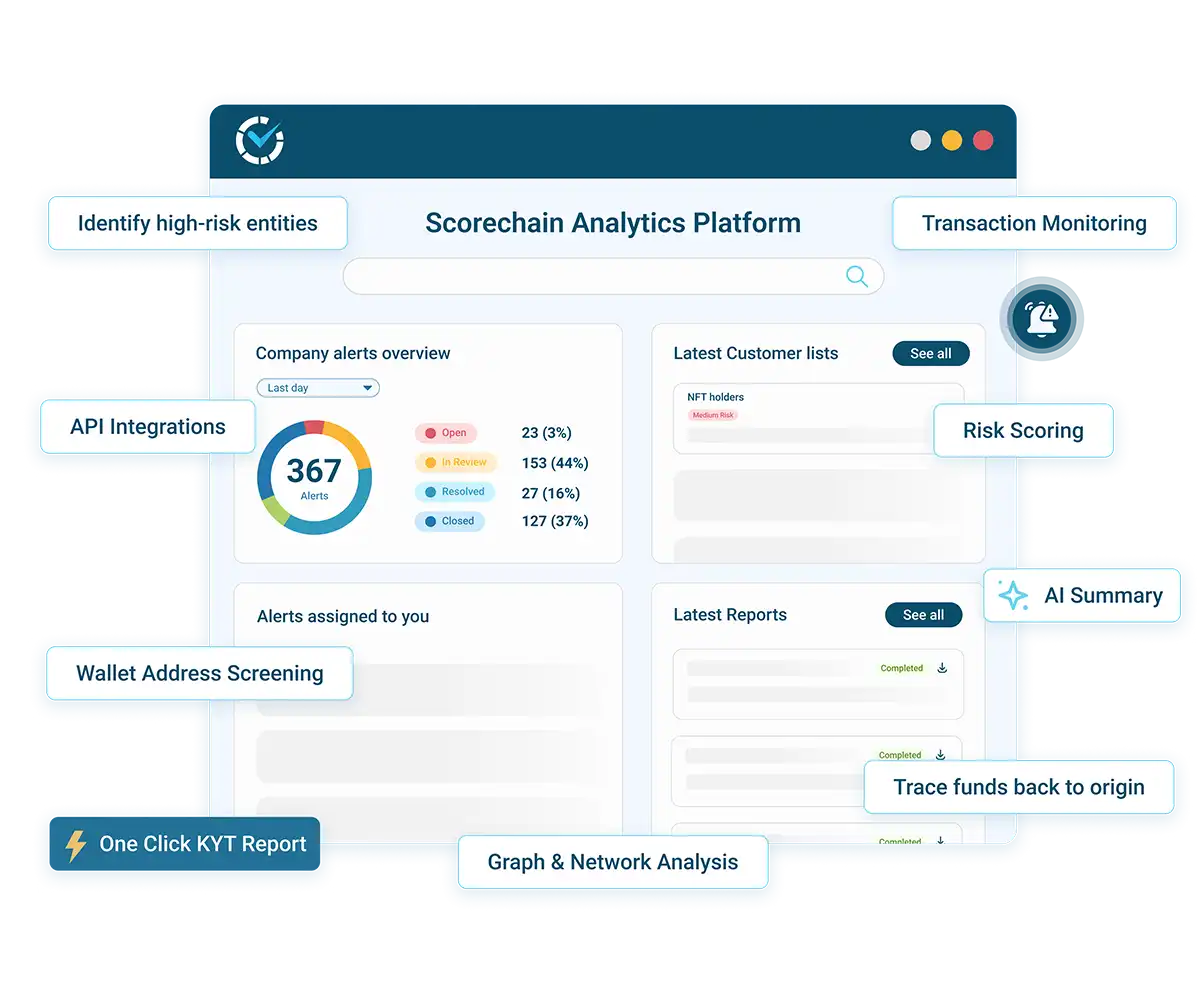
The FSA expects applicants to show working AML/CFT systems, including transaction monitoring, and it requires an Institutional Risk Assessment. Scorechain covers transaction monitoring, wallet risk scoring and counterparty checks. It does not verify customer identities or file suspicious transaction reports, and it does not replace your Institutional Risk Assessment or the FSA’s assessment.

  • Transaction monitoring: Transaction Monitoring runs rule-based scenarios by transaction direction, amount and triggered risk indicator, with an audit trail for each alert.
  • Wallet risk scoring: Wallet Screening scores an address or transaction from 1 to 100 for incoming and outgoing funds, where a lower score means higher risk.
  • Counterparty checks: the VASP Directory shows each VASP’s jurisdiction, compliance and security risk assessment, and its KYC and onboarding policies. A Know Your VASP report covers one provider’s regulatory status and fund flows.
  • Source of funds: the Source of Funds advisory service covers the origin of crypto assets and transactions, which can support the proof of source of funds the FSA asks for.
  • Travel Rule: the Travel Rule API provides one endpoint to send and receive originator and beneficiary data, routed through partner infrastructure.

To see how transaction monitoring and wallet screening could fit the AML controls in your Seychelles application, book a demo with the Scorechain team.

Frequently Asked Questions

Do I need a licence to run a crypto business from Seychelles?

Yes. The VASP Act requires a licence for anyone providing virtual asset services in or from Seychelles. A Seychelles-incorporated entity needs one even if it operates only from abroad.

How much does a Seychelles crypto license cost?

The application fee is SCR 75,000. The annual base fee is SCR 75,000 plus a fee per activity: SCR 300,000 for wallet providers, SCR 375,000 for exchange, SCR 150,000 for broking and SCR 75,000 for investment providers. Minimum paid-up capital for new entrants is USD 75,000 for wallet providers, USD 100,000 for exchange, USD 50,000 for broking and USD 25,000 for investment providers.

How long does a Seychelles VASP licence take?

The FSA says processing can take from 3 months to 2 years, depending on the complexity of the application. It advises within 90 working days whether an application is incomplete.

Do I need an office and staff in Seychelles?

Yes. You need a fully manned physical office, at least one resident director who spends 183 days or more a year in Seychelles, and a full-time compliance officer who cannot be outsourced. You must also hold at least 2 board meetings and 4 management meetings in Seychelles each year.

Is a Seychelles VASP licence the same as a CASP licence?

No. CASP is the term used in the EU’s MiCA regulation, while Seychelles licenses VASPs under the VASP Act, 2024. A Seychelles licence does not authorise services to clients in the EU, where a firm needs authorisation under MiCA from an EU national competent authority or must be entitled under MiCA Article 60.

Ready to Get Clarity on Your Risks?

From wallet screening and KYT monitoring to deep-dive investigations, Scorechain gives you everything you need to stay compliant, secure, and audit-ready.