Quick overview
This is some text inside of a div block.
.png)
Law enforcement agencies are facing increasingly complex forms of crime driven by globalisation and digitalisation. Ransomware attacks, large-scale fraud, and illicit financial flows now operate across borders by default, exploiting the speed of digital transactions and the fragmentation of regulatory and investigative frameworks. Criminal networks move faster, coordinate more effectively, and adapt quickly to enforcement pressure.
Traditional law enforcement investigations often struggle to keep pace. Many investigative tools were designed for domestic crime, linear case development, and retrospective analysis. In today’s environment, this creates blind spots. By the time suspicious activity is identified and intelligence is exchanged, criminal proceeds may already be laundered or beyond recovery.
Collaborative consortia are emerging as a practical response. By enabling intelligence sharing, pooled resources, and access to next-generation crime detection tools, consortia help law enforcement agencies strengthen investigations, improve cross-border cooperation, and respond more effectively to modern financial crime.
Financial crime today is inherently cross-border and technology-driven. Digital assets, online payment systems, and decentralised infrastructure allow criminal actors to obscure ownership and move value rapidly across jurisdictions. Investigations must now account for complex transaction chains, interconnected actors, and constantly evolving laundering techniques.

Law enforcement agencies often operate with fragmented data. Intelligence is distributed across multiple organisations, including financial institutions, supervisory authorities, and international partners. Signals that appear low risk in isolation may represent significant threats when analysed together, yet they are rarely correlated in real time.
This fragmentation limits investigative effectiveness. Addressing cross-border crime requires not only better tools, but also new models of collaboration that allow intelligence to be shared securely and acted upon quickly.
Consortia provide a structured framework for law enforcement collaboration without undermining legal mandates or operational independence. Participants contribute intelligence, typologies, and alerts within clearly defined governance structures, creating a shared understanding of risk across jurisdictions.
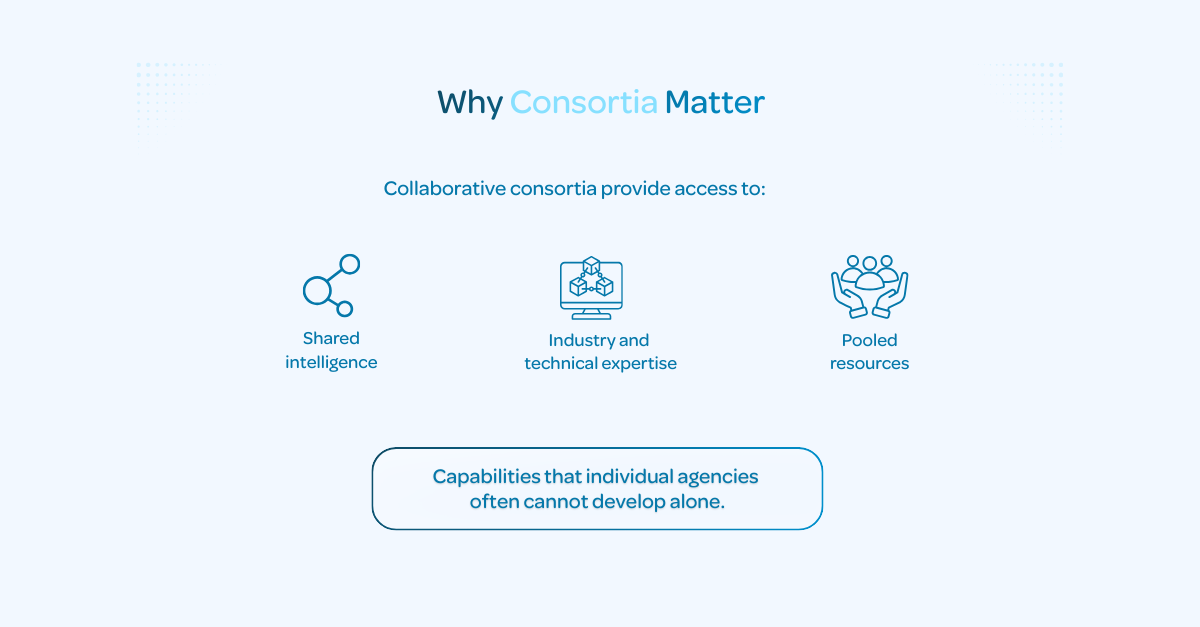
Through consortia, agencies gain access to shared intelligence and technical expertise that would be difficult to develop independently. Resources are pooled, reducing duplication of effort and enabling more advanced crime detection capabilities. This approach supports both operational investigations and strategic threat analysis.
Importantly, consortia do not replace existing investigative authorities. They enhance them by extending visibility, improving coordination, and enabling faster decision-making in complex cases.
One of the key advantages of consortium-based intelligence sharing is the ability to transform fragmented signals into actionable insight. When alerts and behavioural indicators are analysed across organisations and jurisdictions, emerging threats become visible earlier and with greater confidence.
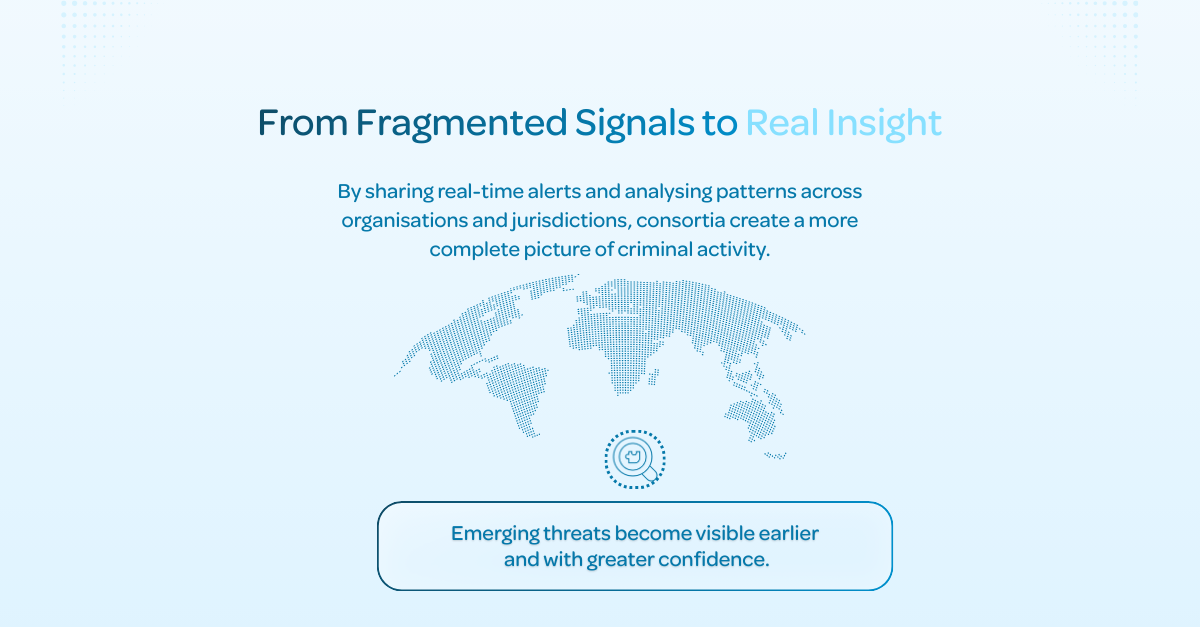
This collective visibility allows law enforcement agencies to identify coordinated criminal activity, trace illicit financial flows, and understand how networks operate across borders. Investigators can move beyond isolated transactions and analyse entire networks of actors and infrastructure.
Early detection is critical in financial crime investigations. Identifying patterns sooner increases the likelihood of intervention, disruption, and asset recovery.
The integration of advanced analytics and artificial intelligence further enhances investigative capabilities. Algorithms can detect anomalies, flag suspicious activity, and prioritize cases that require human intervention, improving both efficiency and accuracy. By collaborating within consortia, law enforcement can leverage these tools while benefiting from collective experience and best practices.
Modern consortia rely on next-generation crime detection tools designed to operate at scale. These tools enable law enforcement agencies to trace digital transactions, map networks of actors, and analyse large volumes of data efficiently.
Advanced transaction tracing and network analysis are particularly important in investigations involving digital assets. These capabilities support cross-border investigations by providing consistent methodologies and shared analytical views across participating agencies.
Within a consortium, shared platforms improve the quality and reliability of intelligence. Consistent analytical standards reduce friction in joint investigations and support effective information exchange.
In practice, participation in a consortium accelerates response times and increases the success rate of investigations. Agencies gain visibility into trends across industries, receive actionable intelligence, and can coordinate enforcement actions more effectively. Ultimately, consortia help law enforcement stay ahead of evolving criminal tactics, protect public safety, and make data-driven decisions in an increasingly complex environment.
Advanced analytics and artificial intelligence are increasingly central to modern law enforcement investigations. Algorithms can detect anomalies, flag suspicious behaviour, and prioritise cases that require human analysis.
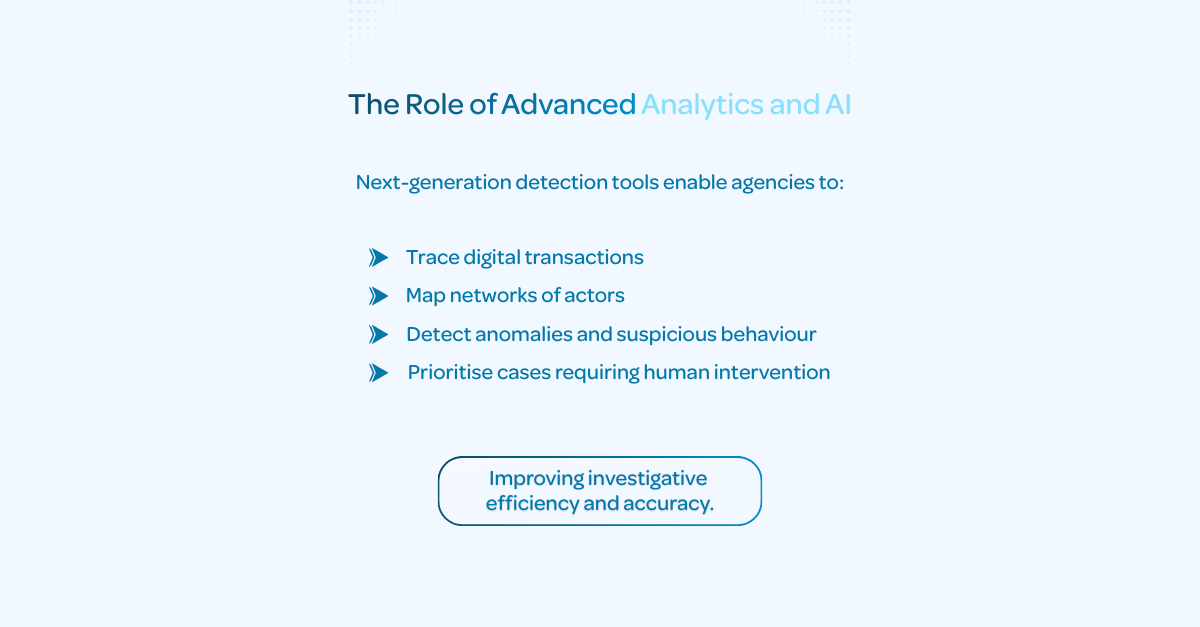
AI does not replace investigators. It supports them by filtering noise and highlighting high-risk activity. This allows investigative teams to focus resources on cases with the greatest potential impact.
When used within a consortium, analytics and AI deliver even greater value. Insights generated in one investigation can inform detection models across the network, improving accuracy and reducing response times for all participants.
In practice, participation in a law enforcement consortium leads to faster response times and improved coordination across agencies. Intelligence is shared proactively rather than through slow, formal requests, enabling more timely intervention.
Consortia also contribute to higher investigation success rates. Broader visibility and advanced analytics strengthen case development and support more effective enforcement actions. Over time, shared intelligence helps agencies anticipate emerging threats rather than reacting after harm has occurred.
Criminal networks continuously adapt to enforcement pressure and regulatory change. Static investigative models are no longer sufficient. Law enforcement must be able to evolve at the same pace.
Collaborative consortia provide a framework for continuous learning and adaptation. By combining intelligence sharing, advanced analytics, and coordinated action, consortia empower law enforcement agencies to address cross-border crime more effectively and protect public safety in an increasingly complex environment.