Quick overview
This is some text inside of a div block.
.png)
Tether’s launch of USAT, issued through Anchorage Digital Bank and deployed on Ethereum, marks an important shift in how stablecoins are entering regulated financial infrastructure. Unlike previous generations of stablecoins that operated primarily through offshore issuance models, USAT is anchored to US banking rails while remaining fully transparent on public blockchains.
For compliance teams, exchanges, banks, and crypto service providers, this creates a new operational reality. Stablecoins are no longer just settlement tools. They are becoming regulated digital payment instruments that require continuous transaction monitoring, exposure analysis, and real-time risk oversight.
The advantage is that this activity happens on-chain. Every minting transaction, exchange allocation, and liquidity movement can be traced using blockchain analytics.
USAT is a USD-backed stablecoin issued via Anchorage Digital Bank, a federally chartered crypto-native bank. The first deployment on Ethereum immediately exposes issuance and distribution flows to public blockchain monitoring.
This matters because stablecoin compliance risk does not start at the retail wallet level. It starts at the issuance layer. Understanding where newly minted supply is distributed, how liquidity is routed, and which counterparties receive early allocations is now part of institutional risk management.
Regulators increasingly expect crypto businesses to demonstrate visibility over stablecoin activity. This includes transaction traceability, counterparty risk identification, and exposure concentration analysis. With USAT entering the market under a more structured issuance framework, the operational bar is being raised.
Traditional finance relies on delayed reporting and fragmented settlement data. Stablecoins operate differently. Every transaction is public, timestamped, and verifiable.
This allows compliance teams to monitor stablecoin activity in real time. USAT minting transactions can be traced from the issuing wallet. Distribution flows to exchanges can be identified. Liquidity movement patterns can be analyzed as they develop, not weeks later through reconciliation reports.
This level of transparency changes how risk teams operate. Instead of reacting to post-event reporting, institutions can proactively monitor stablecoin exposure and transaction behavior as it happens.
Blockchain analytics platforms such as Scorechain allow institutions to convert raw transaction data into structured compliance intelligence.
When USAT transactions are processed on Ethereum, they can be automatically classified, attributed, and scored. Exchange clusters can be identified. Treasury wallets can be monitored. Transaction flows can be mapped across counterparties and platforms.
This allows compliance teams to answer critical operational questions. Where is newly issued stablecoin liquidity being concentrated? Which exchanges are receiving the highest share of supply? How quickly is liquidity being redistributed? Are high-risk counterparties interacting with stablecoin flows?
These insights are not theoretical. They are visible directly on-chain.
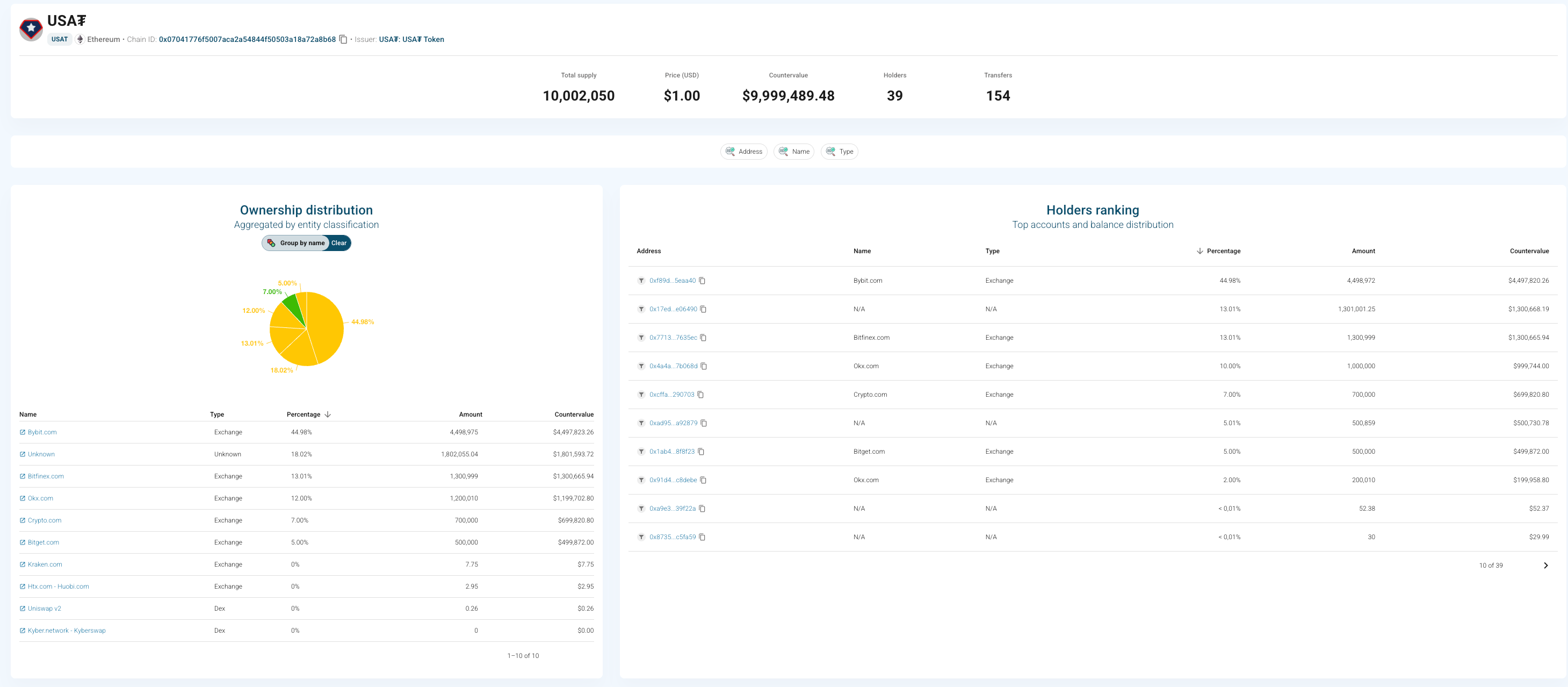
Inside Scorechain’s platform, USAT transactions can be analyzed using risk scoring, entity attribution, and transaction flow visualization.
The interface allows compliance teams to view transaction volumes, USD equivalent values, exchange exposure breakdowns, and risk indicators in a single workflow. This supports faster investigations and clearer audit trails.
By combining transaction monitoring with entity clustering and compliance scoring models, institutions gain operational visibility that aligns with regulatory expectations for crypto AML monitoring and blockchain compliance.
Stablecoins are increasingly used by payment providers, crypto exchanges, banks entering digital asset custody, and institutional trading desks. As usage grows, regulators treat stablecoins less like experimental crypto assets and more like digital representations of fiat currency.
This means compliance obligations will continue to expand. Institutions will be expected to demonstrate transaction monitoring coverage, exposure reporting, counterparty due diligence, and real-time alerting capabilities.
USAT is an early example of this transition. It shows how stablecoin issuance is becoming more structured, regulated, and institutionally integrated.
Partnership announcements create headlines. Blockchain data reveals operational reality.
With on-chain analytics, institutions do not need to rely on press statements to understand how stablecoin liquidity is deployed. They can observe minting activity, exchange distribution, and transaction flows directly.
For compliance teams, this represents a major shift. Monitoring stablecoin risk is no longer about static reporting. It is about continuous visibility, transaction-level intelligence, and proactive risk management.
As stablecoins continue to expand across regulated markets, institutions that invest in proper blockchain analytics infrastructure will be better positioned to manage compliance risk, satisfy regulatory expectations, and operate confidently in digital asset markets.



















.webp)