Crypto License Switzerland
Switzerland has no single crypto licence. SRO membership covers most payment and exchange services. FINMA licences cover deposits, securities and trading.
Switzerland has no single crypto licence. SRO membership covers most payment and exchange services. FINMA licences cover deposits, securities and trading.








FINMA, the Swiss Financial Market Supervisory Authority, applies existing financial market law to crypto activities. The authorisation you need depends on what your business does and which assets it handles.
MiCA does not apply in Switzerland. Swiss firms still have to meet Swiss AML rules, and those that actively serve EU clients should check whether MiCA applies to that activity. See our MiCA guide for the EU framework.
Switzerland does not issue a CASP licence the way EU member states do under MiCA, so searching for one leads nowhere. FINMA treats a business that only moves or exchanges crypto-assets for clients as a financial intermediary under anti-money laundering law. A business that holds client deposits, trades securities or runs a trading venue needs a FINMA licence.
You are likely to need SRO membership or a FINMA licence if your company:
Confirm the classification with FINMA before you build. FINMA publishes its crypto guidance documents on its website.
FINMA licensed its first DLT trading facility, BX Digital AG, on 18 March 2025. BX Digital applied for a small facility, which carries certain regulatory relief and size limits.
The Federal Council opened a consultation on 22 October 2025 to replace the FinTech licence with a payment instrument institution licence and to add a crypto-institution licence. The proposed crypto-institution licence would cover custody (including staking), customer trading and crypto exchange services. Licensed banks and securities firms would not need a separate crypto-institution licence. The consultation closed on 6 February 2026. The Federal Council planned to send its dispatch to Parliament in the second half of 2026 at the earliest. As of 28 October 2026 we found no adopted dispatch or law, so check the Federal Council’s site for the current status. Law firm commentary expects entry into force in 2027 at the earliest.
Both new categories would sit under direct FINMA supervision. That would move most custodial wallet and customer trading providers that are now supervised by an SRO. The proposal would also remove the CHF 100 million cap on client funds. The consultation draft proposes a one-year transition after entry into force. This is a proposal, not law. Until a law is enacted, nothing changes for existing SRO members or FinTech licence holders.
FINMA sorts tokens by economic function, and the category decides which rules apply. Hybrid forms are possible.
FINMA Guidance 06/2024, published on 26 July 2024, covers the risks for stablecoin issuers and for banks that provide guarantees. A default guarantee from a bank can take the issuer outside the deposit rules, so it does not need a banking licence, but the guarantee must meet FINMA’s minimum requirements. FINMA also expects the identity of every stablecoin holder to be verified, by the issuer or a supervised intermediary, and does not allow anonymous transfers. The proposed payment instrument institution licence would regulate issuance directly. Stablecoin compliance tools track token and stablecoin activity.
FINMA Guidance 08/2023, published on 20 December 2023, states FINMA’s current assessment that staked crypto-assets should be separated from a bankrupt provider’s estate and returned to custody customers, while the legal position awaits legislation or case law. FINMA names three risks providers should explain to customers: technical risk such as slashing, counterparty risk in bankruptcy, and market risk from lock-up or exit periods. Staking does not trigger a capital requirement for a supervised institution that has put risk-mitigating measures in place and informed customers.
FINMA Guidance 01/2026, published on 12 January 2026, applies to FINMA-supervised institutions that hold crypto-based assets or offer related services, including banks, securities firms, portfolio managers and collective investment schemes. Customers’ assets must be held so that they are protected in the custodian’s bankruptcy. A custodian may delegate to a foreign provider only if that provider is subject to equivalent prudential supervision and foreign law gives comparable bankruptcy protection. The supervised institution stays fully responsible for the custody structure.
The steps differ by licence. The outline below follows FINMA’s published process for bank and securities firm licences. FINMA publishes separate guidance for the FinTech licence and the DLT trading facility.
To operate a crypto business in Switzerland, you must:
All financial intermediaries in Switzerland, FINMA-licensed or SRO-affiliated, carry the same core customer due diligence duties:
FINMA lowered the client identification threshold for crypto exchange transactions from CHF 5,000 to CHF 1,000, effective 1 January 2021.
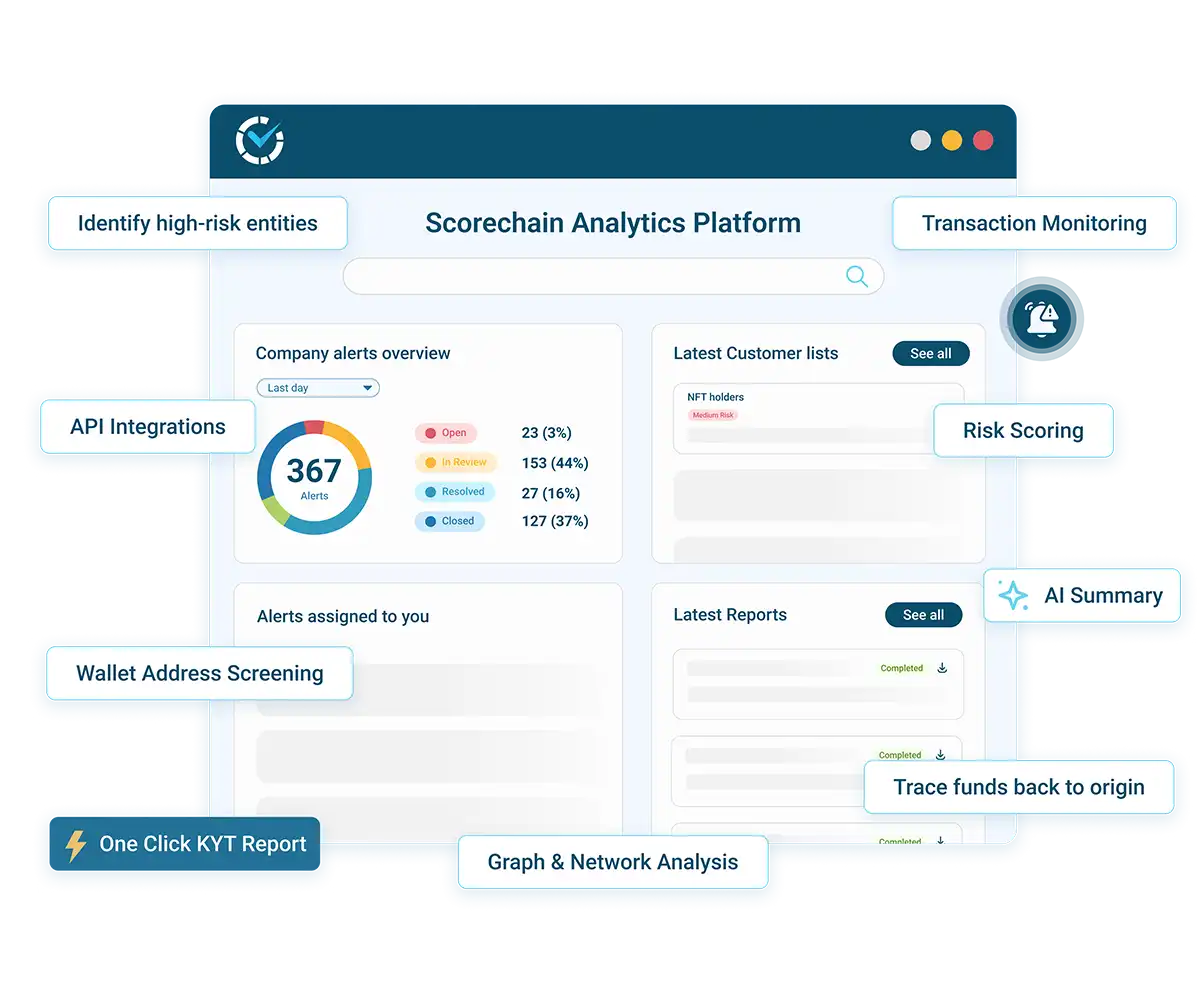
Scorechain gives Swiss crypto companies AML and risk monitoring tools for domestic and cross-border flows. The table shows what the tools cover and what stays with your team.
Transaction monitoring lets you build alert scenarios from transaction direction, amount and triggered risk indicators. Monitoring runs in real time across 25+ blockchains, with risk scores on addresses and transactions.
The Travel Rule API gives one endpoint to exchange originator and beneficiary data through partner infrastructure, and Scorechain works with Travel Rule partners such as Notabene and CryptoSwift. Customer identification stays in your own KYC process, and the API does not guarantee regulatory approval.
KYT and KYA reports show the risk indicators, entities and exposure behind an address or transaction, including exposure to darknet markets and scams. KYA reports export as PDF or CSV.
Wallet screening identifies exposure to sanctioned, illicit and high-risk wallets. The free Sanctions Screening API checks addresses against OFAC, OFSI, MOFA and NBCTF lists. For transfers with external wallets, screening gives the risk view on the counterparty address, while proof of ownership remains a separate step in your onboarding. Scorechain flags the risk so your team decides whether to proceed.
Scorechain has supported more than 200 organisations with AML compliance, blockchain analytics and regulatory risk management. Swiss firms that actively serve EU clients should check whether MiCA applies to them, because an authorised CASP needs a registered office and effective management in the EU.
To see wallet screening, transaction monitoring and KYT reports run on your own Swiss flows, book a demo with the Scorechain team.
No. Switzerland has no CASP licence and MiCA does not apply. Crypto firms need the authorisation that fits their activity: SRO membership as a financial intermediary, or a FINMA licence such as a FinTech, bank, securities firm or DLT trading facility licence. A crypto-institution licence is proposed but not in force.
It depends on the model. Exchange activity falls under anti-money laundering rules, which means SRO membership as a baseline. Holding client deposits can require a FinTech or bank licence, and operating a trading facility can require a securities firm or DLT trading facility licence. Confirm the classification with FINMA before launch.
There is no single figure. The FinTech licence needs 3% of deposits and at least CHF 300,000, a securities firm needs CHF 1.5 million fully paid up, and a bank needs CHF 10 million fully paid up. SRO membership carries no licence capital.
FINMA gives no fixed timeline. Duration depends on the licence type, the quality and complexity of the application and how quickly foreign supervisory authorities respond.
FINMA distinguishes payment, utility and asset tokens, and hybrids of these. Payment tokens fall under anti-money laundering rules, asset tokens are treated as securities, and utility tokens are securities only if they work partly or wholly as an investment.
Issuance is not yet covered by a dedicated licence. Many issuers rely on bank default guarantees under FINMA Guidance 06/2024. The proposed payment instrument institution licence would allow issuance of a defined type of stablecoin under special obligations.
Not on a Swiss authorisation alone. A Swiss licence is not among the entities MiCA lists for providing crypto-asset services in the EU, and an authorised CASP needs a registered office in an EU Member State. Under Article 59, the CASP also needs its place of effective management in the EU and at least one director resident in the EU. Firms that actively serve EU clients should take legal advice on EU authorisation.
Knowingly carrying on an activity that requires authorisation, including SRO membership, without it is an offence under Article 44 of the Financial Market Supervision Act. The penalty is up to three years in custody or a monetary penalty, and negligent conduct carries a fine of up to CHF 250,000. Licensed and SRO-affiliated firms can also face supervisory action and reputational damage if their AML controls fall short.
From wallet screening and KYT monitoring to deep-dive investigations, Scorechain gives you everything you need to stay compliant, secure, and audit-ready.