Quick overview
This is some text inside of a div block.
.png)
The recent dismantling of Cryptomixer by Europol, German authorities, and the Swiss Federal Police has become one of the most significant enforcement actions targeting crypto mixers in Europe. Europol’s announcement confirms that the mixer’s infrastructure was taken offline, its servers were seized, and over twelve terabytes of operational data were secured, along with an estimated twenty five million euros worth of Bitcoin.
The operation effectively removes a major mixing service that had been active since 2016 and was widely used by illicit actors to conceal the origin of funds. According to Europol’s statement, Cryptomixer processed more than 1.3 billion euros in Bitcoin flows tied to criminal activity.
Read here for official Europol announcement
Custodial mixers like Cryptomixer operate by pooling deposits and redistributing funds to break transaction traceability. While the intention is to obscure origin, such activity consistently aligns with high-risk typologies expected in money laundering cases.
For regulated entities, mixer interaction is a high-severity red flag within AML frameworks. Funds routed through mixers often show proximity to darknet markets, fraud networks, ransomware operations, and sanctioned entities. Regulators increasingly classify mixer usage as an attempt to conceal financial activity rather than a legitimate privacy practice.
Scorechain’s analytics highlight a particularly relevant risk signal for compliance teams: one Bitcoin wallet associated with Cryptomixer shows incoming funds traced to an entity linked to a darknet marketplace. This confirms known behavioural patterns where criminal proceeds
Incoming exposure from darknet marketplace
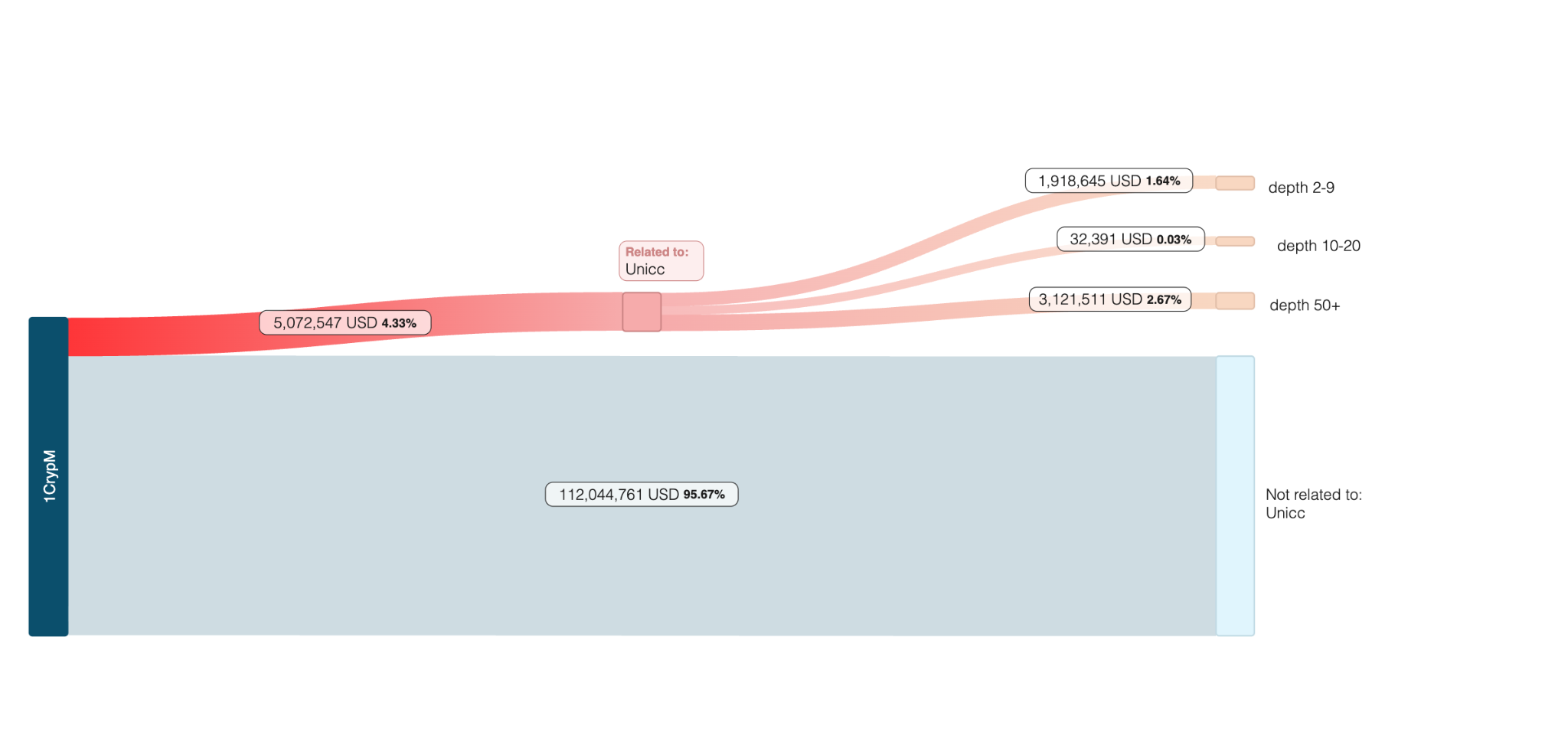
On the outgoing side, the same wallet shows fund flows toward an entity associated with another previously seized platform, illustrating how laundered funds often circulate between compromised or illicit services rather than toward regulated exchanges.
This reinforces the importance for compliance teams to treat mixer-derived transactions with heightened scrutiny, as exposure is rarely isolated and often intersects across multiple high-risk clusters.
Outgoing exposure toward a seized service
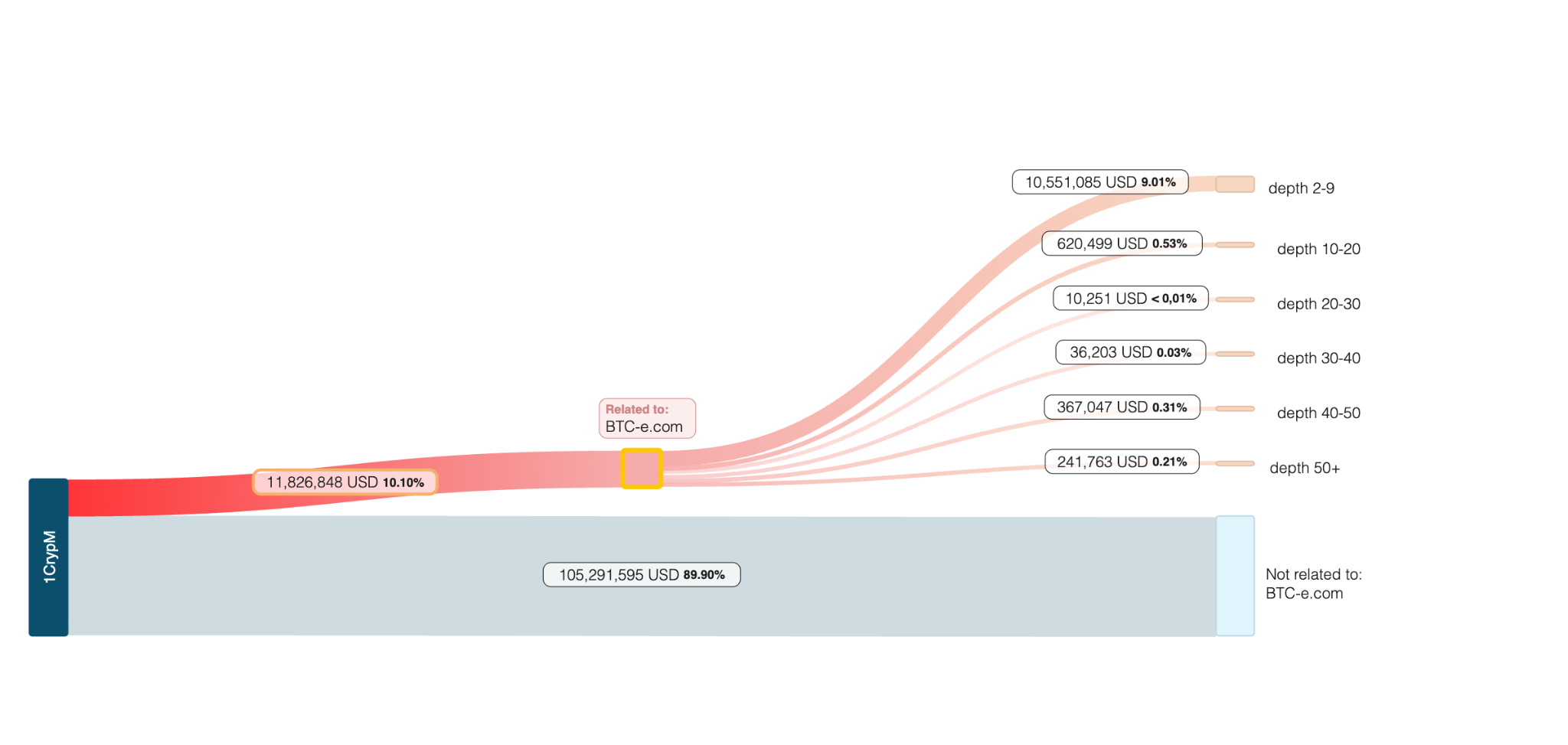
Beyond direct counterparties, Scorechain’s flux analysis reveals the depth and distribution of flows connected to the Cryptomixer wallet. This includes:
• Early-stage inflows from darknet-linked origins
• Distribution patterns at varying transaction depths
• Long-range outgoing flows reaching high-risk or seized entities
• A clear separation between illicit-linked flows and non-linked flows that pass through the mixer
The flux diagrams show that while most of the wallet’s flows are not directly tied to high-risk entities, a meaningful portion can be traced to illicit sources at early depths and re-routed toward additional high-risk destinations further down the transaction path.
This illustrates how mixers disperse risk across multiple layers and why AML teams require analytics that classify exposure not only at direct adjacency but across multiple hops.
The Europol takedown reinforces an important reality for compliance operations. Mixer exposure is no longer limited to darknet-related environments. It regularly appears in customer deposits, withdrawals, OTC trading activity, and institutional settlement flows.
For regulated entities, strong AML controls must include the ability to:
• Identify mixer exposure at different depth levels
• Detect indirect connections to darknet markets and seized assets
• Assess transaction risk using objective on-chain data
• Implement enhanced due diligence workflows for flagged flows
• Document compliance decisions using reliable analytics
As enforcement actions increase, the expectation for proactive monitoring will only grow. Scorechain enables compliance teams to identify high-risk flows efficiently and ensure that adherence to AML requirements remains consistent and defensible.
The removal of Cryptomixer marks another shift in how regulators and law enforcement approach anonymity-enhancing tools. Criminal actors will continue adapting, moving to new mixers, decentralised protocols, or cross-chain obfuscation techniques. The pressure on compliance teams, therefore, is increasing.
Reliable blockchain analytics provide the visibility needed to navigate this environment with confidence. Understanding how funds move before and after interacting with mixers is essential for maintaining a strong AML framework.
With high-risk signals now clearer than ever, the Europol action against Cryptomixer underlines the importance of stronger AML controls supported by transparent, data-driven blockchain analysis.