Brazil now licenses crypto firms through the Central Bank. See the AML, Travel Rule and reporting rules that apply, and how Scorechain supports your controls.
Brazil now regulates crypto service providers under Law 14,478/2022 and three Central Bank of Brazil (BCB) resolutions that took effect on 2 February 2026. Providers need BCB authorisation, must run AML and counter-terrorist financing controls, and report to the authorities.
Brazil’s Crypto Regulations in 2026
Until 2026, Brazil had a crypto law but no operating authorisation regime. The Virtual Assets Law was enacted in December 2022, and the BCB resolutions published on 10 November 2025 set out how providers, called SPSAVs (Sociedades Prestadoras de Serviços de Ativos Virtuais), are authorised, supervised and reported on. Several obligations are phased in through 2028, so deadlines matter.
Why Crypto Compliance in Brazil Matters
Avoid fines and licensing problems: Providers must hold BCB authorisation to operate. Firms already operating had to file the first phase of their application by 30 October 2026, and firms that did not file must end regulated services within 30 days of that date.
Prevent illicit crypto activity: Under the AML Law (9,613/1998), providers carry customer identification, recordkeeping, internal control and COAF reporting duties. Screening and monitoring show where funds come from and where they go.
Show regulators your controls: Documented alerts, case notes and an audit trail give you evidence when a supervisor asks how you reached a decision.
Law 14,478/2022 (Virtual Assets Law): Defines virtual assets and VASPs, and requires prior authorisation from the regulator the federal Executive designates. Decree 11,563/2023 designated the BCB for services that are not securities.
BCB Resolutions 519, 520 and 521: Published on 10 November 2025 and effective from 2 February 2026. Resolution 519 covers authorisation, Resolution 520 covers operations, AML and the Travel Rule, and Resolution 521 brings virtual asset activity into the foreign exchange regime.
AML Law 9,613/1998 and COAF: Law 14,478/2022 added virtual asset service providers to the obliged persons in Article 9. Providers follow customer identification, recordkeeping and internal control rules, and send suspicious activity reports to COAF, Brazil’s financial intelligence unit.
Foreign exchange rules: Buying or selling fiat-pegged stablecoins and using virtual assets for international transfers fall under FX regulation. Under Resolution BCB 574/2026, institutions authorised in the FX market send monthly data on virtual asset operations to the BCB, for operations from 3 November 2026, by the fifth day of the following month.
Counterparty restriction (Resolution BCB 589/2026): From 6 November 2026, financial institutions, payment institutions and other BCB-authorised institutions may not carry out or enable virtual asset operations with providers that lack BCB authorisation, except where Resolution 520 expressly allows.
Crypto Travel Rule: Resolution 520 requires the Travel Rule in two stages, in line with FATF standards: by February 2027 for transfers between providers established in Brazil, and by February 2028 for cross-border transfers.
CVM and tax reporting: The CVM keeps authority over tokens that are securities. For tax, Receita Federal’s DeCripto (IN RFB 2,291/2025) follows the OECD CARF and applies to monthly reporting from 1 July 2026.
Rules differ by activity, so confirm which obligations apply to your service with Brazilian counsel. Use wallet and transaction screening to see how risk scores apply to wallets and transfers under these rules.
Scorechain’s AML Solutions for Crypto Businesses in Brazil
Scorechain supports these controls with data and workflow. It does not file reports for you or replace your compliance programme.
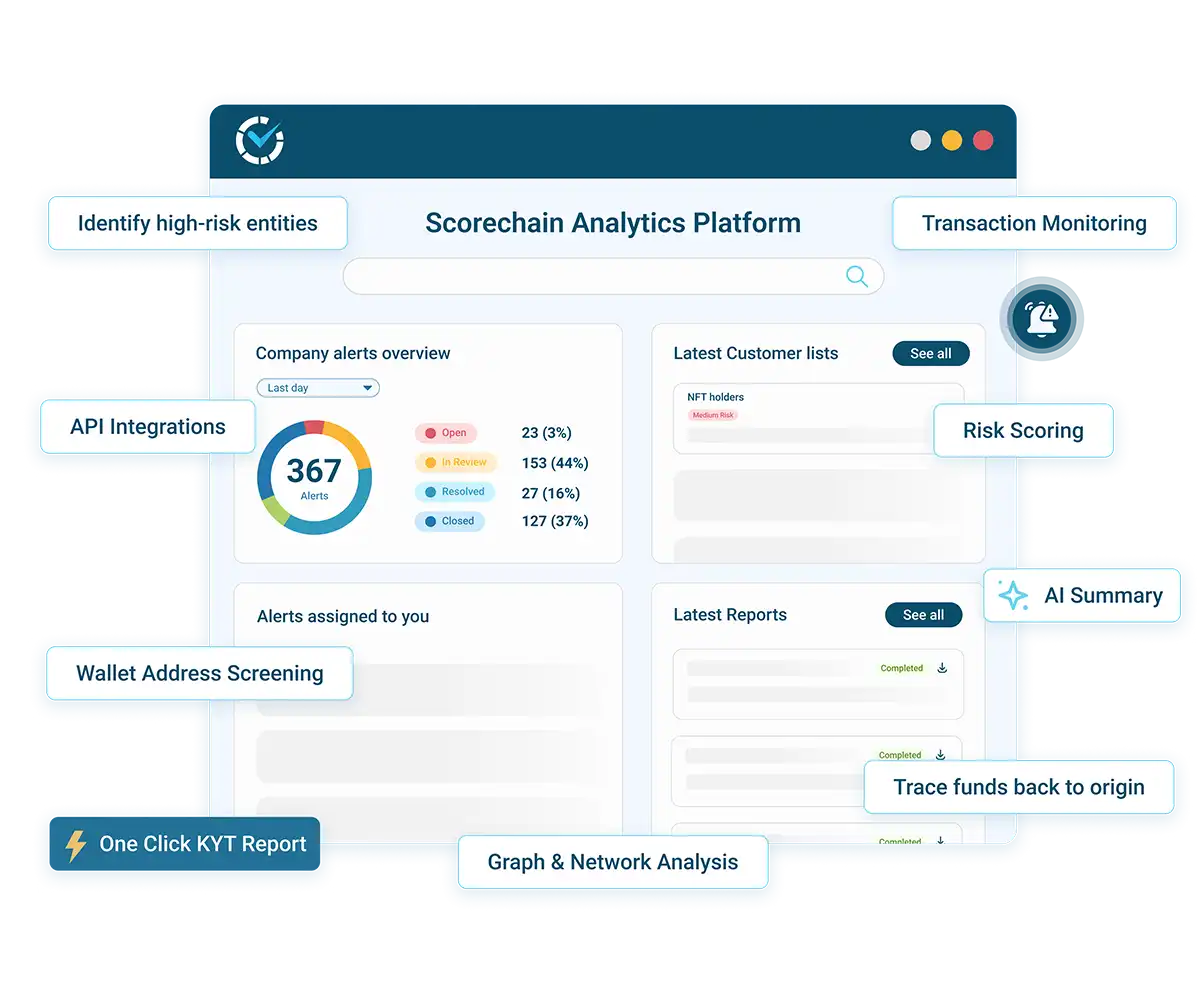
Transaction monitoring: Build scenarios from amount, direction and triggered risk indicators, receive alerts in real time and keep an audit trail of each decision.
Wallet and transaction screening: Each address gets a risk score from 1 to 100 for incoming and outgoing funds, where a lower score means higher risk, across 25+ blockchains.
Alerts and cases: Set thresholds and risk indicators with customisable alerts, then investigate in Case Manager with an owner, comments, files and exportable case reports for internal records or authorities.
Travel Rule data exchange: The Travel Rule API sends and receives originator and beneficiary data through partner infrastructure. It supports your process and does not replace your own compliance assessment.
Counterparty checks:VASP risk assessments cover a counterparty’s regulatory status, countries of operation and fund flows, which supports your due diligence before you transfer or enable operations.
Integrations: Scorechain connects to custody platforms such as Fireblocks, Taurus and BitGo, and to your own systems through its API.
Crypto Compliance in Brazil Checklist for Your Business
Use this list to check where your programme stands.
Authorisation: You hold BCB authorisation, or you filed the first-phase application by 30 October 2026 with the independent assurance report that BCB rules require for virtual asset service provider applications.
Screening: Customer wallets and counterparties are screened before onboarding and before transfers.
Monitoring: Crypto transaction monitoring scenarios are set, and every alert has an owner and a documented outcome.
Travel Rule: You have a process to collect and send originator and beneficiary data for the phase that applies to you.
Counterparties: You know whether each VASP you deal with holds BCB authorisation, and you document the check.
Suspicious activity: Your team knows when and how to report to COAF.
Reporting data: You can produce stablecoin FX records and DeCripto data from your own records.
For a one-click report on any address or transaction, with risk scores, risk indicators and entity information, use KYA and KYT reports.
Frequently Asked Questions about Crypto Compliance in Brazil
Who regulates cryptocurrency in Brazil?
The BCB authorises and supervises virtual asset service providers under Law 14,478/2022. The CVM regulates tokens that are securities, COAF receives suspicious activity reports, and Receita Federal handles crypto tax reporting.
Do crypto businesses need authorisation to operate in Brazil?
Yes. Providers need prior BCB authorisation and must operate through a legal entity incorporated in Brazil. Firms already operating had to file the first phase of their application by 30 October 2026 and can keep operating while the BCB reviews it. Firms that did not file must end regulated services within 30 days of the deadline.
Can Brazilian banks work with unauthorised crypto providers?
Generally no. Since 6 November 2026, financial institutions, payment institutions and other BCB-authorised institutions may not carry out or enable virtual asset operations with providers that lack BCB authorisation, except in the forms Resolution 520 expressly allows.
Is reporting crypto transactions mandatory in Brazil?
Yes, in several ways. The reporting duties are:
Suspicious activity: Providers report to COAF under the AML Law.
FX data: Institutions authorised in the FX market send monthly virtual asset data to the BCB for operations from 3 November 2026.
Tax reporting: Service providers report to Receita Federal through DeCripto from 1 July 2026.
Does Brazil require the Travel Rule for crypto?
Yes. Resolution 520 requires it, with a first stage by February 2027 for transfers between Brazilian providers and full compliance by February 2028, including cross-border transfers.
How does Scorechain help with crypto compliance in Brazil?
Scorechain provides transaction monitoring, wallet screening, risk scoring, alerts and case management for exchanges, fintechs and banks. It supports your controls and records, and it does not file reports on your behalf.
Scorechain for Crypto Compliance in Brazil
Since 6 November 2026, Brazilian institutions generally cannot enable virtual asset operations with unauthorised providers, and monthly FX reporting now applies to operations since 3 November. To test your alert rules, case records and counterparty checks against both, book a demo with the Scorechain team and bring one real scenario.
Ready to Get Clarity on Your Risks?
From wallet screening and KYT monitoring to deep-dive investigations, Scorechain gives you everything you need to stay compliant, secure, and audit-ready.