A guide to the Portugal CASP license under MiCA: Banco de Portugal process, capital classes, required documents and the AML tools that support your application.
Portugal implemented MiCA through Law 69/2025 of 22 December, approved by Parliament on 5 December 2025. Until then, crypto firms only needed to register with the Banco de Portugal for anti-money laundering purposes. That registration no longer lets a company operate on its own.
30 December 2024: MiCA rules for crypto-asset service providers start to apply.
22 December 2025: Law 69/2025 implements MiCA in Portugal.
1 July 2026: the transition period ends. Firms that were only on the old VASP register must have been authorised or stop serving clients.
29 July 2026: Bison Bank announced that it had become the first bank in Portugal to operate directly as a CASP under MiCA, offering custody, exchange and advisory services.
Firms registered with the Banco de Portugal before MiCA could keep operating during the transition, but pending registration applications lapsed when the law took effect. Firms that changed their corporate purpose, activity type or shareholder structure lost the transitional benefit.
Firms without authorisation had to stop onboarding and marketing to new clients and limit themselves to an orderly exit, while still meeting their AML obligations in full. Check the live ESMA register for the current number of Portuguese CASPs, as it changes frequently.
Portugal Crypto License (CASP): Your Guide to Banco de Portugal Authorisation & AML Compliance
Portugal’s crypto regime is overseen by the Banco de Portugal and the CMVM. A CASP authorisation here also gives access to the EU market, and Scorechain supports the AML controls you need at every stage.
What is a Crypto License in Portugal?
A crypto license in Portugal is an authorisation as a Crypto-Asset Service Provider (CASP) under MiCA. It replaces the former VASP registration with the Banco de Portugal. It is mandatory for businesses offering:
Exchange between crypto-assets and fiat currency, or between crypto-assets
Transfers of crypto-assets
Custody or administration of crypto-assets, including private keys
Operating a trading platform, executing orders, placing, and advice or portfolio management for crypto-assets
Who Regulates Crypto Firms in Portugal?
Banco de Portugal: grants or refuses CASP authorisation, sets prudential and governance requirements, and supervises issuers of asset-referenced tokens and e-money tokens. It is also the AML/CFT supervisor under Law 83/2017.
CMVM: gives a reasoned opinion on each application (10 business days on completeness and 15 on compliance, with silence counting as no objection) and supervises conduct rules, custody, trading platforms and market abuse.
Travel Rule: Regulation (EU) 2023/1113 on information accompanying transfers is implemented in Portugal by Law 70/2025. Its data-sharing duties are covered by the Travel Rule.
Why Portugal for Your Crypto Company?
EU access: a CASP authorisation granted in Portugal can be passported across the EU and EEA.
A defined process: the Banco de Portugal authorises, the CMVM gives its opinion, and the MiCA time limits apply to the review.
Capital by service class: MiCA sets minimum capital from €50,000 to €150,000 (see the classes table below).
Portugal Crypto License Requirements
Local entity: incorporate a company, for example an LDA or SA.
EU presence with real substance: a registered office in an EU member state and effective management in the EU, with at least one EU-resident director. For an application to the Banco de Portugal, a Portuguese entity with a physical office and local staff is the normal route.
AML officer and controls: meet AML-CFT and KYC standards, and appoint a named AML officer.
Minimum capital: hold the capital for your service class (€50,000, €125,000 or €150,000).
Fit and proper management: managers and qualifying shareholders must show good repute, and ownership must be transparent.
ICT resilience: DORA-aligned ICT, security and business continuity arrangements.
Documentation: operational, financial and risk management documents (see the documents list below).
CASP License Classes in Portugal
Portugal does not issue different license names. MiCA groups crypto-asset services into three capital classes, and your class depends on the services you want to provide.
Class
Minimum capital
Services covered
Class 1
€50,000
Execution of orders, placing, reception and transmission of orders,
advice, portfolio management and transfer services
Class 2
€125,000
Everything in Class 1, plus custody and administration, and exchange
of crypto-assets for funds or other crypto-assets
Class 3
€150,000
Everything in Class 2, plus operating a trading platform
If a quarter of your previous year’s fixed overheads is higher than the minimum, that higher amount applies. Banks and investment firms do not apply for a full CASP license. They notify their regulator at least 40 working days before offering crypto-asset services.
Step-by-Step Guide to Getting a Portugal Crypto License
Step 1: Company Formation
Choose a legal structure (LDA or SA), register the company in Portugal, and secure an office and a local representative.
Step 2: Compliance Preparation
Draft AML/CFT policies and KYC procedures, hire and train an AML officer, and prepare your risk assessment, monitoring framework and internal controls. Plan your transaction monitoring and Travel Rule processes before you file.
Step 3: Submit the CASP Application
Apply to the Banco de Portugal with the full documentation, then answer any information requests from the Banco de Portugal and the CMVM. Under MiCA, the authority has 25 working days to check that the file is complete and 40 working days to decide on a complete application. A request for more information can pause the clock for up to 20 working days. Preparing the file usually takes much longer than the review itself, so plan several months in total.
Required Documents for a Crypto License in Portugal
Corporate documents: articles of association, company details and group structure.
Programme of operations: services, business model, target markets and financial projections.
Governance: details, CVs and good repute evidence for managers, and information on qualifying shareholders.
Capital and prudential: evidence of own funds and safeguards.
AML/CFT: business-wide risk assessment, KYC and customer due diligence, monitoring and suspicious activity reporting procedures.
ICT and security: ICT risk framework, incident reporting and business continuity.
Client protection: client asset segregation, custody policy, complaints handling and conflicts of interest.
Outsourcing and trading rules: third-party provider arrangements, and trading platform rules where relevant.
What Can Hold Up a CASP Application
A weak programme of operations or business plan
AML/KYC policies that exist on paper but do not run in practice
Opaque ownership or unclear funding sources
Insufficient capital or a lack of real substance in the EU
Gaps in ICT security and governance documentation
EU Passporting from Portugal
A CASP authorised in Portugal can offer services in other EU and EEA countries by notifying its home authority under Article 65 of MiCA, with no second license required. The same MiCA rules apply in each market, for example under the CASP license in Spain.
Taxes for Crypto Companies in Portugal
Portuguese companies pay corporate income tax (IRC), and the rate and any regional regime depend on the company’s location and eligibility. Crypto gains follow separate rules. Rates and conditions change, so confirm the current position with a Portuguese tax adviser before you choose a structure.
Penalties for Operating Without Authorisation
Since the transition ended, providing crypto-asset services in Portugal without authorisation is an administrative offence under Law 69/2025, which provides for significant fines and ancillary penalties. Check the penalty framework in the law text with a Portuguese lawyer.
Post-Authorisation Responsibilities
Prudential and governance rules: keep meeting the requirements the Banco de Portugal supervises, including capital, governance and information to the authorities.
Conduct rules: follow the CMVM’s rules on client interest, custody, complaints and conflicts of interest.
AML/CFT: run ongoing transaction monitoring and customer due diligence, and report suspicious activity.
Travel Rule: collect and send originator and beneficiary data with crypto transfers.
How Scorechain Supports Your Compliance
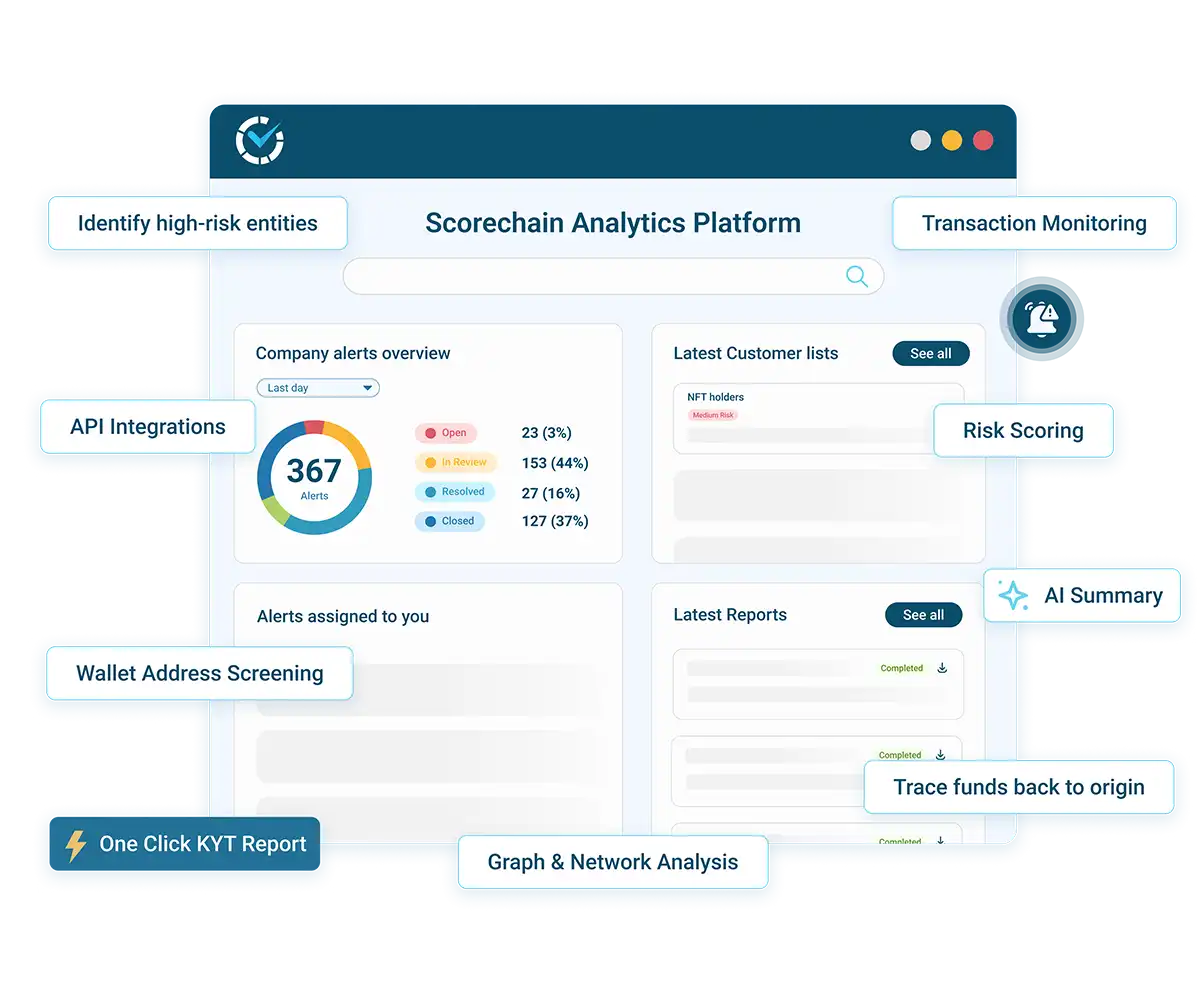
Transaction monitoring: risk scoring and alerts for KYT, with alerts exportable as CSV or PDF for your internal records.
Wallet and counterparty risk checks: address checks with Wallet Screening and counterparty due diligence with the VASP Directory.
Travel Rule data exchange: the Travel Rule API sends and receives originator and beneficiary data through partner infrastructure.
API access: the Crypto Risk Scoring API and the free Sanctions Screening API plug into your onboarding and monitoring.
Scorechain for Portuguese CASPs
More than 200 organisations use Scorechain, from startups to institutions. Scorechain supports the AML, KYT and counterparty controls a CASP needs, and does not replace your own policies or compliance officer. Flux Analysis helps with investigations, Customisable Alerts apply your own risk rules, and Source of Funds support is available for verifying where assets come from.
Build Your CASP Application on Working AML Controls
The Banco de Portugal and the CMVM will look for AML/CFT controls that run in practice, not only policies on paper. Scorechain provides transaction monitoring, wallet screening and Travel Rule tooling that you can show in your application and keep using after authorisation. To see how these tools fit the AML section of your CASP file, book a demo with the Scorechain team.
Frequently Asked Questions
How long does the application take?
The authority has 25 working days to check completeness and 40 working days to decide on a complete file, and requests for information can pause the clock for up to 20 working days. Preparing the file usually takes several months.
Can I serve other EU countries with a Portuguese license?
Yes. A Portuguese CASP can passport its services across the EU and EEA by notification, without a second license.
Do I need a local presence in Portugal?
You need a registered office and effective management in the EU, with at least one EU-resident director. For an application to the Banco de Portugal, a Portuguese entity with real substance is the normal route.
Can I keep operating while my CASP application is pending?
No. After the transition ended on 1 July 2026, a pending application does not allow a provider to keep operating. Only authorisation does. Providers without it must stop onboarding new clients and limit themselves to an orderly exit, while keeping their AML obligations in place.
Do crypto firms in Portugal need AML and transaction monitoring tools?
Yes. CASPs must run customer due diligence, monitor transactions, comply with the Travel Rule and report suspicious activity. Blockchain analytics and monitoring tools are the practical way to do this.
Ready to Get Clarity on Your Risks?
From wallet screening and KYT monitoring to deep-dive investigations, Scorechain gives you everything you need to stay compliant, secure, and audit-ready.