Crypto License in Bulgaria
Bulgaria’s MiCA transition ended on 1 July 2026. See FSC licence fees from EUR 5,112.92, capital from EUR 50,000, the application steps and which firms are licensed.
Bulgaria’s MiCA transition ended on 1 July 2026. See FSC licence fees from EUR 5,112.92, capital from EUR 50,000, the application steps and which firms are licensed.









Bulgaria’s MiCA transition ended on 1 July 2026. Only providers authorised by the Financial Supervision Commission (FSC), or passported in from another EU state, can offer crypto-asset services in Bulgaria. This page covers who licenses crypto firms, what a licence costs, how to apply and how to check that a provider is licensed. For the EU rules behind it, see what is MiCA.
Bulgaria adopted the Markets in Crypto-Assets Act on 20 June 2025, and it took effect on 8 July 2025. The Act applies MiCA in Bulgarian law and names the FSC as the competent authority for crypto-asset service providers (CASPs).
Firms on the older National Revenue Agency (NRA) register could keep operating during a transition. That transition ended on 1 July 2026, or earlier for any firm whose licence application was decided first. The FSC confirmed the end of the transition in a notice published on 2 July 2026. An entry on the old register is not a MiCA licence.
Searches for crypto company registration in Bulgaria usually refer to the old register of virtual asset providers. The NRA kept that register until the Act took effect, and the FSC now maintains it. An entry in it does not let a firm offer crypto-asset services.
A new crypto business now has two steps: set up a company, usually a limited liability company (OOD), then apply to the FSC for CASP authorisation.
MiCA sets minimum initial capital by service class. The applicable amount is the class figure or one quarter of the previous year’s fixed overheads, whichever is higher.
The FSC sets its fees in Ordinance No. 76 of 12 June 2025. Since 1 January 2026 the one-off licence fees are:
The ordinance also sets fees for extending a licence to a higher class and for other approvals. Licensed firms pay an annual supervisory fee as well. It has a fixed part for each service in the licence and a variable part of 0.03% of total annual income, subject to a cap (Article 43). The FSC has amended the ordinance since it was adopted, so check its current text before you budget.
The steps below follow MiCA Articles 59 and 62 and the FSC’s process. The preparation notes come from the law firm CMS, not from the FSC.
CMS estimated four to nine months from start to authorisation in July 2025 and noted that the FSC had no track record yet. Treat any timeline as an estimate.
MiCA Article 62(2) sets the contents. Every applicant provides:
Some services need extra documents, such as a custody policy or trading platform rules.
MiCA Article 59(2) requires an authorised CASP to have a registered office in a member state where it carries out at least part of its services. Its place of effective management must be in the Union, and at least one director must be resident in the Union. CMS adds that foreign managers need an NRA registration number, which can be obtained remotely.
A CASP authorised in Bulgaria can serve clients across the EU after notifying the regulator in each member state where it operates. This is the MiCA passport. It works in reverse too: a provider authorised elsewhere in the EU can serve Bulgarian clients once it has notified the FSC.
On 2 July 2026 the FSC reported that it had licensed two crypto-asset service providers. When checked on 28 October 2026, the FSC register listed five firms. Four hold a licence under MiCA Article 62. Alaric Securities is an investment firm that notified the FSC under MiCA Article 60.
Each licence covers only the services listed. The register changes often, so check the live FSC register and ESMA’s interim MiCA register before relying on this list.
The FSC says unlicensed providers cannot offer new services and must prepare a plan to wind down. Clients can move assets to a licensed provider, move them to their own wallet, or close positions.
Crypto transfers must carry originator and beneficiary information under the Transfer of Funds Regulation (EU) 2023/1113, which has applied to CASPs since 30 December 2024. For transfers exceeding EUR 1,000 to or from a self-hosted wallet, the CASP must verify that its customer owns or controls that wallet. Read more in Travel Rule. Licensing does not replace these duties or customer due diligence.
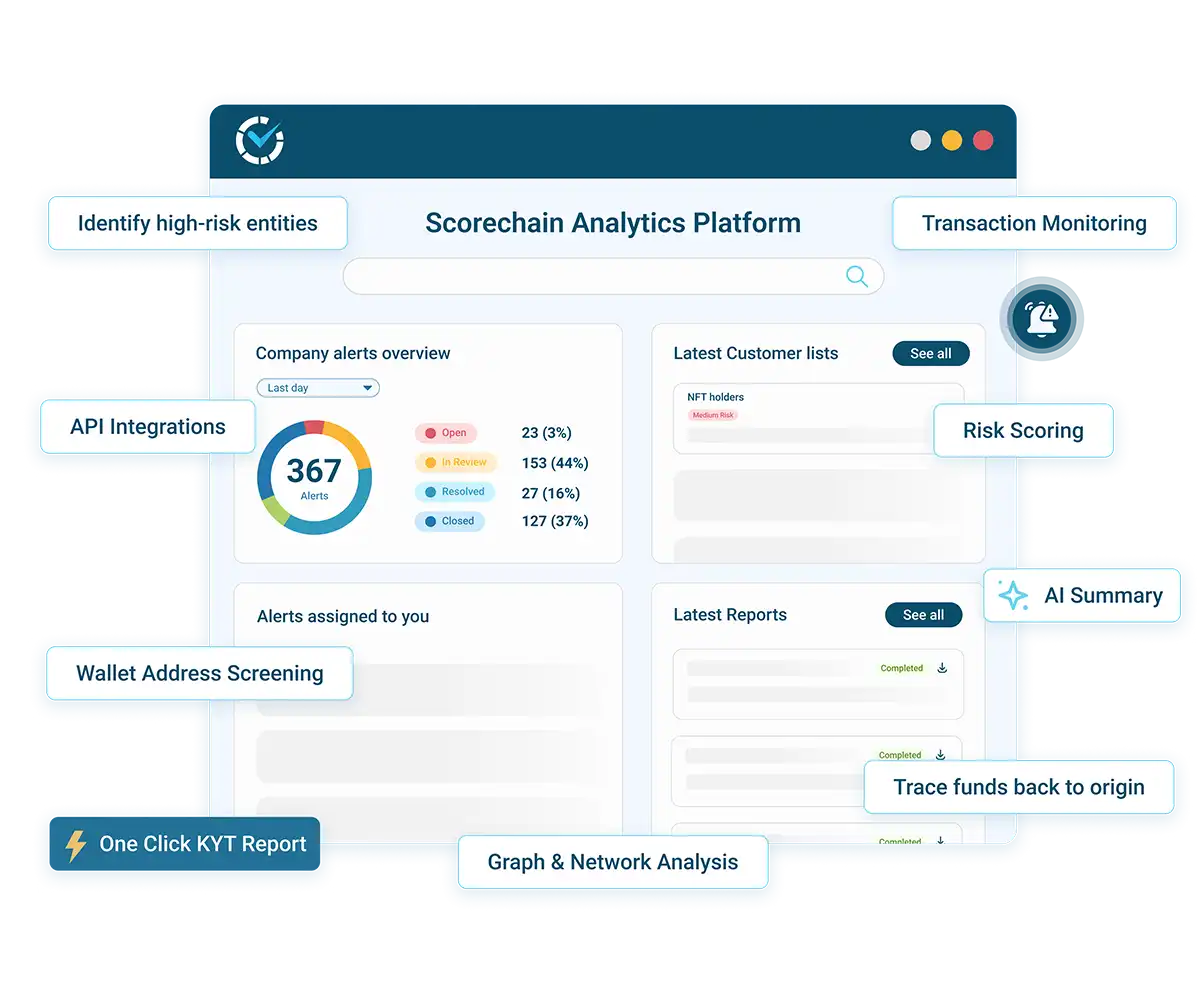
Your application must describe the internal controls you use to manage money laundering and terrorist financing risk. Scorechain covers transaction risk and counterparty checks, which are part of those controls. It does not replace your customer identification, governance or regulatory reporting obligations, or the FSC’s assessment of your application.
To see how transaction monitoring and Travel Rule checks could fit the AML controls in your application, book a demo with the Scorechain team.
Yes. Since 1 July 2026 a business must hold MiCA authorisation from the FSC, or be authorised in another EU member state and have notified the FSC. An old register entry does not allow a firm to operate.
Not in the old form. The register of virtual asset providers is now kept by the FSC, and an entry in it is not a licence. A new business sets up a company, usually an OOD, and applies to the FSC for CASP authorisation.
MiCA gives the FSC 25 working days to check completeness and 40 working days to decide, and the clock can pause for up to 20 working days when it requests information. In February 2026 the FSC said it expected a review to take four to five months. Preparing the file before filing adds time.
The FSC one-off licence fee is EUR 5,112.92 for Class 1, EUR 10,225.84 for Class 2 and EUR 30,677.51 for Class 3. Minimum capital is EUR 50,000, EUR 125,000 or EUR 150,000 by class, or one quarter of the previous year’s fixed overheads if higher. Licensed firms also pay an annual supervisory fee.
The FSC register listed five on 28 October 2026: Belayer, Altcoins BG, Digital Assist and FF Digital, which hold MiCA licences, and Alaric Securities, an investment firm that notified the FSC under Article 60. Firms authorised in other member states can also serve Bulgarian clients after notifying the FSC. Check the live FSC and ESMA registers.
From wallet screening and KYT monitoring to deep-dive investigations, Scorechain gives you everything you need to stay compliant, secure, and audit-ready.